
 We are happy to present a preview of Zachary McLeod Hutchins’ Joseph: An Epic, a book-length epic poem about Joseph Smith, published this month by the University of Illinois Press. Below are selections from Hutchins’ preface, discussing the challenges of depicting Smith, the journey to writing the book, and the poem’s structure. It is followed by a selection from Book V, an imagined rendition of the Book of Lehi, the section of the Book of Mormon lost by Martin Harris. This section features Lehi sending his sons back to Jerusalem for the plates and tracks happenings in their absence—centered on the experiences of Olam (a servant adopted into the family of Lehi) and his wife Abishag.
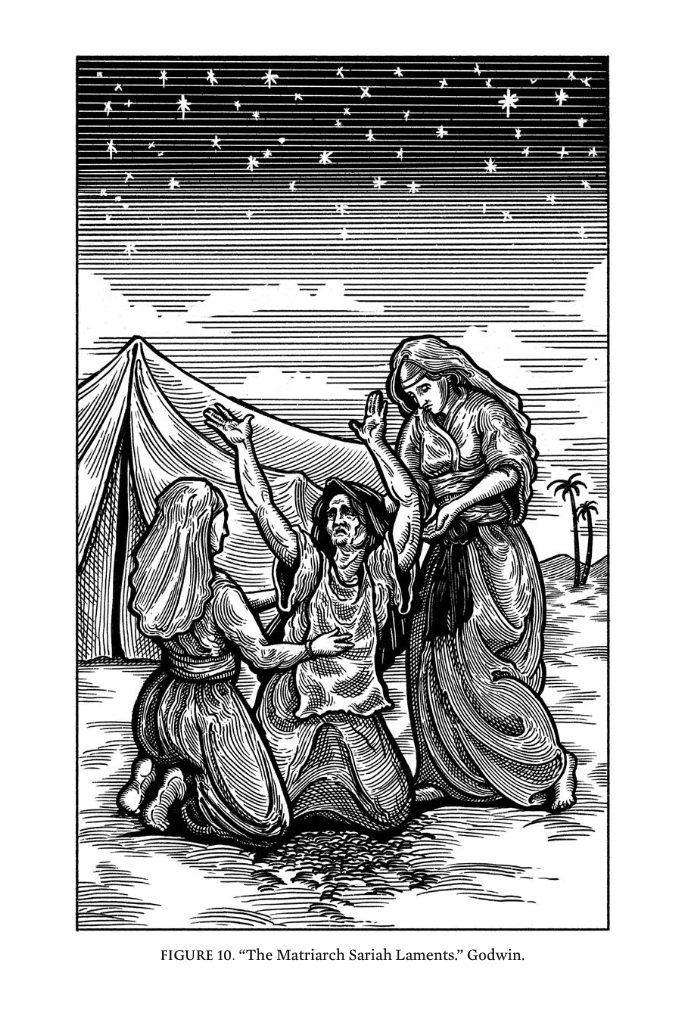
The selection features the illustration “The Matriarch Sariah Laments” by Godwin. Godwin’s art, which is collected at the Library of Godwin, links The Church of Jesus Christ of Latter-day Saints and Mormon folklore to centuries of Christian art through classical archetypes and the symbolic grammar of mysticism.
Hutchins recently participated in a Dialogue podcast with Lance Larsen and Elizabeth Garcia, where they talked about their recent poetry. You can listen to or watch a video of the conversation in the links.
Preface (Selections), by Zachary McLeod Hutchins
. . .
Even those who reject Joseph Smith’s foundational claims, that he saw and conversed with God the Father and with Jesus Christ and with angels, cannot help but regard his story as a compelling case study in the American imaginary—a reminder that colonists and early citizens of the United States regarded the North American continent as a place of unparalleled opportunity, where the impossible was made manifest.
Some treatments of the prophet’s life have, accordingly, leaned into the fantastical. Orson Scott Card’s six-novel Tales of Alvin Maker sequence attempts to deal with the supernatural elements of Joseph Smith’s life story by setting it in an alternate world, where magic is commonplace. Card recasts Joseph as Alvin Miller, the seventh son of a seventh son, whose magical abilities allow him to reshape the natural world. Like Joseph, Card’s protagonist confronts skeptical religious leaders, like the Jonathan Edwards–inspired Reverend Philadelphia Thrower, and receives a midnight visit, in his bed, from a Shining Man who commissions him to restore all things. Card’s novels are entertaining and address important moral problems, but displacing Joseph’s story into a world of fantasy effectively dodges the most pressing questions raised by his account of heavenly messengers: What does it mean for angels and devils to be active participants in our own, material world? What is God’s role in the affairs of nations? If God appeared to Joseph, how can we explain his apparent absence or inaction, in the face of others’ suffering and supplication? Why might an impoverished and relatively ignorant adolescent like Joseph Smith be chosen as God’s mouthpiece? Joseph’s story is saturated with supernatural elements, but his claims must be situated in the known world, or the most challenging questions implicit in his narratives of heavenly visitation are stripped of their potency and relegated to the realm of fantasy.
Most accounts of Joseph’s life adopt the opposite approach, hewing so closely to demonstrable facts and historical sources that they, also, eschew the essential questions of visions and angels and miracles. Richard Bushman’s Joseph Smith: Rough Stone Rolling, published in 2005, is still the biographical benchmark, and he treats the prophet’s life with meticulous care, grounding every claim in the voluminous primary source material documenting Joseph’s life. But such sources are, necessarily, finite; not every event or exchange can be memorialized, so confining our consideration of a subject to the documentary record necessarily relegates important private matters to the dustbin of history. For example, historical sources cannot address questions about miraculous means and divine silence or recreate the intimate, undocumented moments shared between Joseph and Emma during their courtship and marriage. Such scenes and questions can only be considered through an imaginative approach that supplements the extant record with inference and analogy and conjecture to reclaim the joy, whimsy, despair, and uncertainty of Joseph’s surreal life. The goal of such an approach to Joseph Smith’s story is not a more minutely accurate account of his actions but a greater appreciation for the pathos of his experience and the implications of his claims. Ironically, a life substantiating the maxim that truth is stranger than fiction might only be fully appreciated by turning to a fictionalized narrative as the means of reclaiming its full wonder and strangeness.
Only the epic is capacious enough, as a genre, to capture both the historical and the supernatural sweep of Joseph’s cosmological story, which situates the prophet in medias res, caught up in a conflict between God and Satan predating the world’s creation and hastening, through Joseph’s prophetic labors, to its conclusion. A genre equally committed to theomachy and national history, the epic poem presupposes the intervention of divine beings in human affairs and frames politics as an outgrowth of providence. In other words, an epic renders human experience in the same terms in which it was understood by Joseph Smith and his followers, who thought of their conversion to the restored gospel of Jesus Christ as a form of participation in the eschatological vision of Revelation: their distinctively American piety pitted against the forces of Satan in a spiritual battle preparing the way for Jesus Christ’s Second Coming. To rewrite the story of Joseph Smith as an epic poem, therefore, is to restore the prophet’s own imaginary, considering the implications of a literal conflict between hostile, invisible, infernal powers and the benevolent, visible, heavenly beings who taught a New York farm boy to think of himself in heroic terms.
. . .
Joseph is divided into two volumes, each of which can be read independently—potentially in a single sitting. Samuel Johnson complained of Paradise Lost, “None ever wished it longer,” and that accusation applies equally to many other epics, which prolong their narratives with asides on a wide variety of subjects. However, readers should, by design, finish each of these volumes with an unsettling sense that more must be said. In his thirty-ninth year Joseph’s life was cut short by an assassin’s bullet, and many who study his career have expressed curiosity about what he might have accomplished if afforded additional decades. His death was a disquieting event that troubled his followers, many of whom believed that his story would end in triumph, at the Second Coming of Jesus Christ. Readers might find these volumes similarly disquieting, as the arc of his life is unexpectedly cut short in each. The first volume, Awakenings, ends in despair, but a knowledgeable reader will know that remarkable spiritual experiences and accomplishments are around the corner for Joseph. The second volume, New Covenants, ends in contentment, but again, a knowledgeable reader will know that serious controversy and adversity would arrive to afflict the prophet and his followers shortly after its concluding scene. The aim of these foreshortened narratives is to provide new vantage points from which to survey the life and legacy of Joseph Smith, seeing him not as the static martyr of 1844, robbed of possibility, but as a figure whose future is still indeterminate, unsettled. The confused and troubled boy whose anguished cry concludes volume one is a very different figure from the confident and contented father appearing at the end of volume two. Each volume tells a different story, featuring a different cast of characters; the prophet’s parents, who feature prominently in the first volume, are succeeded by Emma Hale Smith and Oliver Cowdery in the second, and Joseph is himself transformed in the intervening white space.
. . .
I first conceived of this project two decades ago while washing my laundry by hand in Brazil, where I was serving a proselytizing mission for the Church of Jesus Christ of Latter-day Saints. As I wrung out each article of clothing, I listened to Truman G. Madsen’s celebratory lectures on Joseph Smith and dreamed of retelling his story in verse. The poem, as I imagined it in Brazil, was to be an unambiguous celebration of the prophet and his divine mission. Twenty-two years later, I am still a devoutly practicing member of the Church, and I still believe that Jesus Christ revealed himself to Joseph Smith, commissioning the boy prophet to translate the Book of Mormon and to organize a church that could administer saving and exalting ordinances. But I am, today, far more aware of Joseph’s flaws and foibles—the failings that he himself acknowledged in canonized revelations and casual conversations as well as those alleged by his adversaries and disaffected followers. And I feel deep compassion, today, for close friends and family members who experienced their own, belated realization of his humanity as a form of harm or betrayal. As a result, this final product is a much more nuanced expression of my faith than I could have imagined twenty years ago. It is an epic poem that equivocates, inviting readers to consider for themselves whether a beloved LDS anthem like “Praise to the Man” is still the lyric best suited to a twenty-first century understanding of his life and legacy or whether a novel hymn might better encapsulate his contributions to the Church and to the American mythos he embodies. . . .
A Selection from Book V: New Covenants
And now in answer to his cries, the Lord
did visit Lehi in the night, and when
the morning came, he roused his eldest sons
and said, Awake, O Laman, and arise,
O Lemuel! and hear the merciful
bequest of your Almighty King: Behold,
I dreamed a dream in which methought I saw
a man in purple robes, and on his head
a crown: he made a proclamation, Who
among you worshippeth the Lord? Let God
be with him, and let him go up unto
Jerusalem. And from the children of
the covenant, the young men gathered to
Jerusalem. The people of the land
rose up to greet them, but one brother fought
another for dominion, and to them
with whom the Lord prevailed, the word of God
was given. And their genealogy
was found therein; yea, even their descent
from Jacob and a knowledge of their right
to be ordained as priests according to
the Order of the Son of God.
And now,
behold, my sons, is not the meaning of
these things as plain as word can be? The Lord,
our Holy King, hath granted your desire
to go again unto Jerusalem and seek
out your inheritance, for he hath laid
up treasures not of gold and silver but
of precious ore whose worth shall never dim
with time: my jealous kinsman Laban hath
the sacred record of our people which
Josiah did commission to be kept
on plates of brass. And if ye will attempt,
the Lord will prosper and provide for you
the means whereby ye might obtain these plates,
for he hath given no commandments to
the sons of God save he hath first prepared
a way for them, that they accomplish all
the things which he commandeth them. And are
ye not the children of the covenant? Then rise,
like men; go up unto Jerusalem,
and seek the word of God, lest we
should lose a knowledge of our fathers and
the goodness of our God, in saving them
from bondage, and our ordinances be
corrupted from their ancient purity.
And come not down again until ye have
obtained the record.
Now when Lehi made
an end of speaking, Laman marveled that
his father would command him, like a bird
back to its cage, and think that he should sing
for joy to go again unto a land
on which the judgment of Almighty God
must soon descend: its rulers overthrown
and all of its inhabitants enslaved.
And Lemuel did also murmur in
this manner. But when Sam and Nephi heard
the Lord’s command, they rent their garments as
a token of their covenant to do
these things and sacrificed a little ewe
lamb, from among the firstlings tended by
their sisters, as a burnt offering.
And
the sons of Lehi traveled to the home
of their rich kinsman in the city, and
they left their father and their mother and
their sisters in a valley by the sea.
And also Olam and his wife remained.
But Olam, being seventy-and-eight
years old, began to be diminished; his
natural force abated, and he died.
And after he was buried, Olam’s wife
(and now, behold, her name was Abishag)
rehearsed to Lehi the assurances
made unto Olam: more especially,
that he should be esteemed a brother, not
a servant. Therefore Abishag waxed bold
and asked if Lehi would fulfill the law
himself or if, as proxy, he would give
a son as husband in his stead; for it
had not yet ceased to be with Abishag
after the manner of a woman, and
she still retained her moisture.
And he spake
unto Sariah, saying: Zachiel
saved Hagar in the wilderness and drew
his sword, commanding Sarah to receive
her up again a wife and sister of
an equal stature with herself; but we
have never heard the voice nor felt the touch
of Zachiel. What obligation can
we have to one unbound by marriage or
by blood? The law availeth none such.
And
Sariah answered him, What question can
there be of obligation when the law
availeth none, except it turn our souls
to him who veileth our iniquities
and covereth our nakedness in robes
of righteousness and strength? Have ye not called
the law a typifying of his coming? Let
us not, then, hide from its provisions, like
unfaithful servants from their master’s gaze,
but ask on what conditions justice, yea,
and mercy also, might be satisfied,
and having chosen, let us seek a sign,
like Gideon, in confirmation of
our resolution.
Lehi said to her,
And what shall be our course? Can justice make
demands upon our bed or ask that we
enlarge our habitation to give place
for strangers? No; though I cut covenants
with Olam, surely I cannot be held
accountable for Olam’s covenants
with Abishag. To cast his burdens on
my back would be unjust.
She answered him,
And what of mercy? She hath done no wrong
that she should be left barren and alone,
and we cannot expect the Shepherd to
provide her husband in a thicket when
our sons return to hunt for game. But as
the Suffering Servant hath taken on
himself our griefs and sorrows, surely he
hath given us the law to teach us how
we also ought to bear the burdens of
a neighbor and to love the stranger as
ourselves.
He said unto Sariah, Which
now of your sons and husband, thinkest thou,
should be her neighbor? And whose wife shall she
be made, among the five of us? Perchance
the son ye choose rebuff his bride and it
displease the Lord; would not he slay our son
as he slew Judah’s Onan? Tempt them not
with Onan’s sins, lest they become a hiss
and byword in the mouths of Israel,
whose daughters speak of onanism with
contempt. And Judah, when he came unto
Tamar, went up in secrecy and shame,
after his wife had died, not knowing her
until she showed the signs and tokens of
his coming unto her. Then how much more
the shame if I should turn aside from thee
whilst thou art living? Far be it from me
to do so unto thee, and let me not
fall into error.
But she answered him,
and said, Transgression giveth no offense
or cause for shame, but sin; on Judah, not
Tamar or Shuah, be the shame. Joined hand
in hand, the wicked shall be punished, but
the seed of them that follow righteousness
shall be delivered. Was not Pharez made
the father of King David? From the same
embrace a crown and condemnation, each
according to their understanding. I
am old and shall not bear again. But stand
ye forth in Olam’s stead, and God shall give
thee eden on the lees; as Abishag
was brought to stand before the king and it
was counted unto her for righteousness,
so much the more if thou shalt do it to
the least among us. For myself, I would
that ye remain my husband, but the Lord
hath shewn me linden hills all strewn with leaves,
and though the holy seed be scattered forth,
their substance shall come home unto the stump
like sap returning to its mother roots;
not my will, but the Lord’s be done.
And now
Sariah placed a nail, or tent stake, in
her husband’s palm, in token of her free
consent that he stretch forth the curtains of
their habitation and enlarge the place
to which their tent gave shade; but she retained
the hammer for herself. And Lehi spake
to Abishag of their decision and
of their intent to seek a sign from God:
how they would lay a fleece upon the ground
at night and pray that it be soaked with dew
though all the earth surrounding it be dry,
and then, again, the second night, how that
the fleece should be left dry though all
around be wet with dew. And Abishag
consented to abide the trial.
And
it came to pass that on the second day,
Lehi arose and left his tent to find
the ground well-watered, but the fleece was dry.
And Lehi, taking Abishag to wife,
fulfilled her week.
And now Sariah, for
the space of fourteen days, had waited for
her sons’ returning from Jerusalem;
but on the fifteenth day, she pulled the hair
from off her head and rent her mantle, and
she clothed herself in sackcloth and sat down
among the ashes, weeping bitterly,
like Rachel for her children. And it came
to pass that Lehi counseled patience and
exhorted her to place full trust in him
who sent their sons as agents to retrieve
the record. But Sariah mourned, and found
no comfort in his admonition, and
reproached him, saying that he was a hard,
unfeeling man who gave no thought for her
security and that her sons were dead
to rise no more because his foolish dreams
and vain imaginings persuaded them
to throw away their lives and perish in
the wilderness. And with this manner of
complaint, Sariah remonstrated with
her husband.
Wherefore, Ruth and Eden gave
her solace, saying, Mother, ye have taught,
and we believe, that God is able to
deliver us from dangers, and the Lord
may yet return to you our brothers; but
if not, we know he will make recompense
and publish peace unto thy soul. Intreat
us not to call thee Mara, for the Lord
shall bless thy latter end, and we shall be
to thee as sons and daughters both, and thou
shalt nurse the sons which we shall bear thee: kings
and priests to rule and reign in Israel
forever. So Sariah girded up
her loins with strength, and she was comforted.
And on that day her sons returned, and she
rejoiced and with her husband offered thanks
for their safekeeping to the Lord. And thus
we see in many cases that the Lord,
who proveth all his children, doth withhold
immediate relief so that we might
be free to choose and not constrained by our
indebted state; and only after we
have passed the trial of our faith do we
perceive the weakness of our faculties,
which cannot comprehend the means whereby
he worketh to effect the immortality
and endless happiness of all mankind
and to deliver us from present fears.
Zachary McLeod Hutchins is a professor of English at Colorado State University. He is the author of Before Equiano: A Prehistory of the North American Slave Narrative and Inventing Eden: Primitivism, Millennialism, and the Making of New England, as well as two devotional books for Latter-day Saint readers — The Best Gifts: Seeking Earnestly for Spiritual Power and Shall I Have Pleasure? An Answer for Sarah.