
Review
———-
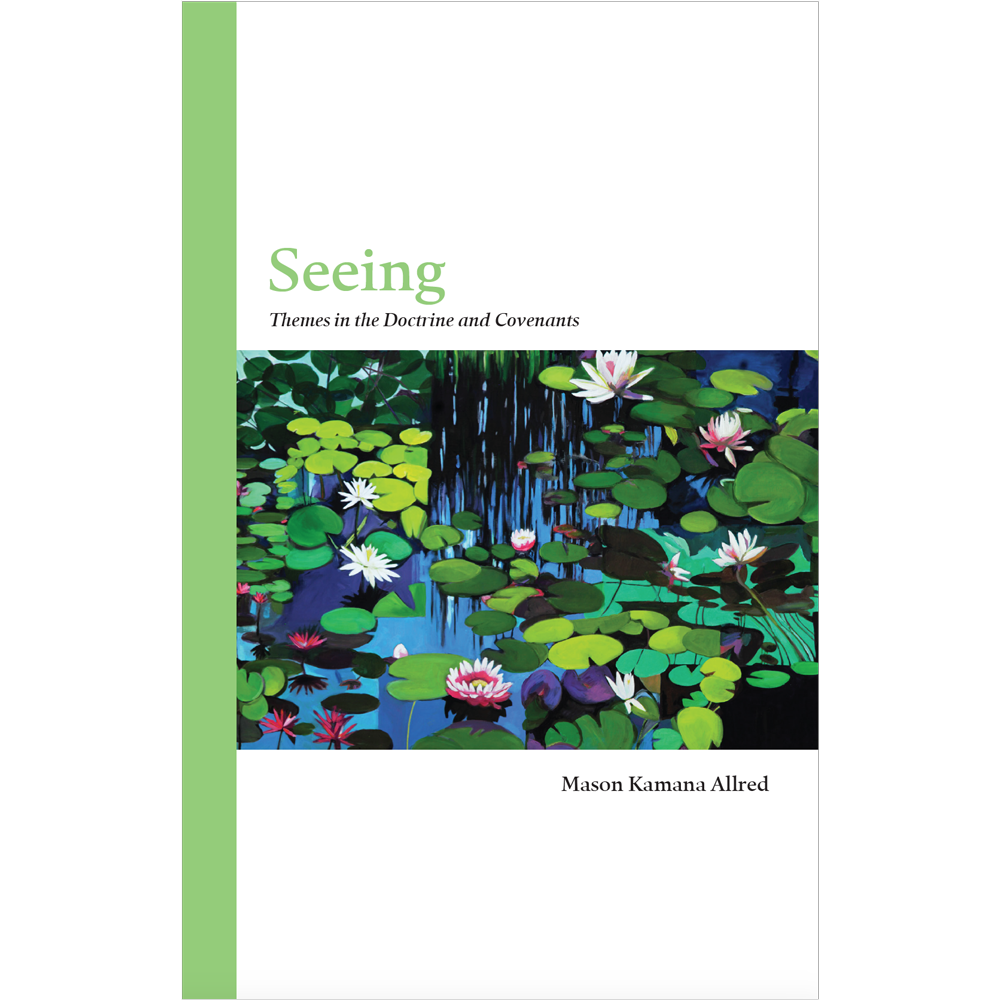
Title: Seeing (Themes in the Doctrine and Covenants)
Author: Mason Kamana Allred
Publisher: BYU Maxwell Institute & Deseret Book
Genre: Religious Non-fiction
Year Published: 2024
Number of Pages: 120
Format: Paperback
ISBN: 978-0-8425-0130-9
Price: $12.99
Reviewed by Conor Hilton for the Association of Mormon Letters
Seeing, Mason Kamana Allred’s entry in the Themes in the Doctrine and Covenants series from the Maxwell Institute, is a delight. Allred’s prose is somehow dense and light at the same time, characterized by a playfulness that’s lurking just beneath the surface.
The book is filled with references to often obscure historical media objects as well as media critics, as Allred draws on his professional training and background to engage deeply with the Doctrine and Covenants on his chosen theme of “seeing.” Allred peppers the book with other pop cultural references too, fitting somewhat surprisingly well alongside the more historical and academic material. All of this would make the book a fun curiosity, but Allred also is able to demonstrate the real, lived religion stakes for his ideas, giving the book an actionable weight.
Throughout the book, Allred insists on the embodied nature of “seeing” in the Doctrine and Covenants, that even when visions or people are seen with spiritual eyes, there is some material, embodied experience at the core. He draws on unique Restoration teachings about the materiality of spirit and the ways that “seeing” is deployed as a framework throughout the Doctrine and Covenants to persuasively make this case.
Allred also discusses how the Doctrine and Covenants and other Restoration teachings might help us see into and through things. He suggests that this “might mean we gain the ability to look at a surface and see beyond it. We could couple our vision with a deeper understanding of the plan of salvation that would, in turn, help us to see into things and their place in the great plan of happiness” (40). I find this idea compelling, particularly as Allred links it to the embodied nature of seeing and hearkening–that is, that this seeing into and through is not a purely mental exercise, but something that is done with our bodies and our senses, that to truly hearken to God’s commands requires engaging our bodily senses and not just some disembodied mind or will.
Perhaps my favorite and most delightful part of Allred’s book is the concluding chapter that is all about section 129 of the Doctrine and Covenants–perhaps my favorite weirdo section of scripture. For those unfamiliar, section 129 details what to do when faced with an extraordinary vision to determine what kind of visitor you have–a resurrected being, a heavenly personage of spirit, or a devil masquerading as an angel of light. The key? To ask to shake their hand. Allred argues that rather than seeing this section as “an odd outlier,” there’s something to be gained from viewing it as “an integral touchstone for the entire book, a key that might unlock a guiding visionary theme throughout the Doctrine and Covenants” (95). If there is one thing I love more than careful, serious, generous attention paid to peculiar bits of scripture, it’s arguing that those peculiar bits are also deeply significant! And Allred’s bold gambit here pays off, at least for me, spectacularly. He says that “the section’s core is a call to see with our whole bodies, hearts, and minds. This is the key to seeing things as they really are and eventually seeing the Lord” (95). Man, I love it! And I love the way that I personally feel called to a better, holier, more present and embodied way of being through this beloved strange section.
Mason Kamana Allred’s Seeing is an engaging, surprising, playful, and heartfelt witness to the value of seeing with our whole, embodied selves. A careful reader of scripture and history, Allred makes a compelling case for “seeing” as expansively understood as possible, to be one of the central messages of the Doctrine and Covenants. A book that is well worth your time.