
From Robert Bennett’s Mormon Short Stories series on Substack.
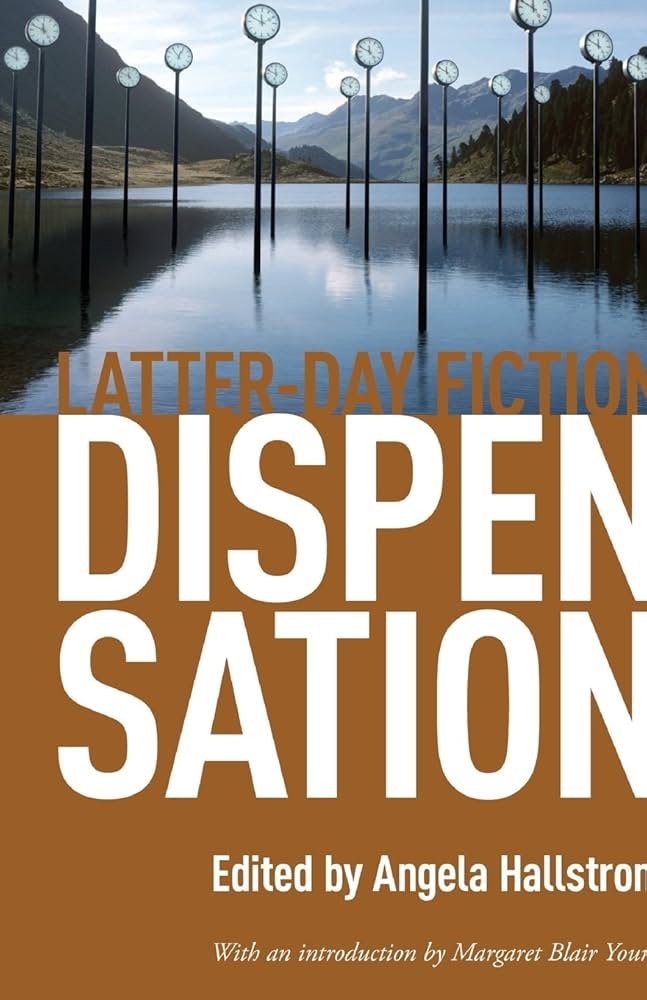 Angela Hallstrom’s 2010 anthology of Mormon short stories, Dispensation: Latter-Day Fiction, is the obvious stepping-stone or transitional intermediary between Eugene England’s earlier Bright Angels and Familiars (1992) and Andrew Hall and Robert Raleigh’s later The Path and The Gate (2023). In fact, it is not only published roughly equidistant between these other two, dare I say, “companion” anthologies, but it also literally shares common writers with both. Levi S. Peterson, Lewis Horne, Orson Scott Card, Darrell Spencer, Phyllis Barber, Karen Rosenbaum, and Douglas Thayer all appear in Bright Angels; Todd Robert Peterson, Jack Harrell, and Larry Menlove all appear in The Path and the Gate. Phyllis Barber appears in all three, while Michael Fillerup leapfrogs over Dispensation straight from Bright Angels to The Path and the Gate. Consequently, simply at the level of authorship, Dispensation clearly occupies some sort of middle-ground position even if it perhaps leans slightly more toward the former than the latter.
 Obviously, we should expect to see some clear throughlines. For starters, each anthology has a well-developed science fiction story—a longtime staple of Mormon fiction—and I personally believe that these three stories continue to get better as they evolve from Orson Scott Card’s “The Fringe” (BAF) through Lee Allred’s “The Hymnal” (D) to Danny Nelson’s “Narrow is the Gate” (PG). This is perhaps the simplest example of a step-by-step progression of a specific genre across the three anthologies. This is the kind of continuous methodical development that we should expect.
Similarly, there are also stories by Phyllis Barber in all three anthologies, but in my opinion these stories decline in quality over time. This is probably not because any of the later stories are particularly bad, but rather just because I especially like her story in England’s anthology. There are perhaps even some who might even embrace this declension narrative for the anthologies as a whole, but I am not one of them. Overall, I see a clear and steady development over time with the final anthology standing head and shoulders above the other two.
 Moreover, Dispensation also marks a significant advancement in representations of the international church. M. Shayne Bell’s “Dry Niger,” in Bright Angels is set in Niger, but it arguably has more to do with prostitutes than Mormonism. Dispensation, however, opens in medias res—in Paul Rawlins’s “The Garden”—with a missionary hiding from an angry mob in the back alleys of a Black township in South Africa, while Todd Robert Peterson’s “Quietly” depicts an African convert dedicating a grave for a church member who has been killed by Hutus in Rwanda. Dispensation, therefore, builds a solid foundation for later representations of the international church in The Path and the Gate’s “Missionary Weekly Report, Mumbai First Branch” by Mattathias Singh and the well-traveled transnational Mormon couple in “Sister Carvalho’s Excellent Relief Society Lesson” by Steven L. Peck. In this respect, Dispensation probably represents something closer to a decisive turning point rather than simply a mere throughline.
In other cases, Dispensation also reveals some almost inevitable dead ends for Mormon short fiction. For example, Indian Placement stories—which are represented in both Bright Angels and Dispensation as well as Robert Raleigh’s anthology In Our Lovely Deseret (1998)—predictably disappear in The Path and the Gate, having more or less run their course in Dispensation. I’m not going to prophesy that we will never see another one, but I’ll bet cold hard cash that they will never return to being the predictable growth industry that they once were.
Similarly, stories about Utah’s rural, agrarian, and pioneer past in general quickly exit stage left after their starring role in Bright Angels, with Dispensation all but driving the final nail in their coffin. In fact, Phyllis Barber’s polygamy era story, “Bread for Gunnar,” is about all that remains of this pioneer, or even rural, heritage in Dispensation, and the only real historical story in The Path and the Gate, Theric Jepson’s “Curse,” merely uses a frame story that goes back generations largely as a set-up for the punchline to a story specifically set during the presidency of Russell M. Nelson. Jepson’s story may have tendrils stretching back in time, but its narrative thrust clearly focuses on the present. Once again, rural, agrarian, and pioneer Mormon stories may not be quite dead yet, but they have clearly become passé. Dispensation helped pave the way for this change.
In at least one case, Dispensation even presents something more like a lacuna. In Bright Angels Neal Chandler’s “Benediction”—perhaps with a hockey assist from Levi S. Peterson’s “The Christianizing of Coburn Heights”—puts the confrontational church lesson story firmly on the map. In The Path and the Gate, Chandler’s story finds an obvious and equally accomplished avatar in Steven L. Peck’s “Sister Carvalho’s Excellent Relief Society Lesson.” Dispensation, however, does not have a story in this genre. A regrettable omission because this has always been one of my favorite—and I would add one of the most quintessentially Mormon—genres.
So, certainly in some sense Dispensation provides some kind of evolutionary missing link between Bright Angels and The Path and the Gate, but this does not mean that it can simply be reduced to some kind of Goldilocks and the Three Bears middle ground between the old and the new. As I have tried to suggest already, the evolutionary record is complex and multi-dimensional with new species constantly emerging, evolving, and disappearing in fits and starts, making Dispensation perhaps an essential data point in the history of the Mormon short story but not necessarily on a linear graph. While we are often accustomed to see history, including literary history, as a relatively smooth flow in time, gradually evolving and gently developing through some slow, steady process always inching toward inevitable progress, history also includes dramatic upheavals and unusual detours, backsliding and reversals, and lost ages and dark times. For Walter Benjamin, in fact, history is little more than a continual trainwreck.
Without altogether dismissing the conventional view of Dispensation as one small, perhaps even predictable, step forward for the Mormon short story, I also want to consider how it simultaneously functions as a giant leap for Mormon letters in its own right. Dispensation is not simply the often-neglected middling middle child, who can claim neither to be the first original voice of the tradition nor the latest advance of its avantgarde. Instead, it is also a kind of radical sui generis middle that stands on its own unique merits and stakes claims to its own peculiar literary territories.
In my opinion, if there is one story in Dispensation that marks something closer to a bold mutation in, rather than just a simple evolution of, the Mormon short story it is clearly Jack Harrell’s “Calling and Election.” If I didn’t find this story the most unique and compelling story in the anthology, I might even be tempted to try to steer clear of trying to analyze it for several reasons.
First, it is the most difficult story in the anthology to paraphrase, and it is the hardest story to discuss without giving away too many spoilers. I’ll do my best to paraphrase what is even paraphrasable without spoiling what deserves to be left unspoiled. The story opens with Jerry Sangood, a seminary teacher in Southern Idaho, being invited to a mysterious meeting with Brother Lucy, “a representative of the prophet,” who—true to the story’s title—extends to Jerry the opportunity to have his calling and election made sure, but not before requiring him to sign a letter to the prophet acknowledging that he accepts the “weighty charge that comes with this high and holy calling.”
This much is paraphrasable and predictably implied in the title, but the rest of the story is a wild goose chase of completely unexpected twists and turns, beginning with Brother Lucy’s warning that “each case is different” when he “caution[s]” Jerry after signing the letter. Then immediately after signing, Jerry unexpectedly feels the impending “gloom” of “dozens of devilish fiends, encircling him, entering his thoughts, taunting and tempting, blaspheming his faith.” Finally, Jerry wakes up the next morning mysteriously soaking wet in his backyard and then changes his clothes to go to work only to find “hundreds” of pornographic “images from the internet—grainy, explicit, hardcore—cover[ing] the walls and cabinets of his classroom.”
 That’s only the basic premise, which is already enough to make your head spin, but how Jerry—and his class, and the town, and the authorities, and the church, and his wife—respond to this unexpected turn of events proceeds to take the reader on a roller coaster ride that is clearly not implied in the title. This is definitely not the way that the highest and holiest ordinance in the church is supposed to unfold, but as the Dude himself says, this is a story with “a lotta ins, a lotta outs, a lotta what-have-yous.” I won’t pretend that I can paraphrase them all, and I’m certainly not going to spoil them, but I hope that I have enticed you enough to read it yourself. The story is both in Dispensation and in Harrell’s collection, A Sense of Order and Other Stories, and both are immediately available as e-books, so it is easily accessible,
While I’m not about to claim that Cleanth Brooks is the last word on all matters literary, his “Heresy of Paraphrase” makes a compelling argument that the meanderings and even the seeming irrelevancies of a work of art—those which most resist paraphrase—are precisely its most essential parts. I would be hard pressed to find a better explanation of what makes Harrell’s story so fascinating. It is just so damn unparaphrasable. There are so many story lines, so many unpredictable twists, so many ambiguities, so many detours, and so many gaps for the reader to fill in merely implied or even missing details. It is truly what Umberto Eco refers to as an open rather than a closed work. It requires the acute attention of an actively engaged reader open to playful uncertainty and distrustful of easy answers. Or, as the kids say, this story will simply blow your mind.
Second, “Calling and Election” is also the most difficult story to classify. I’ve used the Center for Latter-day Art’s term the “Mormon Weird” to describe some of William Morris’s writing, but that term came into use in 2023. This makes Harrell’s story a full decade avant la lettre, and I would argue that what Harrell is doing here is more eccentric and perhaps even more disturbing than merely weird. I am tempted to give this story an even stronger label of the Mormon Grotesque. It has all the elements of the strange, unnatural, ugly, bizarre, frightening, and comically absurd, and it has them in spades.
If this story, which is quite different from most of Harrell’s other stories, has any comp at all in Mormon letters, it is probably only in the work of Brian Evenson who has made something of a cottage industry of grotesque literature. And yet, in Harrell’s story there is also an incongruous linking of all these grotesque elements back to an inherently sacred ordinance, a devout man, and a special dispensation from the prophet himself that renders this story more complex and multi-faceted than anything that I have yet read in my admittedly limited reading of Evenson. It is precisely this unique mix of the legitimately sacred and the obviously grotesque, rather than simply the grotesque per se, that I find most compelling in this story.
If you make even a quick comparison between “Calling and Election” and Evenson’s “The Prophets” in Raleigh’s anthology In Our Lovely Deseret, it is clear that Harrell’s story is still struggling to get at some kind of deeper spiritual, if perhaps ultimately ineffable, message about what it means to sacrifice everything—perhaps even goodness itself—in the service of God, whereas Evenson’s grotesquerie serves as little more than the punchline to a joke. A very good, twisted, dark joke perhaps, but simply a joke, nonetheless. I might add, however, if only parenthetically, that Harrell’s more spiritually inclined Mormon grotesque seems to have provided fertile ground for further development in a story like Ryan Habermyer’s “We’re Going to Need a Second Baptism,” a story about baptism and a sex doll in The Path and the Gate.
Finally, “Calling and Election” is simply so brazenly creative, inventive, and clever in its specific details. Since I don’t want to give away too much, I’ll limit myself simply to two examples from early in the story. First, Jerry has recently discovered that he has a brain tumor, so the story implies that he may have done this whole inexplicable deed because he was driven into madness by his tumor. This accomplishes two aesthetic goals in one blow. First, it provides just enough plausible motivation for the pornographic pictures which otherwise seem at least highly improbable if not outright preposterous. This keeps the reader invested in the story as something other than simply ridiculous. In addition, the tumor also provides ambiguity to the story because it never fully resolves whether or not the tumor is responsible for Jerry’s actions. This possibility always remains in the back of the reader’s mind, but it is never definitively either confirmed or denied.
The second detail that delights me in this story is that Brother Lucy makes Jerry sign a letter acknowledging acceptance of the consequences of his decision to have his calling and election made sure. This is a very small, seemingly insignificant, detail in the story, and yet—to my very limited understanding of the Second Anointing—it is a fictional literary device rather than a realistic account of the actual ritual. This significantly complicates the story for me, however, especially given the chaos that results immediately afterword. I can’t help but see this scene as the classic Faustian bargain where an individual signs a deed to their soul to the devil. Harrell may not intend this explicitly, but whether intended deliberately or not, the story does at least insinuate—if for no other reason than the resulting events—that Brother Lucy’s presence is possibly sinister, even devilish.
This in turn provides yet another plausible, albeit also ambiguous, reason for the pornography in Jerry’s classroom. A tumor, a pact with the devil, a trial of his faith, or some other kind of madness all circulate wildly in the story as plausible, yet inconclusive, explanations for Jerry’s fall from grace. Taken collectively, however, these small details matter and add weight and complexity to what is already a clever tale. Like a trail of breadcrumbs, these small, yet ingenious, details lead the reader through to the end of a compelling, albeit confusing, story.
 The other story that I wish to comment on is Orson Scott Card’s “Christmas at Helaman’s House”—a very different, almost diametrically opposed, kind of story, which I also believe more or less creates a new, much more easily defined, genre almost ex nihilo. If Harrell helps pioneer the Mormon Grotesque, I can only call Card’s story the most brazen articulation of what I would define as the Suburban Mormon short story. Obviously, there have been many other Mormon stories, both before and since, that have been passively situated in suburbia, but I have never read one whose characters, plot, theme, and moralism are so aggressively suburban, focusing primarily on Helaman Willkie who got his “new house built and the family moved in before Christmas.” Even though he is “exhausted from the move,” his family still manages to “find all the Christmas decorations and get them in place” just in time for Santa. Meanwhile, Helaman’s wife, Lucille, “squeal[s] in delight” when she sees the kitchen and “kiss[es] all the appliances.” The whole story, top to bottom, is as suburban as Home Alone, if not The Graduate or even American Beauty.
If I am being charitable, however, I might point out that at some level Card’s story is also about the international church given that the story’s central inciting incident, and the most interesting moment in the story, is set in motion when Helaman’s daughter, Trudy, starts to develop a crush on a returned missionary who served in Medellín, Columbia. Upon seeing Helaman’s vast and ornate suburban McMansion, however, Trudy’s new beau suddenly tearfully realizes that he just doesn’t “belong” here in “America” anymore not simply because everybody “here has so much,” but more specifically because they “keep it all for [them]selves.” Only the “mafia” has such homes in Colombia, he quips.
This might have been the starting point for an interesting discussion about how missionaries’ experiences abroad reshape their moral compasses, if Card’s protagonist had bothered to listen to this missionary even for one minute, but instead Helaman immediately turns away from this missionary’s personal experiences, let alone the lives of real Colombians, to make the story all about himself and the guilt he feels because of his own fragile upper-middle class white suburban privilege.
Initially, Helaman quickly retreats into defensiveness, even “rage,” that anyone would “unfair[ly] insult” his self-earned prosperity, but of course, Card’s story isn’t simply a sendup of suburban arrogance, so Helaman’s initial bluster is just a straw man moral plot twist. Obviously, even Helaman cannot possibly be so boorish, so he all too quickly and simplistically does a moral 180 and contritely asks, “What am I doing here, living in one of these houses” because now he himself will also “never see this house again without imagining [some] poor Colombian family, standing outside in the cold.” With only a moment’s introspection, Helaman entirely appropriates the missionary’s experience and perspective, let alone an entire nation’s, turning it all into his own personal moral crisis. Mea culpa! Mea magna culpa! Mea magna suburban culpa!
Even this might have been a starting point for genuine moral introspection, but instead Helaman simply rattles off a series of highly suburban self-justifications: he built this big house only to show his family how much he loves them, he can’t possibly sell the house now because others will speculate that he is having financial troubles, and ultimately he built this house only for the “best motives” of just wanting to serve God and family. But even this is ultimately all just another smoke screen for Helaman’s still more profound dark night of the soul when he excruciatingly probes his personal morality to its suburban depths, deciding to give away his house in his “heart” and live in it “as if it weren’t [his] own.” This way he can “consecrate this house” and “covenant” to “always treat this house as if others have as much right to use it as we do.” He even vows to take in the homeless off the street and anyone in the stake who needs shelter, promising to circumvent single-family zoning laws if necessary. This way he will teach his children good Christian “values.” When Helaman finally dedicates his new home, he even “consecrate[s] it as the Lord’s property” and envisions gathering his family around the “table with their visitors, and there was food enough for all, and all were satisfied.” All that is missing is Tiny Tim.
Admittedly, Helaman does sincerely try to do some good with his wealth, perhaps even more than most do, but I ultimately find this conclusion—both as a moral philosophy and as a literary ending, let alone as some kind of attempt to escape the dead end cul de sac logic of suburbia—deeply unsatisfying and almost absurd. Helaman’s self-justifications are so couched in some kind of hyper-religious variation on the law of consecration—as opposed to Jesus’s more simple “sell all that thou hath and give to the poor”—that they ultimately read to me as little more than shallow self-deceptions and obvious rationalizations deeply entwined in the cultural and moral logic of Mormon suburbia.
They remind me of all the suburban Mormon families in my youth who repeatedly protested that they bought such big homes so they could hold firesides for the youth or installed a pool so the young women would have somewhere to swim modestly. I’m not even arguing that Helaman’s reasoning here is morally unsound—to each his own—I am just pointing out that his reasoning is so desperately suburban. Maybe Card is just being ironic and purposefully means for Helaman’s moral reasoning to come off as vapidly suburban, but the story is articulated with such moralistic sincerity, and so temple-coded, not to mention without even a hint of sarcasm, that it is hard for me to read this as satire.
If it is, God bless his soul. He fooled me. If it’s not, God help him. He’s just fooling himself. Either way, however, whether ultimately shallow or profound, realistic or satirical, moral or self-deceived—read it however you want to yourself personally—but the story is simply so dreadfully suburban that I feel compelled to describe it as a new genre of the Suburban Mormon story. Perhaps it can be read in different ways with certain nuances and subtleties, some of them probably more against the grain than with it, but it simply cannot be read outside the context of suburbia—and Mormon suburbia at that.
As a morality tale, some may find this story meaningful, even instructive, and even I will admit that it may inspire many people to live more charitable lives, but at the end of the day I personally find its moral reasoning too self-serving: more moralistic, even moral grandstanding, than moral. Moreover, as a work of literature I find it little more than a tale of shallow narcissism and white middle class fragility—however couched in faux moral introspection. But hey, that may just be me. Not every story works for every reader, and I certainly welcome others to disagree with me in the comments. And I openly admit that I myself have lived a privileged life in suburbia my whole life, too. I’m just not quite so morally melodramatic about it. So, I’m not trying to throw stones or claim any kind of moral superiority myself. I’m just suggesting that if it walks like Wally Beaver and talks like Wally Beaver, then it just may be Wally Beaver—no matter how consecrated it may claim to be.
But give the man credit where it is due, at least he tried to confront the moral logic of Mormon suburbia head on, even if it may have ultimately gotten the best of him. I just hope that his story doesn’t prove to be the last word on Mormon suburbia, let alone some kind of final solution, although I have yet to see another Mormon writer take up suburbia so directly. And make no mistake about it, Mormon suburbia needs to be more directly engaged in literature. It is a moral and religious conundrum, even Gordian knot, that Card’s story only barely scratches the surface of. If your keeping score then, score one point for Card: His story is a valiant, albeit perhaps ultimately only Sisyphean, effort.
At the end of the day, Dispensation will inevitably probably always be seen, to one degree or another, as some kind of stepping-stone between its two “companion” anthologies, but I hope that I can persuade you that even if this is perhaps ultimately at least partially true, it is still valuable to consider the evolution of literary history as more complex than a simple linear path. In addition to providing some kind of simple transition from the old to the new, Dispensation also marks decisive turning points, new interventions, dead ends, lacunae and even sui generis innovations.
Not only is there a complex diversity between these three anthologies, therefore, but there is also notable diversity within Dispensation (and the other anthologies) as well. For me, the broad continuum between the Mormon grotesque of the anthology’s most experimental story—Harrell’s “Calling and Election”— at one end, and the suburban moralism (ironic or not) of its most conservative, yet nonetheless still innovative, story—Card’s “Christmas at Helaman’s House”—at the other, suggests that Dispensation remains an important landmark in its own right, providing fertile ground for the development of new genres and styles, producing new central texts in the expanding and constantly changing—as opposed to simply evolving—canon, and expressing a wide range of diverse new voices.