
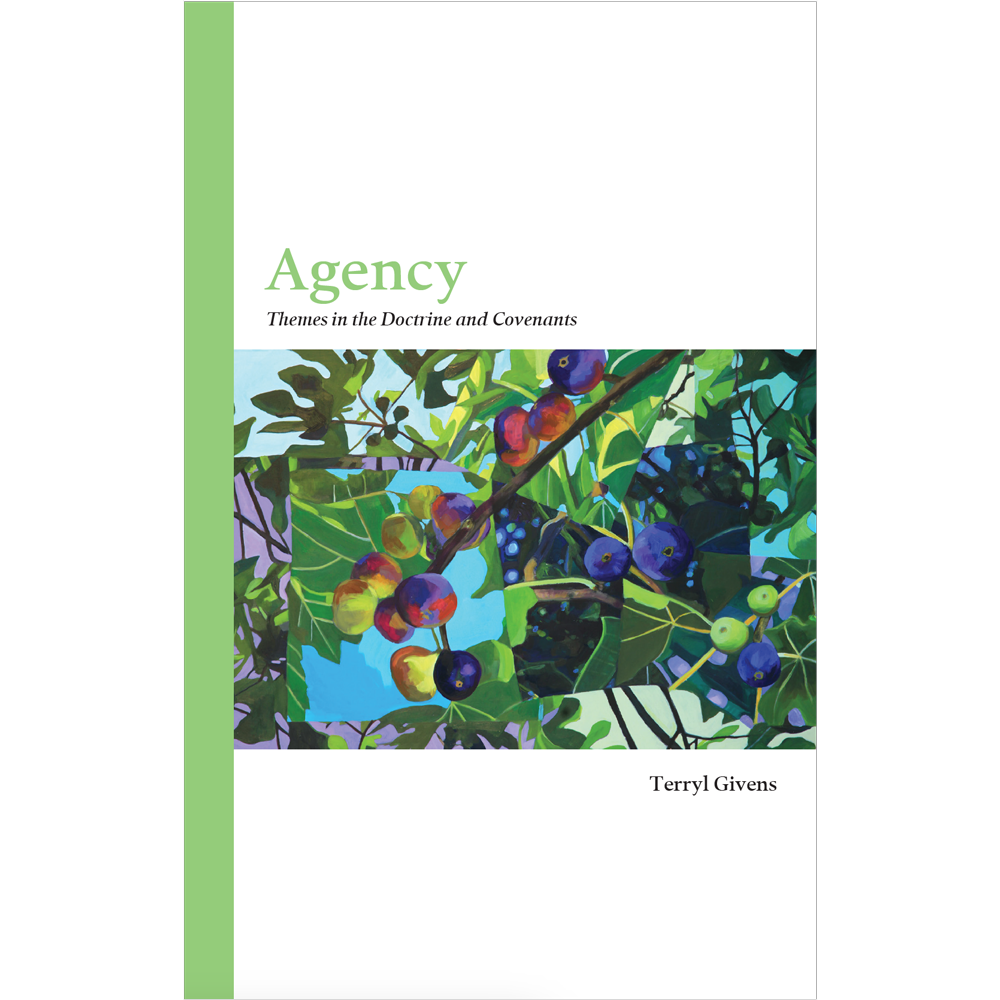
Review
———-
Title: Agency (Themes in the Doctrine and Covenants)
Author: Terryl Givens
Publisher: BYU Maxwell Institute & Deseret Book
Genre: Religious Non-fiction
Year Published: 2024
Number of Pages: 102
Format: Paperback
ISBN: 978-0-8425-0133-0
Price: $12.99
Reviewed by Conor Hilton for the Association of Mormon Letters
Agency (Themes in the Doctrine and Covenants), by Terryl Givens, draws on expansive research and offers a brief primer on many facets of agency as a lived religious principle. Givens opens the book by tracing some threads of Christian thought on free will that he sees as informing the way that the Doctrine and Covenants thinks about agency. These chapters are a whirlwind of theological and philosophical debate.
The book’s second part is to more explicitly grapple with what modern revelation teaches about agency, with chapters titled “Agency as Relational,” “Receiving and Giving,” “Impediments,” “Common Consent and Personal Conscience,” and “The Atonement and Agency.” These chapters are all quite short, often presenting what feels almost like a tease of an idea that begs a more thorough treatment. These ideas are often compelling and provocative!
One example is from that first section. Givens writes, “Agency is not even meaningful; it has no value or discernible reality except insofar as it registers in a network–or community–of other agents” (35). This is a rich counter to individualist understandings of agency that are fairly pervasive in my experience of the church. I would love to see Givens extend these ideas and more fully weave together these different facets of agency.
Later, Givens discusses the phrasing “Receive the Holy Ghost” used as part of the ordinance for the Gift of the Holy Ghost and says, “But what if those words betoken an invitation, even a plea, an entreaty from the Lord that we willingly and openly and gladly receive this ordinance that is explicitly called a ‘gift’” (46). This kickstarts a thoughtful gloss on a variety of scriptural injunctions to “receive,” which Givens suggests should be read less as a “command” and more invitational. The language of receiving gifts is helpful for providing a new orientation to many elements of the restoration and has some interesting implications and ties to the relational interpretation of agency that Givens offers earlier in the book.
The section that is most tantalizing for me personally, and which I found relatedly dissatisfying, is “Common Consent and Personal Conscience.” Givens argues towards the end of the section that, “The wisdom of eldest, the words of the prophets, scriptural texts, ‘wisdom’ from ‘the best books,’ our own moral intuitions, prayerful searching–all these are resources that constitute points by which we have to triangulate our place in the cosmos and the way forward” (79). I find this and the setup for it that Givens offers rich and compelling and provocative, but it all feels like the beginning of a conversation, the preliminaries, that then abruptly ends, right as it’s getting good! I hope to see Givens or others pick up these ideas and explore them more fully, really digging into and grappling with what this might mean and look like in practice.
Terryl Givens’ Agency is best read as an appetizer of Christian historical approaches to agency and important facets of a Restorationist interpretation. The book is a provocative launching point for future work on the subject that I hope to see.