
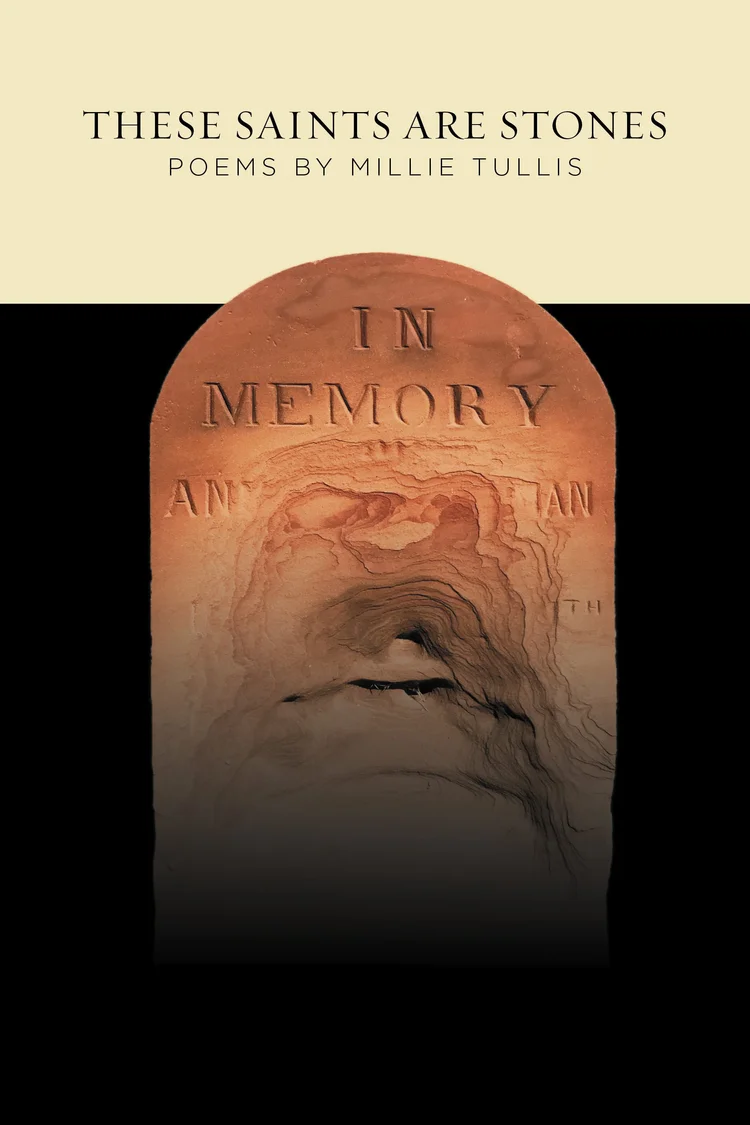
 Millie Tullis’s debut collection of poems, These Saints are Stones, will be published by Signature books on March 16, 2026. These poems investigate Tullis’s relationship to her pioneer ancestors, focusing on women’s history, family narratives, polygamy, and her experiences. In this post, she discusses these themes and where the book began.
Several years ago, at an extended family event, my paternal grandfather told me and my sister, in passing, that we had a pioneer ancestor who married a widowed woman. He told us that this man also married the widow’s daughter. I knew we had polygamist ancestors at the time, but I was fuzzy on the details. In fact, I’d avoided knowing much about the role polygamy played in my family tree. But I knew polygamy was there—most of my paternal and maternal lines converted to Mormonism and came to Utah in the 19th century. I knew some of them had lived polygamy, even if I’d dodged those stories.
But I knew many other stories about my pioneer ancestors because these narratives had always been an important part of our family and culture. On our rare family trips, we drove to southern Utah and western Nevada, where our ancestors had settled. We stopped in tiny towns and listened to my mother tell stories; she conducted family history research in preparation for our trip. She was a good storyteller. She planned stops for us to read pioneer monuments and walk around cemeteries. Polygamy came up, sometimes, in our pioneer accounts, but it wasn’t the focus of these stories. It was just an uncomfortable and confusing part of our past.
As a young Mormon girl, I was happy that polygamy was over and I was happy to avoid talking about it like most everyone else I knew. But this dynamic my grandfather had mentioned—how could I even begin asking questions about it? Where was the terminology for this kind of polygamy—a mother and daughter sharing a husband?
My grandfather’s anecdote bothered me for a long time; it nettled deep and stayed with me for years. When I was getting my Master of Fine Arts in Creative Writing, I decided to read all I could to understand the lives of these ancestors: the husband, David, the mother/sister-wife, Alice, and the daughter/sister-wife, Martha. I have long been concerned about and interested in gender and violence, feminism, women’s stories and Mormon identity, and I saw these themes in the questions I was trying to articulate about these ancestors. I started to ask questions and look for the scraps I could uncover about their histories.
I did learn things about Martha, Alice, David, their children and their shared lives in Pinto, Utah. But there was also so much that was unfindable, unknowable. So much I still could not understand about what their lives could have been like, felt like, but I started to write about what I could find and what I could imagine. One poem, “Martha,” begins: “I know / some things / about how / you lived / here” but admits, “…there is more / I can’t see.” These gaps in knowledge reflect the reality of most non-famous women’s recorded and remembered lives.
The more I researched, the more began to understand women’s history as holey, like the frayed pioneer fabric placed under glass displays in so many Daughters of Utah Pioneer museums across the state. I was looking for threads, but I knew there were also large gaps. Textile imagery also impacted the forms my poems were taking. I wrote epistolary (letter) poems between David and Martha, and then I erased them. Working with erasures allowed me to center sparse images and illustrate a feeling of being haunted directly on the page. The book includes the epistolary poems and their erasures in sections two and four.
I was also writing dream poems, and this is where the project began: with a written dream. The first poem I wrote was “Martha dreams” (the second poem with that name in the book). After reading the basics about Martha’s life, I tried to picture her dreams. How did she feel, newlywed and newly pregnant, when she woke up in the night, in the home she shared with her mother and their husband? Where was her newborn, half-brother sleeping? How did she sleep? Where did she sleep? Did she miss Bolton, England, where she’d been born? Did she dream about the ship that brought her to the United States, or did she dream about traveling by handcart to Utah? I couldn’t know, but I could imagine.
This first “Martha Dreams” poem surprised and haunted me; it pulled me to keep writing. I wrote more dreams for my ancestors and placed them in the book alongside more research-rooted poems and personal poems. In two poems titled “Reenactment,” I described participating in Trek as a teenager. I wore a bonnet and long skirt I sewed myself. I wore Martha’s laminated name, it “hung low on my chest / like a medallion.” In a patriarchal culture, women’s lives are deeply impacted by the narratives they inherit—narratives about their purposes, their work, their sexualities, their bodies, their identities, the shapes of their lives. Writing this book was one way of wrestling with some of these inheritances, uncovering and examining the threads that lead me back to my earliest Mormon women.
“Martha Dreams”
of green apples. Of Bolton.
Of pissing her only dress
when she couldn’t stand
in the boat’s black belly.
Of the baby hardening in
her black dress. Her mother
breathes nearby. Her baby
loose in the bed. In her dreams
their husband stands
an inch above the dirt.
[Originally published in Rock & Sling]
Millie Tullis is a poet, editor, and researcher from northern Utah. She holds an MFA from George Mason University and an MA in American Studies & Folklore from Utah State University. Her poetry has been published in Dialogist, Sugar House Review, Cimarron Review, Dialogue, Ninth Letter, and elsewhere. Her digital micro-chapbook, Dream With Teeth, was published by Ghost City Press in 2023. Her research has won awards from the Utah Historical Society, the Folklore Society of Utah, and the American Folklore Society. She is the editor-in-chief of Exponent II. Find more at millietullis.com.