
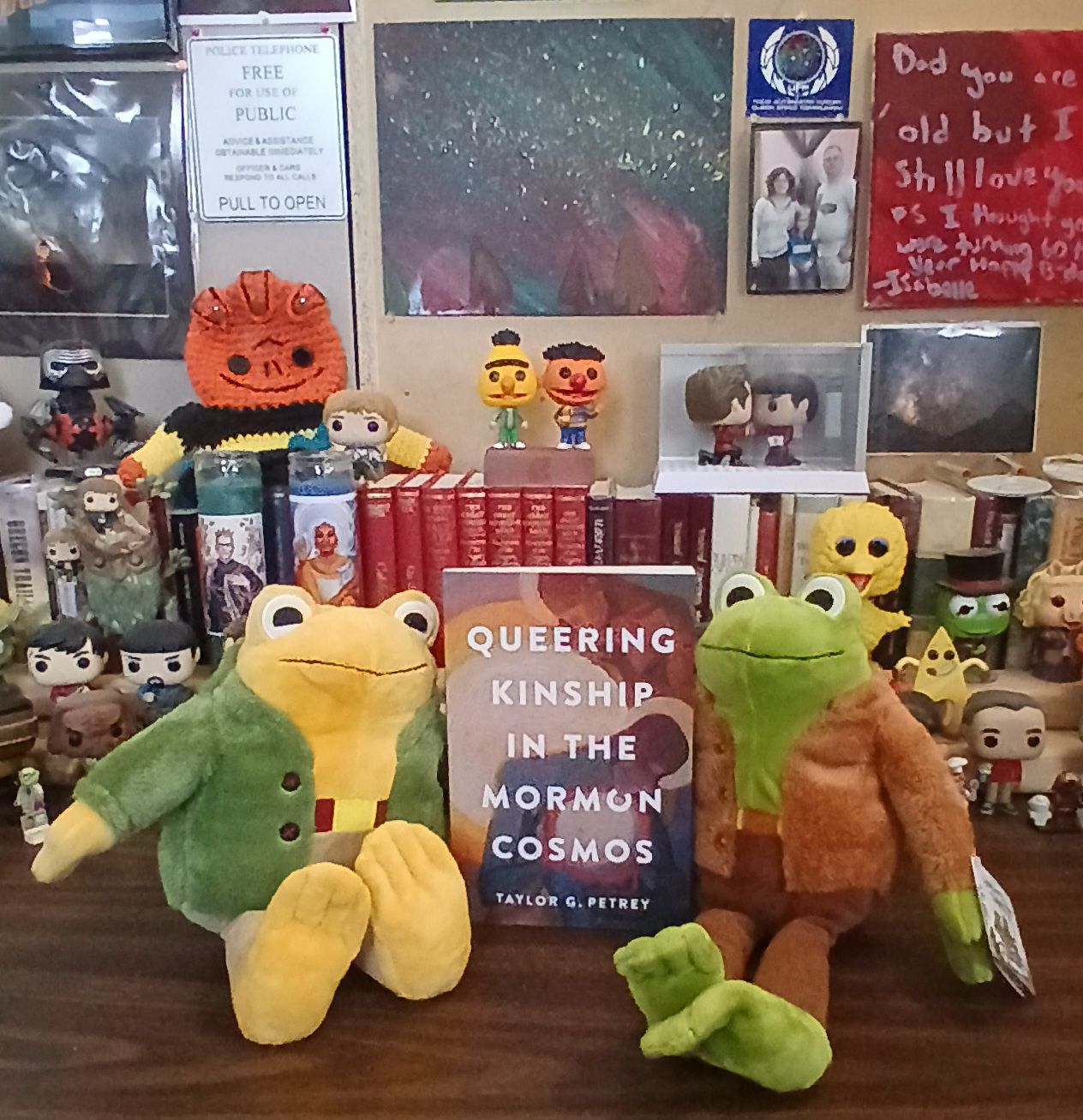
Review
————
Title: Queering Kinship in the Mormon Cosmos
Author: Taylor Petrey
Publisher: University of North Carolina Press
Genre: Religious non-fiction, Academic
Year Published: 2024
Number of Pages: 200
Format: Paperback
ISBN: 978-1-4696-8270-9
Price: $27.95
Reviewed by Conor Hilton for the Association of Mormon Letters
Taylor Petrey’s Queering Kinship in the Mormon Cosmos was among my most anticipated books in 2024, and it proved to be a provocative work, demonstrating the rich possibilities of queer approaches to Mormon theology.
Queering Kinship is deeply rooted in both Mormon scripture and queer theory, including some of the deconstructionist elements of queer theory. This grounding leads the book to “trouble” the Mormon cosmos. Thoroughly. Petrey’s work moves through what he identifies as the major elements of a Mormon cosmology across the book’s six chapters—kinship, the Godhead, Heavenly Mother, gender, embodiment, and polygamy (reducing the richness and complexity of Petrey’s framework a bit for simplicity of shorthand).
Readers unfamiliar with the way “queer” functions in an academic context may be a bit flustered at some of Petrey’s work, as it doesn’t always neatly fit into the ways “queer” is used in popular discourse. However, I think that if they can settle into the rhythms of what Petrey is doing, readers will ultimately be rewarded by how the Mormon cosmos is newly and queerly illuminated.
Petrey often takes a “both/and” approach to his readings of scripture, theory, and other authoritative texts. This approach is quite fruitful for the project and allows it to be broadly valuable, with Petrey laying out possibilities more than insisting on particular ideas. While I appreciate much of what this approach allows Petrey and the book to do, I found myself repeatedly longing to see what one could make of all these ideas, to really see a coherent, unified take (or really a variety of coherent unified takes!) on what a queer Mormonism could be. That is not Petrey’s project, so I hope to see many scholars and artists mine Petrey’s book for possibilities and run wild with them—picking up ideas about queer Heavenly Mother readings and polygamy and the complications of materialism and embodiment that Petrey describes and fleshing them out and building queer Mormon theologies.
Queering Kinship in the Mormon Cosmos is a fascinating, wide-ranging, dense delight. Petrey provides thoughtful, sensitive, provocative readings of a variety of Mormon texts and ideas, seeing them through the light of queer theory. Folks interested in queer approaches to Mormonism will be richly rewarded, while scholars and theologians looking for further avenues to explore within a queer Mormon framework will be given a wealth of opportunities to pursue, develop, and complicate. Petrey’s work is a delicious sampler of what queering kinship and its related cluster of concepts can offer the Mormon cosmos, and I cannot wait to taste the fruits that follow.