Review
———
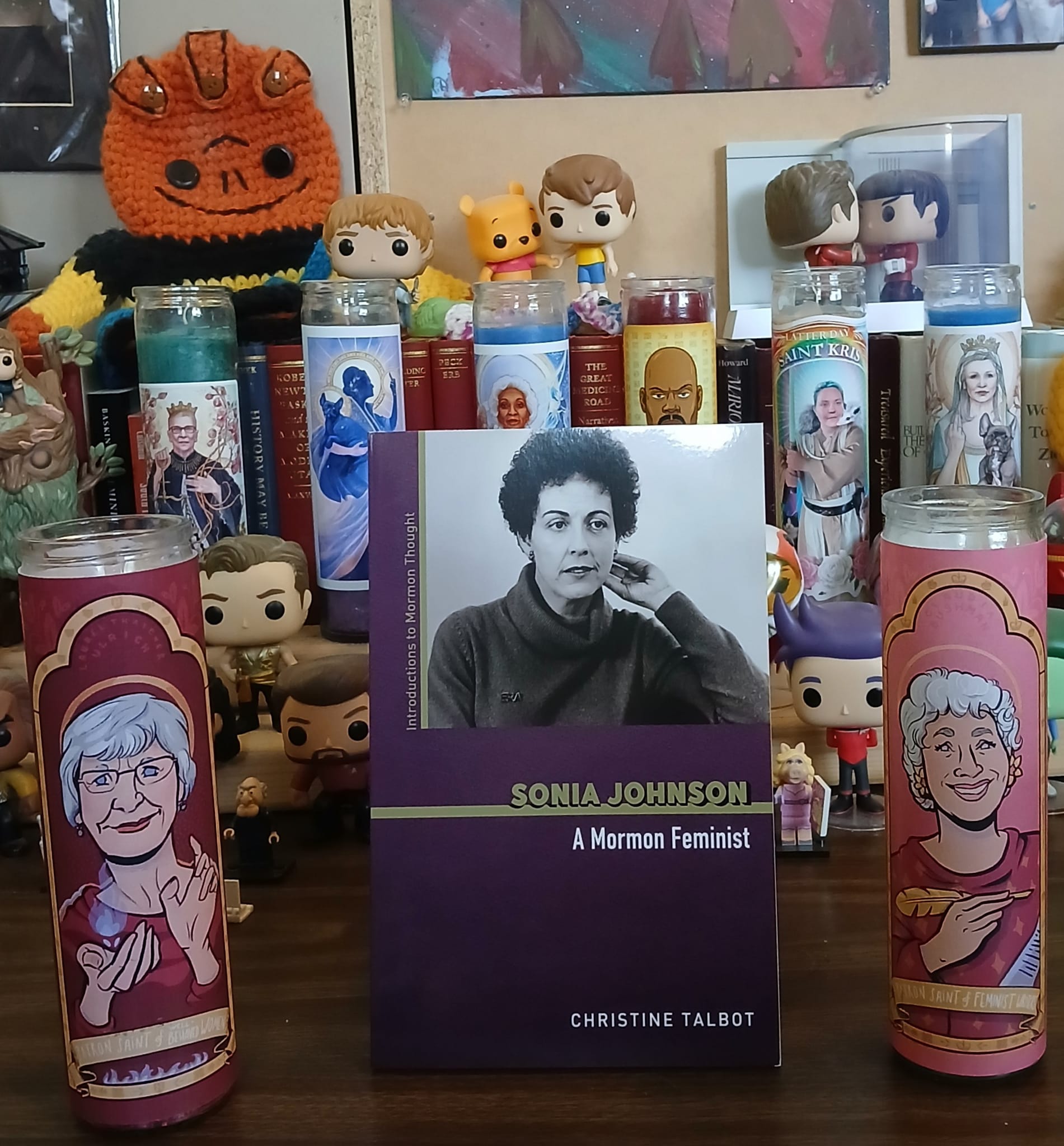
Title: Sonia Johnson: A Mormon Feminist
Author: Christine Talbot
Publisher: University of Illinois Press
Genre: Academic
Year Published: 2024
Number of Pages: 124
Format: Paperback
ISBN: 978-0252-08817-9
Price: $14.95
Reviewed by Conor Hilton for the Association of Mormon Letters
Sonia Johnson: A Mormon Feminist by Christine Talbot is a provocative and well-researched glimpse into the life and thinking of Sonia Johnson, which strains against the constraints of the series in which it’s a part. The book, in many ways, yearns to be a more comprehensive and sustained biography, drawing on Talbot’s robust and extensive research to tell Johnson’s story more fully. Yet, it still offers an interesting introduction to Johnson, particularly her ‘anti-anti-ERA activism’ of 1978-1982.
Talbot opens the book by saying that “Few people in the history of the Mormon faith community provoke such varied and visceral responses as Sonia Johnson” (1). This observation will likely prove equally true of Talbot’s book. Readers may find the book too critical of Johnson or perhaps too critical of the institutional church, or maybe both, all at once. This is likely to the book’s credit—striving to walk a difficult line. At times, I found myself wanting some additional context for the world of feminist thought that Johnson was participating in, or for the timeline of what Johnson knew—or believed—when it came to the church’s anti-ERA efforts. Some additional contextualization could clarify Johnson’s thought and the role it played in Mormon feminism.
The book’s last moments offer a few intriguing insights about the afterlives of both Johnson and Johnson’s thought in Mormon feminist circles. With a longer format, I’d love to see how Talbot traces both of those ripples throughout Mormon feminism. I can imagine part of how Talbot would sketch those influences given her concerns and focus throughout the volume, but I would love to see them more thoroughly investigated.
For readers invested in discussions of feminism, activism, and discipline within Mormonism, there is much of value in the book. The events and relationship between Johnson and the institutional church may be illuminating for some (and readers will likely find Talbot too generous to Johnson and the institution—again, a consequence of Johnson’s still-provocative cultural presence). I learned quite a bit about the history of the church’s anti-ERA activities and the specifics of Johnson’s anti-anti-ERA activism and fallout, with Talbot excelling at weaving together archival material and information gleaned from interviews. However, I found myself wanting a bit tighter and neater of an argument—a slightly more sharpened angle on Johnson’s thought itself. Others may appreciate the more biographical, historical focus that the volume has.
Christine Talbot’s Sonia Johnson: A Mormon Feminist is a deeply researched addition to the Introductions to Mormon Thought series. The book offers a wealth of archival and interview-based research distilled for the readers, with its biographical and historical focus on a few years, both a benefit and a drawback, depending on your preferences. A valuable book for those interested in Mormon feminism and various types of Mormon activism, as well as tracing ideas about authority and the relationship of individuals to the institutional church.