
[An earlier and shorter version of this essay was presented in May 2017, in Boston, at the Conference of Mormon Scholars in Humanities. I prefer [ ] for in-text citations, confident that sooner or later MLA and CMoS will recognize that most of us now compose on keyboards with [ and ] keys that require one less finger than ( and ) keys, and that []s clearly mark the citations as coming from the writer. Initials used in citations are identified in the Sources list.]
Mormons, would-be Latter-Day Saints, are twice-told “seek ye out of the best books words of wisdom” [D&C 88.118; 109.7]. It is clear that Brigham Young, at least back in 1853, did not limit “the best books” to the scriptures: “when you have done [reading the Bible, Book of Mormon, and Book of Commandments], you may be nothing but a sectarian after all. It is your duty to study to know everything upon the face of the earth, in addition to reading those books”; he also said his children should “read novels and do anything else that will tend to expand their frames, add fire to their spirits, improve their minds, and make them feel free and untrammeled in body and mind” [JD 2.93–94]. But less than a decade later (likely influenced by George Q. Cannon’s anti-novel editorial first published in 1857) he began to narrow his reading recommendations. In 1862 he allowed he “would rather that persons read novels than read nothing”; but then he deplored women of all ages “who would rather read a trifling, lying novel than read history, the Book of Mormon, or any other useful print. Such women,” he went on, “are not worth their room”; and since it “would do no good” to forbid their novel-reading, he might as well tell them to “read on, and get the spirit of lying in which [novels] are written, and then lie on until you find yourselves in hell” [JD 9.173?]. Strong stuff! — like a big dose of ipecac. And here I stand, a novel-reader who will, before this essay is over, invite you to attend to some pages from a novel.
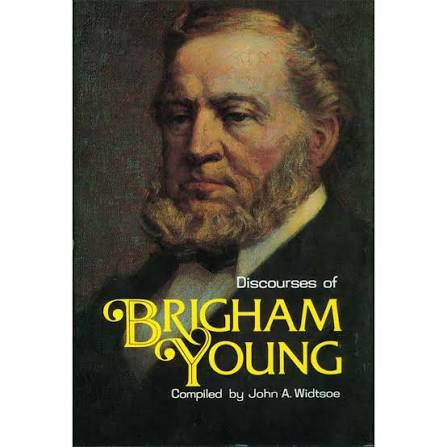 Almost to the day of his death, President Young kept on disparaging “novels” as “nonsense” and worse, a sort of moral poison that would induce children to “run away” and be “reckless” — “and if you do not break their backs and tie them up they will go to hell” [JD 15.224]. As late as Pioneer Day in 1877 he emphatically reversed his 1853 position, urging Sunday school children to study the scriptures and “read the sermons that are published in the Deseret News, as well as all the standard works of the Church” because “Such reading will afford you instruction and improvement,” while “novels allure the mind and are without profit” [JD 19.64]. It’s a partial consolation that Brigham Young’s clearest allusions to the “novels” he warned against all point to what he specifically identified in an 1873 sermon as “‘yellow-covered’ literature” or “yellow covered books” [DNW] — that is, the dime novels and other junk fiction of that era. In what I’ve read, it’s not clear whether he had looked into any other kinds of “novels,” though in a letter written just a week before he died, he did advise his son Feramorz to “sell [his] Dickens’ works” and buy books of travel and religious history [314].
So I have to doubt that Brother Brigham would concur with my most “liberal” amateur translation of 2 Timothy 3.16, that “All writing is God-breathed and is useful for teaching, for reproof, for correction, for training in justice.” In that letter, Paul counsels Timothy to “continue” in the things he has learned [3.14], particularly from “the holy scriptures” (ἱερὰ γράμματα, hiera grammata: holy letters), “which are able to make thee wise unto salvation through faith which is in Christ Jesus” [3.15]. Then, as I read it, he refers to a broader category, “all writing” (πασα γραφὴ, pasa graphē), and using two parallel predicate adjectives joined by “and” (και, kai), calls this category both “inspired by God” (θεὸπνευστος, theopneustos: god-breathed) and “profitable” (ὠφέλιμος, ōphelimos: useful).
The breadth of Paul’s apparent claim that “all writing is god-breathed” might have bothered or even scandalized the King James translators, hence their somewhat equivocal use of “scriptures” and “scripture” for grammata and graphē, respectively; the Vulgate more scrupulously renders the Greek with “sacras litteras” and “omnis scriptura.” If that claim about pasa graphē bothers me, and if — big IF — I were willing to ignore the co-ordinating conjunction (as some English translations do), I might give the devil and humans their due, treat the first adjective as a restrictive modifier, and read “every scripture inspired by God is also useful” (as the NRSV suggests in a footnote). But I’m not willing to treat Paul’s syntax that way. Even if I were willing, I would still think Paul draws a distinction between “holy letters” and “all writing inspired by God” — though (odd as it sounds to me) he may have used pasa graphē as an equivalent to hiera grammata. I take hiera grammata to mean the still-unsettled Jewish canon (including, for instance, “the book of the prophet Esaias” from which Jesus read in the Nazareth synagogue [Lk 4.17], but not yet the Song of Songs, Qoheleth, etc.). These hiera grammata, Paul tells Timothy, “are able to make thee wise unto salvation through faith which is in Christ Jesus” [3.15]. Pasa graphē, the larger category of “all writing,” or even “all writing inspired by God,” though not salvific, also “is profitable for doctrine, for reproof, for correction, for instruction in righteousness: that the man of God may be perfect, throughly furnished unto all good works” [3.16–17].
One made “wise unto salvation” (σοφίσαι εἰς σωτηρίαν, sophisai eis sōtērian; instruere ad salutem) by “the holy scriptures,” a “man of God” through faith in Jesus, can still use further teaching, reproof, straightening-up, and especially training (παιδείαν, paideian: training as for a child) in justice (δικαιοσύνῃ, dikaiosynē, which the Vulgate translates as iustitia); all this will “complete” or “perfect” the man of God, and fully equip him for “good works” — that is, I take it, for acting well and doing justly in the world. Most of the “wisdom” of “the best books” that are not among our hiera grammata, then, must be practical and ethical knowhow, more phronēsis than sophia; and “the man of God” needs that as well as he needs wisdom “unto salvation.”
So I think we may have scriptural warrant for seeking wisdom in “literature,” construed as broadly as we like: novels, short stories, dramas, poems, personal essays. Not just the ostensibly “truthful” and “useful” books — histories, travels, etc — that Brigham Young recommended in 1862 and after.
If I want to find out — for myself, not just taking others’ judgments on faith — what “writing,” out of “all writing,” is or was “inspired by God,” I will have to read; just as, if I want to know for myself what “the best books” are, I will have to read. Setting those questions aside, then: how do we seek “words of wisdom” in books, any books at all?
It seems clear that “words of wisdom” need not be limited to single sentences, like proverbs and maxims, since the best-known “word of wisdom” in LDS scripture, our only canonical text that declares itself “a word of wisdom,” D&C 89, is a substantial cautionary, hortatory, and promissory discourse of 21 verses, well over 500 words. So while we may well seek “words of wisdom” in the form of propositions, proverbs, maxims, aphorisms, etc., we are not limited to “wisdom” encoded in such brief forms, however time-honored that practice is among us — how often has Shakespeare or, say, C. S. Lewis been quoted in LDS sermons.
But would culling and compiling sentences, or even brief discourses, “out of the best books” be all there is to it? If it were, what then would we do with stories — of which our hiera grammata (with the notable exception of D&C) are so full, but with few of the stories offering readily extractable maxims? Suppose there is something we may call “narrative wisdom”; that “words of wisdom” in narrative forms, though they may not be extractable and portable in propositional forms, may be both sought and found; and that there are habits of reading that may afford practice in, or for, that kind of wisdom.
Here’s my favorite example of an unwise reading practice: how not to get “out of the best books” — indeed, out of holy letters — the “words of wisdom” offered there; quite specifically of how not to do it by extracting (and in this case distorting) a clause and ignoring how it is embedded in a narrative.
The current LDS chapter heading to Proverbs 23 includes a by now dull and rusty old saw: “As a man thinks in his heart, so is he” (it used to read “thinketh”). There must be some truth in this; the thoughts of our hearts must count for something in our character, if less than our habits and our spontaneous or deliberated choices and deeds count.
But “as a man thinks in his heart, so is he” is a misleading gloss on this text:
1When thou sittest to eat with a ruler, consider diligently what is before thee:
2And put a knife to thy throat, if thou be a man given to appetite.
3Be not desirous of his dainties: for they are deceitful meat.
4Labour not to be rich: cease from thine own wisdom.
5Wilt thou set thine eyes upon that which is not? for riches certainly make themselves wings; they fly away as an eagle toward heaven.
6Eat thou not the bread of him that hath an evil eye, neither desire thou his dainty meats:
7For as he thinketh in his heart, so is he: Eat and drink, saith he to thee; but his heart is not with thee.
8The morsel which thou hast eaten shalt thou vomit up, and lose thy sweet words. [23.1–8]
In a hortatory mode (about half the verbs are imperative), the writer (or the compiler or redactor whose “composite artistry” may have spliced three distinct bits of wisdom together into the larger unit I read) bids us to imagine a generic but rather fraught situation: we’re “sitt[ing] to eat with a ruler,” but if “given to appetite,” we’re warned to “consider diligently what is before” us and not to “set [our] eyes upon that which is not” — i.e. not set before us? We are also urged to think about what we desire — do we want to furnish our own tables with the “dainties” that rich rulers can afford? do we want riches? Last, we’re warned that although this ruler hospitably invites us to “eat and drink,” his dainties are “deceitful meat” (junk food?) and “his heart is not with [us].”
The main point seems to be that we cannot know what is “in his heart.” Whatever it is, in this little scene, it’s not likely to be us and our benefit, “For as he thinketh in his heart, so is he,” and his “eye” may well be “evil” toward us. The ruler may be (as Robert Alter translates 6a) “a stingy man.” And thus in the end, we may “vomit up” the “morsel” of his “deceitful meat” that we’ve swallowed, and “lose [our] sweet words” — which I take to mean that (especially if we vomit at his table) we’ll waste our efforts to ingratiate ourselves with this ruler by flattery, complaisance, or servility.
So “as he thinketh in his heart” is first of all a warning not to suppose that a rich ruler bidding us to “eat and drink” has our benefit uppermost in mind. And even if he should offer to make us “rich” like him, well, “riches certainly make themselves wings; they fly away as an eagle toward heaven,” so we’d just as well not labor to get rich — at least not by signing up for this rich ruler’s scheme. (See Deut. 15.9, 28.54-57; and esp. Prov. 28.22: “He that hasteth to be rich hath an evil eye,” etc.; an “evil eye” is a bad eye, which does not see well).
To make matters worse, the Hebrew in v. 7 is obscure, and may not refer at all to how “a man thinketh.” St Jerome’s verb, aestimat, has the ruler reckoning up the cost of the “dainties” you’re gulping; but the NRSV reads “like a hair in the throat are they” (i.e. the dainties). Robert Alter sides with Jerome, giving us “like one who gauges in his mind, so he is.” This ostensibly and ostentatiously generous host “thinketh” in a calculating way, reckoning his own gain or loss: his bottom line, not yours.
Whatever the ancient Hebrew may have meant, the later decontextualization and distortion of the Jacobean translation, dropping the conjunction “for” and generalizing “he” (this rich ruler) to “a man” (any and every man, though perhaps women are excused), has had, and may still be having, sizeable consequences.
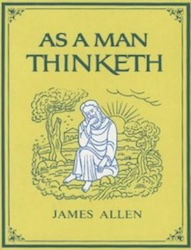 In 1903 a British writer named James Allen announced that his forthcoming book would deal with “the use and application of thought to happy and beautiful issues. I have tried,” he said, “to make the book simple, so that all can easily grasp and follow its teaching, and put into practice the methods which it advises. It shows how, in his own thought-world, each man holds the key to every condition, good or bad, that enters into his life, and that, by working patiently and intelligently upon his thoughts, he may remake his life, and transform his circumstances.” Allen’s little book, As a Man Thinketh, is still available ($5.99 in paperback, $0.99 for your Kindle, last time I checked).
I doubt Allen was the first writer to construe the phrase “as a man thinketh” in the way he does, but in his blurb we can readily see the inflation that replacing the narratively embedded “he” with the generalized “a man” hath wrought: now, not only are my (not “his”) thoughts hidden from others, not only may my thoughts set the aim of my character or my intention in a particular situation, but they also have the power to “remake [my] life, and transform [my] circumstances.” It’s hard to imagine a clearer instance of “the philosophies of men mingled with scripture.”
I suspect that Allen’s book quickly slipped into the stream of American “New Thought” that originated with the mesmerist Phineas Quimby in the 1840s and would later flood the land with Dale Carnegie’s How to Win Friends and Influence People (1936), Napoleon Hill’s Think and Grow Rich (1937), Norman Vincent Peale’s Power of Positive Thinking (1952), and ever so much more. To the point that Barbara Ehrenreich, in Bright-sided: How the Relentless Promotion of Positive Thinking Has Undermined America (2009), would credit the subprime mortgage crisis and financial collapse of 2008 to oversold “positive thinking.” (It’s not unthinkable that the whole culture of multi-level marketing has at least one root in misreading Prov. 23.7a.)
And supposing this is not fake news, not many years ago we were informed, by none other than Himself, that Donald J. Trump’s favorite pastor was (maybe still is) Norman Vincent Peale.
Somewhere in Proverbs there must be a warning against the unfortunate results of getting a proverb wrong. Maybe it’s this one: “As a thorn goeth up into the hand of a drunkard, so is a parable in the mouth of fools” [26.9]. (Hebrew “mashal” = proverb, parable, riddle, etc.)
Carving and carrying off a maxim “out of” its narrative matrix, of course, need not always be so ludicrous or perilous. Yet it’s worth noting that in this case the narrative matrix will not serve as an adequate “example” or “illustration” of the “word” ripped out of it; in fact, it says something much narrower, more particular, than “as a man thinks in his heart, so is he” — but also something well worth knowing, the world being as it is, we and the rich rulers as we and they are.
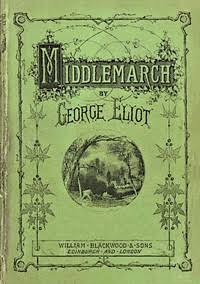 Now — beggin Bro. Brigham’s pardon — for a bit of novel-reading; not much, just a couple pages from a book published in his day that likely he did not read: George Eliot’s Middlemarch (1871–72). In Book Three, Chapter Seven (29 in continuous numbering), I notice another possible “word of wisdom” embedded in a narrative. At first it may look less troublesome than the one in Proverbs 23.7. To my ear, it’s a wry and wise, not to say sly or even wily bit of counter-wisdom, a twist on the tail of a proverb immediately familiar: “There are answers which, in turning away wrath, only send it to the other end of the room.” The pre-text comes from Proverbs: “A soft answer turneth away wrath” [15.1a].
But just as Eliot elided the second (platitudinously obvious) verset, “but grievous words stir up anger” [15.1b], I’ve omitted the second clause of Eliot’s sentence: “and to have a discussion coolly waived when you feel that justice is all on your own side is even more exasperating in marriage than in philosophy.” This does make the whole thing less portable; but if the first clause has seemed enigmatic or obscure, the second might evoke something of our own experience — of marriage or philosophy or whatever — to enlighten it. In any case, we may feel Eliot has hit upon an experiential truth, and we may long remember how turned-away wrath can withdraw to smolder at “the other end of the room.”
That second clause, especially with “even more exasperating in marriage,” also weaves Eliot’s sentence rather tightly back into its narrative context, for it has flashed momentarily, lucidly, “out of” a tense scene between Dorothea and Edward Casaubon in a particular room, the library at Lowick Manor, where he labors stolidly and interminably over his Key to All Mythologies and she copies Latin quotations for him.
We need more context before we look at the two-page scene that Eliot’s supplemental proverb emerges in. Dorothea Brooke, not yet twenty, orphaned near age twelve and raised by her bachelor uncle Mr Brooke, devout, idealistic, morally earnest, “wish[ing], poor child, to be wise,” and desiring “to make her life greatly effective,” fell in love (as we may say) with the Reverend Mr Edward Casaubon, rector of Lowick and (in the view of Dorothea’s rejected suitor Sir James Chettam) “a dried bookworm towards fifty.” Likening Casaubon to Locke, Pascal, Milton, and the “affable archangel” Raphael, the tutor of Adam and Eve, Dorothea accepted Casaubon’s offer of marriage. (A glaring misapplication of Paradise Lost, Book viii, one might remark: Eve does not — should not, could not — marry Raphael.) For his part, Casaubon saw in Dorothea (as he put it in his proposal letter) a “rare combination of elements both solid and attractive, adapted to supply aid in graver labors and to cast a charm over vacant hours.” Within six weeks of her acceptance, they married.
It is now “some weeks” since they have returned from their midwinter honeymoon in Rome (deeply disappointing to Dorothea, and in different ways also to Casaubon), and by this time she has
learned to read the signs of her husband’s mood, and she saw that the morning had become more foggy there during the last hour. She was going silently to her desk when he said, in that distant tone which implied that he was discharging a disagreeable duty—
“Dorothea, here is a letter for you, which was enclosed in one addressed to me.”
The letters are from his young cousin Will Ladislaw, whom he grudgingly acknowledges and has monetarily supported though he disapproves of him, and whom by now, since he and Dorothea encountered him in Rome, he anxiously fears as a potential heir and (posthumous) rival.
Dorothea, it appears, rightly reads Casaubon’s “distant tone” of “discharging a disagreeable duty,” and, regrettably, her soft-enough answer engages a delicately lacerating quarrel. “Immediately look[ing] at the signature” on the two-page letter to her husband, she guilelessly responds:
“Mr Ladislaw! What can he have to say to me?” she exclaimed, in a tone of pleased surprise. “But,” she added, looking at Mr Casaubon, “I can imagine what he has written to you about.”
She may think Will has written to Mr Casaubon about money; if so she’s at least partly mistaken, and her evident knowingness could provoke her husband.
But it might be more her quite unguarded “tone of pleased surprise,” plus the very existence of the letter to her, added to Casaubon’s already “foggy” mood, that prompts his reply, for which Eliot supplies no explicit marker of tone other than a single adverb, “severely”:
“You can, if you please, read the letter,” said Mr Casaubon, severely pointing to it [the letter addressed to him] with his pen, and not looking at her “But I may as well say beforehand, that I must decline the proposal it contains to pay a visit here. I trust I may be excused for desiring an interval of complete freedom from such distractions as have been hitherto inevitable, and especially from guests whose desultory vivacity makes their presence a fatigue.”
Along with the pedantically stiff speech itself, gestures do much of the work here — Casaubon’s “pointing to the letter with his pen” (signaling that his work has been interrupted, as well as distancing himself from the letter) and “not looking at her” (after her “looking at” him). We may, or must, guess at his motives for this, but it cannot make her feel even politely attended to.
At this moment of heightening tension — how will Dorothea take this? and are we already feeling what she must feel? — Eliot pauses the dialogue for a considerable stretch of reflective analysis:
There had been no clashing of temper between Dorothea and her husband since that little explosion in Rome, which had left such strong traces in her mind that it had been easier ever since to quell emotion than to incur the consequence of venting it. But this ill-tempered anticipation that she could desire visits which might be disagreeable to her husband, this gratuitous defence of himself against selfish complaint on her part, was too sharp a sting to be meditated on until after it had been resented. Dorothea had thought that she could have been patient with John Milton, but she had never imagined him behaving in this way; and for a moment Mr Casaubon seemed to be stupidly undiscerning and odiously unjust. Pity, that “new-born babe” which was by-and-by to rule many a storm within her, did not “stride the blast” on this occasion.
The first judgments here—“ill-tempered anticipation,” “gratuitous defence of himself against selfish complaint on her part”—are Dorothea’s (as articulated by Eliot and likely shared by her and by most readers); and, in light of Casaubon’s manner and words, the judgments are not unwarranted.
But they add their acid to that “too sharp a sting to be meditated on until after it had been resented.” Once more, as she began to discover in Rome, Dorothea finds Casaubon not measuring up to the Miltonic or archangelic magnanimity she has thought to devote her young life to. Perhaps more regrettably, she finds her own patience unequal to “this occasion,” even “for a moment.” The last judgments that precipitate her reply — “stupidly undiscerning and odiously unjust” — look harsher, if not excessive, and damaging, and they preclude the very possibility of any “pity” for Casaubon — at least “for a moment.” And a moment is all it takes to do serious harm.
Dorothea’s next answer is not at all “soft” but rather aggrieved, like a “selfish complaint” (had she immediately felt that impulse?); and it sounds unlikely to turn away wrath, “venting,” as it does, her resentment:
With her first words, uttered in a tone that shook him, she startled Mr Casaubon into looking at her, and meeting the flash of her eyes.
“Why do you attribute to me a wish for anything that would annoy you? You speak to me as if I were something you had to contend against. Wait at least till I appear to consult my own pleasure apart from yours.”
The scolding, accusatory “tone” of “her first words,” “Why do you,” so shakes and startles him that, involuntarily, he now “look[s] at her,’ and thus meets, full-on, the resentful “flash of her eyes.”
Much — too much — in this marriage may depend on the timing and direction of unpremeditated glances. Has he attributed to her “a wish for anything that would annoy” him? He seemed to speak only of his need for quiet and “freedom from [. . .] distractions.” Has Dorothea sensed in her own “tone of pleased surprise” just that “wish” for a visit from Will, and projected that recognition onto Casaubon as a way to account for the tone of his pre-emptive refusal of a visit? Has she just read, defensively, too much into his “trust I may be excused” and “especially” and “desultory vivacity” and “fatigue”? Eliot leaves it up to us to sort this out, and it’s no small task, though Dorothea does seem right to imply that (notwithstanding her “tone of pleased surprise) she hasn’t yet “appear[ed] to consult [her] own pleasure apart from” Casaubon’s. Her “as if I were something” — not someone — “you had to contend against” strikes back against his words and tone and gestures, perhaps especially his “not looking at her.” And then her imperative “Wait at least” (which rhythmically echoes “Why do you”) may overstep what Casaubon could regard as a boundary of uxorial propriety.
All this might make the relative softness of Casaubon’s response a little surprising: “‘Dorothea, you are hasty,’ answered Mr Casaubon, nervously.” We’ve been prepared by Eliot’s analysis to hear some justice in “hasty”: to Dorothea, the “sting” of his refusal was “too sharp” not to resent, yet it might have been well for her to “meditate” before replying with the grievous words she did use.
With an edge of authorial irony, Eliot offers us Casaubon’s judgment: “Decidedly, this woman was too young to be on the formidable level of wifehood — unless she had been pale and featureless and taken everything for granted.” “Too young” she may be, at barely twenty; yet she’s hardly “pale and featureless.” Her reply (a bit of stichomythia) could not be gauged to soothe her husband:
“I think it was you who were first hasty in your false suppositions about my feeling,” said Dorothea, in the same tone. The fire was not dissipated yet, and she thought it was ignoble in her husband not to apologize to her.
She might be as guilty of “false suppositions” as she judges him to be. Still, we’re likely to concur with Dorothea’s “ignoble”; she had thought better of him than to expect or mildly overlook — much less take “for granted” — the testiness he has indulged here.
But her “same tone” and undissipated “fire” will not dispose him to apologize. He’ll try a last word to turn away her wrath:
“We will, if you please, say no more on this subject, Dorothea. I have neither leisure nor energy for this kind of debate.”
Here Mr Casaubon dipped his pen and made as if he would return to his writing, though his hand trembled so much that the words seemed to be written in an unknown character.
His “We will, if you please, say no more” is grammatically less imperative than her “Wait at least.” But however much his exercise of it shakes him, his confidence in his right to declare a last word is unmistakable.
And Dorothea yields to that word; she leaves “Ladislaw’s two letters unread on her husband’s writing-table” and goes “to her own place,” simmering with “scorn and indignation” and “not in the least divin[ing] the subtle sources of her husband’s bad temper about [the] letters: she only knew that they had caused him to offend her.” In effect, she lets Casaubon’s word “send [her] to the other end of the room,” where “She began to work at once, and” — unlike his — “her hand did not tremble”;
on the contrary, in writing out the quotations which had been given to her the day before, she felt that she was forming her letters beautifully, and it seemed to her that she saw the construction of the Latin she was copying, and which she was beginning to understand, more clearly than usual. In her indignation there was a sense of superiority, but it went out for the present in firmness of stroke, and did not compress itself into an inward articulate voice pronouncing the once “affable archangel” a poor creature.
Dorothea’s “scorn and indignation” would sadly reduce her reverence for the “affable archangel” Casaubon, if not that “for the present” her “sense of superiority” expresses itself “in firmness of stroke” as she copies a Latin quotation. “Half an hour” later, Casaubon will collapse “on the library-steps” in “some bodily distress” from an “affection of the heart” (Dr Lydgate’s diagnosis when he arrives and examines Casaubon), and Dorothea will melt with “tender alarm” and “penitence.”
Eliot’s sentence about “answers” comes in just after the clause about Casaubon’s hand trembling and just before Dorothea returns to “her own place”: a seemingly detachable word of wisdom turns out to be more thickly embedded than, out of context, it might have looked. However naturally it arises “out of” — or rather, into — this brief scene, the closer we attend to the scene’s small movements, the harder it gets to fit the scene to the generalization without remainder, and all the harder to extract the generalization from the scene.
It applies most immediately to Casaubon’s last word, so if we lift it out for more general use, we strip it of its most concretely experienced meanings. I’ve thought it a “rebuttal” of the well-known verset in Proverbs 15.1a — but is it? Few of the “answers” in this scene between Dorothea and Casaubon (maybe two at most) could be called “soft,” and we may wonder if a sufficiently “soft answer” in just this situation, between just these two spouses, might have been impossible. Eliot omits “soft” from her allusion to Proverbs 15.1a (sure that we’ll supply it?), but likely she agrees that “a soft answer” stands a better chance of “turn[ing] away wrath”; certainly the scene shows how “grievous words,” aggrieved and cutting, “stir up anger.” Eliot’s omission lets us read her clause as saying “There are answers, soft or not, which, in turning away wrath, only send it to the other end of the room”; or we may infer that not all answers meant to turn away wrath are soft and perhaps need not be, though it’s likely better they were.
Well: in all this slow reading of a scene from Middlemarch, have we received any “doctrine” (διδασκαλίαν, didaskalian: teaching), any “reproof,” any “correction” (ἐπανόρθωσιν, epanorthōsin: setting right, straightening up), any “instruction” (paideian: training, as for a child) in “righteousness” (δικαιοσύνῃ, dikaiosynē: iustitia, justice)?
That must depend on the quality, especially the patience, of our attention. A husband or wife who read the scene attentively and recognized how this sort of marital quarrel goes, how much it depends on each one’s interpretation of the other’s words, tone, facial expression, glances, or gestures — that is, on the delicate exigent perilous work of interpersonal hermeneutics — might have taken some reproof or correction: I have suffered that, I have done that, I have behaved just about that badly, or worse, when I felt that justice was all on my own side; mea culpa. “[M]en and women, when facing each other in exchange of speech,” George Steiner wrote, “are at ultimate risk” [58].
One might wonder, in following Dorothea’s and Edward’s exchange, how much our glib talk about “communication” and “mirroring” and “rapport” and “I-messages” vs. “you-messages” could have helped this pair. Could the right “intervention” have prevented this? Could anyone have seen it coming? Not Dorothea, not Edward. And did their author see it coming, before she delivered Ladislaw’s letters and wrote the scene? What might a therapist say to these two, now that some damage is already done, that might help them repair it? And — given Edward’s obviously frail health — how long may they have to heal these small wounds? (Casaubon will die not many months after this incident.) Above all: How would you sum up, in a sentence, please, the “doctrine” or “reproof’ or “correction” or “training in justice” that this scene yields? Clearly Eliot’s sentence will not do the whole job.
A reader might also wonder: has Eliot as a novelist created — or mirrored — a world in which, though she might wish it otherwise, there can be no guarantee of justice for any of her characters? In which whatever justice does occur will be the work of those characters, flawed and “egoistic” as they are? A world that her readers may or may not read justly?
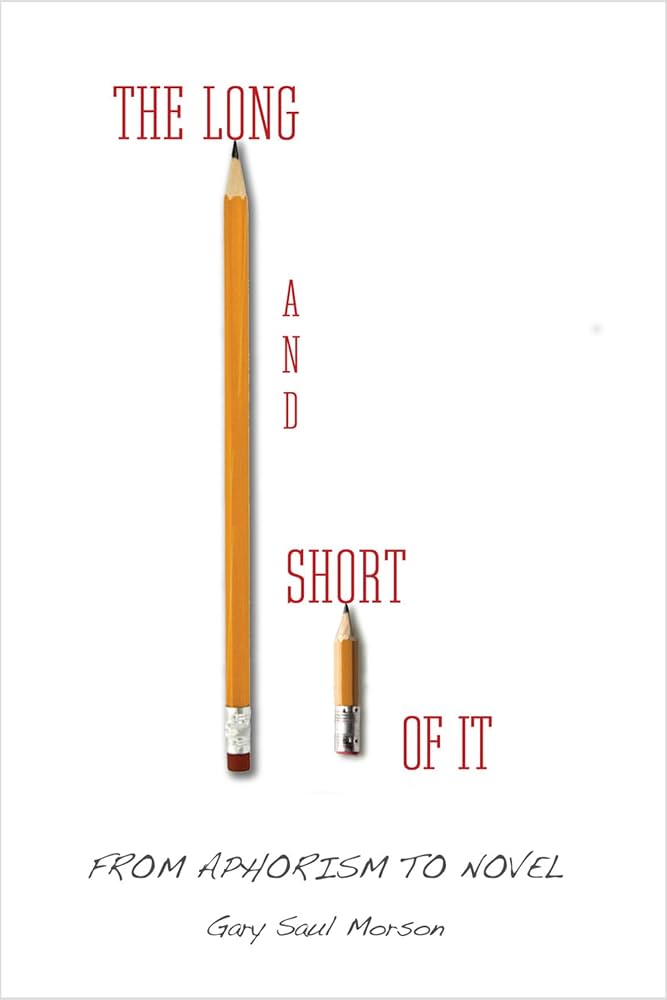 Gary Saul Morson (my favorite literary counter-theorist in the past three decades) regards Eliot, like Tolstoy, as a writer who “relied on detachable aphorisms” in her novels [L&S 2]. Like me, Morson “most often read[s] literature as a source of wisdom and insight” [L&S 5], and I’ve learned a great deal from his work, not so much what “the best” novels offer us by way of “wisdom,” and not “wisdom” as distilled into “detachable aphorisms” (though he has sharpened my attention for those), but rather much more how to read, how to attend to the fine grain of “the best” — or actually any — prose fiction, to the “countless small decisions,” deliberate or spontaneous, that characters make “at ordinary moments,” the “tiny, tiny alterations” in their understandings of and relations to one another, and to the “tiny, tiny alterations” in my own consciousness as I read, the moment-to-moment judgments that I make and adjust and revise, sentence by sentence [see “Prosaics” 520, 521, 528].
Almost four decades ago, Morson wrote that “what really matters most in reading fiction, and in every other experience, are the tiny, tiny alterations of consciousness in process.” He goes on:
Perhaps the real education that literature provides lies in the moment-to-moment decisions we make in the course of reading: where to extend sympathy and where to desire a just punishment; when to be carried away and when to remain skeptical; whether or not (to use a phrase that has gone out of fashion) to “identify” with a character. Whatever conclusions we may explicitly draw, we have practiced reactions to particular kinds of people and situations, and practice produces habits that may precede, preclude, or preform conscious moral judgments in daily life. [“Prosaics” 528]
In Middlemarch, Eliot has worked judiciously to help us learn to practice justice as we read such a scene as the one in Lowick Manor library. Partway through the Rome episode (end of chapter 21) she has warned us that “We are all of us born in moral stupidity, taking the world as an udder to feed our supreme selves,” and specifically that although Dorothea “had early begun to emerge from that stupidity,” she has yet “to conceive with that distinctness which is no longer reflection but feeling — an idea wrought back to the directness of sense, like the solidity of objects — that [Casaubon] had an equivalent centre of self, whence the lights and shadows must always fall with a certain difference.”
Just two chapters before the scene in the library, Eliot has offered a memorable “parable” for our “egoism”: take a “pier-glass [. . .] minutely and multitudinously scratched in all directions” and “place now against it a lighted candle as a centre of illumination, and lo! the scratches will seem to arrange themselves in a fine series of concentric circles round that little sun. [. . .] it is only your candle which produces the flattering illusion of a concentric arrangement, its light falling with an exclusive optical selection.”
And right at the start of our present chapter, Eliot has metafictionally interrupted herself: “One morning, some weeks after her arrival at Lowick, Dorothea — but why always Dorothea? Was her point of view the only possible one with regard to this marriage?” She reminds us that Casaubon, no less than Dorothea, no less than any of us, “had an intense consciousness within him, and was spiritually a-hungered like the rest of us.” And then she has offered, in roughly four pages of strongly condensed summary, Casaubon’s side of the brief story of their marriage so far; doing as much as she can to engage our sympathy for the already unlikeable Casaubon, so we might give him as well as Dorothea as much “justice” as we can.
All of which is to say, I think, that seeking words of narrative wisdom in this manner, reading “prosaically,” is or can be παιδείαν τὴν ἐν δικαιοσύνῃ: a child’s training in — or into — justice, toward emergence from moral stupidity, learning justice by a practice of justice in reading: a practice toward making more just judgments “in daily life.” Where it counts.
Sources
Allen, James. As a Man Thinketh. 1903. Still widely available in print and electronic formats. See Wikipedia s.v. As a Man Thinketh for Allen’s advertisement.
Alter, Robert. The Wisdom Books: Job, Proverbs, and Ecclesiastes. New York: Norton, 2010, 2011. Alter’s translations and commentaries on Proverbs are easily located by chapter and verse numbers, so I do not cite pages.
Cannon, George Quayle. “Works of Fiction.—Their Effects.” Writings from the “Western Standard.” Liverpool, 1864. 503–06. First published in Cannon’s weekly Western Standard (San Francisco) and dated “September 1st, 1858” in the Writings; reprinted in Millennial Star (Liverpool), 18 February 1860, with the subheading “From the ‘Deseret News,’” where Cannon had reprinted the editorial on 1 September 1858, p. 3. The original Western Standard date must have been 18 September 1857, since the preceding and following items in the Writings collection are both dated “September 18th, 1857,” the last referring to “the new Governor and the myrmidons who accompany him on his way to Utah” (506). Cannon started the paper 23 February 1856 and published it for nineteen months (viii–ix), so the 18 September 1857 issue appears to be the last. He left San Francisco on 3 December 1857 (ix), arrived in Salt Lake City in mid-January 1858, and soon relocated to Fillmore, Utah, with the Deseret News printing press for the duration of the Utah War. Brigham Young likely read Cannon’s editorial before decisively changing his mind (and his tune) on the matter of novel-reading.
The Doctrine and Covenants. Salt Lake City, UT: Church of Jesus Christ of Latter-day Saints, 1981. Cited as D&C followed by section and verse numbers decimally.
Eliot, George. Middlemarch. 1871–72. Widely available in print and electronic formats, so I will not cite page numbers; for general textual reliability I suggest the Penguin, Everyman, Oxford World’s Classics, or Norton Critical editions.
Ehrenreich, Barbara. Bright-sided: How the Relentless Promotion of Positive Thinking Has Undermined America. New York: Holt / Metropolitan, 2009.
The Holy Bible. Authorized Version (AV). Cited by book, chapter, and verse. For Greek and Latin versions of 2 Timothy 3 and Proverbs 23, see the New Testament and Vulgate texts and the word study tools at perseus.tufts.edu. NRSV = New Revised Standard Version.
Morson, Gary Saul. The Long and Short of It: From Aphorism to Novel. Stanford, CA: Stanford UP, 2012. Cited as L&S.
—. “Prosaics: An Approach to the Humanities.” American Scholar 57.4 (Autumn 1988): 515–28.
Steiner, George. Real Presences. Chicago: U of Chicago P, 1989, 1991.
Young, Brigham. “Address, by President Brighm Young, Delivered to the Sunday School Children in the New Tabernacle, Salt Lake City, July 24, 1877.” Journal of Discourses. Liverpool, 1854–86. 19.60–65. Cited in-text as JD followed by volume and page numbers decimally. https://contentdm.lib.byu.edu/digital/collection/JournalOfDiscourses3/id/1079/rec/20.
—. “Discourse by President Brigham Young, Delivered in the Bowery, Logan City, Sunday Afternoon, June 30, 1873.” Deseret News Weekly, 23 July 1973. Cited as DNW. https://contentdm.lib.byu.edu/digital/collection/desnews3/id/143407/rec/18.
—. Letter to Feramorz Little Young, 23 August 1877. Letters of Brigham Young to His Sons. Edited by Dean C. Jesse. Salt Lake City: Deseret Book, 1974. 313–15.
—. “Necessity of Paying Due Attention to Temporal Duties, &c.” 26 January 1862. Journal of Discourses 9.167–74. Cited in-text as JD 9. https://contentdm.lib.byu.edu/digital/collection/JournalOfDiscourses3/id/3745/rec/10.
—. “The Order of Enoch.” 9 October 1872. Journal of Discourses 15.220–29. Cited in-text as JD 15. https://contentdm.lib.byu.edu/digital/collection/JournalOfDiscourses3/id/5687/rec/16.
—. “Organization and Development of Man.” 6 February 1853. Journal of Discourses. 2.91–96. Cited in-text as JD 2. https://contentdm.lib.byu.edu/digital/collection/JournalOfDiscourses3/id/7957/rec/3.