
Review
———-
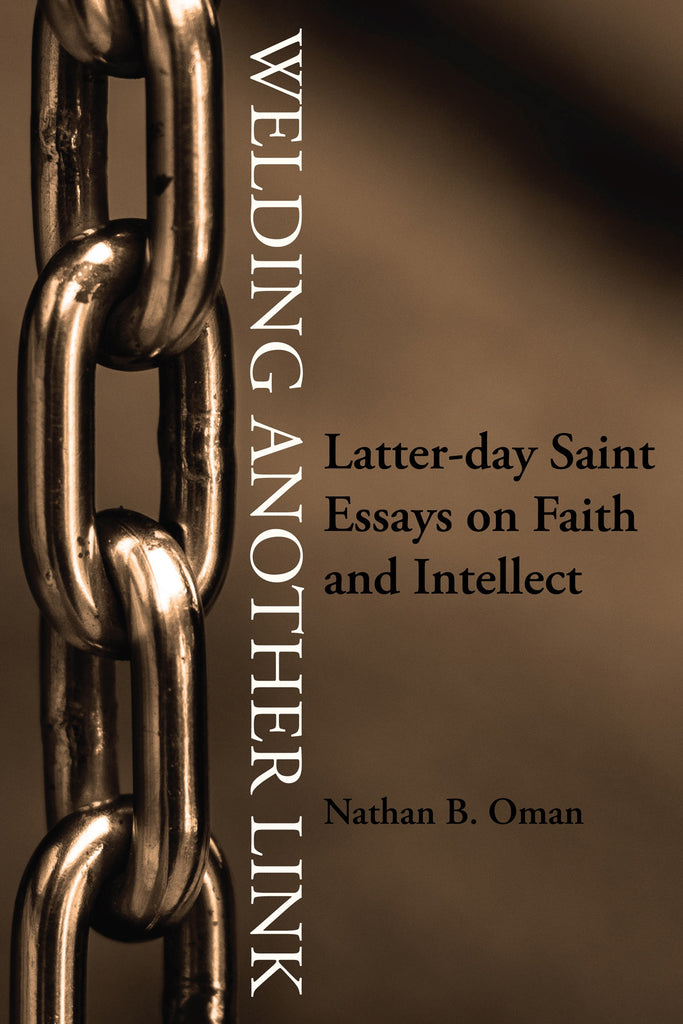
Title: Welding Another Link: Latter-day Saint Essays on Faith and Intellect
Author: Nathan B. Oman
Publisher: Greg Kofford Books
Year Published: 2026
Pages: 109
Binding: paper
Genre: Religious non-fiction
ISBN: 978-1-58958-837-0
Price: 19.95
Reviewed by Conor Hilton for the Association for Mormon Letters
Welding Another Link: Latter-day Saint Essays on Faith and Intellect is an essay collection by Nathan B. Oman, largely comprised of previously published essays, gathered from various other places here together for the first time. Oman’s thought is sharp and well worth reading, with some truly excellent essays here. The collection as a whole suffers from some of the common problems of essay collections that largely republish existing material–there isn’t a clear throughline or sense of why these particular essays are placed alongside each other, and some of the essays are much stronger than others (though the essays I found strongest may not be the same as the ones you would find strongest).
The book is split into two sections, following its subtitle–Faith and Intellect. The opening essay of Intellect, “The Disposition of Mormonism”, is perhaps the weakest in the collection–mostly in that I couldn’t quite follow what exactly Oman’s argument was. This is likely due to not fully grasping the ways in which he is deploying the different types of dispositions that can be had. Oman’s thinking is often dense, but almost always has a clarity and precision to it where it is easy enough to follow along, even if the ideas and perspectives are new and challenging in some other way, so my difficulty following this particular essay stood out.
There were several essays that I loved; some helped me understand ways I relate to my own faith that resonate with what Oman describes, while others offered a new framework for engaging with a particular question or idea.
The essay that closes the book, and gives the book its title, is one of the latter. Oman writes, “What is the most important challenge facing Mormonism’s chattering class? My answer is simple: finding new language in which to celebrate the Restoration” (87). This entire essay is worth reading if you are a person arguably in “Mormonism’s chattering class,” and it gives an interesting, but fairly broad challenge, one that I think can also be received by more creative authors in that space. I wonder if opening the book with this essay could have (re)framed some of the other essays and given a new sense of purpose and connection to the essays gathered together.
Early on in the book is an essay, “From Scandal to Wonder”, where Oman describes some of his own journey of relating to his faith. He writes, “I find that the scandal of Mormonism has, for me, taken an ironic and even mischievous turn. Mormonism has become scandalous in the sense of being audacious, exciting, and iconoclastic” (10). I love this. This was one of those essays that gave me new language to describe myself and helped me articulate why I resonate with Oman’s thought to the degree that I do. This characteristic of Oman drives him to explore the implications of the Restoration and Mormonism in a way that I find refreshing and fruitful.
And perhaps a quote from “Buying Jewish Whiskey” helps connect these two ideas: “The question for a believer is thus always how one adapts a tradition while accepting its authority and maintaining fidelity to it” (27). Here, Oman succinctly describes what he sees as the role of believers, in terms of their relationship to their tradition. The essay goes on to describe elaborate rituals and “legal fictions” developed by Jews that enable them to keep Jewish law and praises the ways that this imaginative engagement with tradition empowers these Jews to embrace their tradition’s authority, even as they find ways to make it new.
Nathan B. Oman remains one of Mormonism’s most original and compelling thinkers. Welding Another Link is worthy of reading and pondering for all those committed to adapting Mormonism while remaining faithful to it.