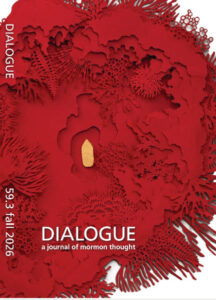
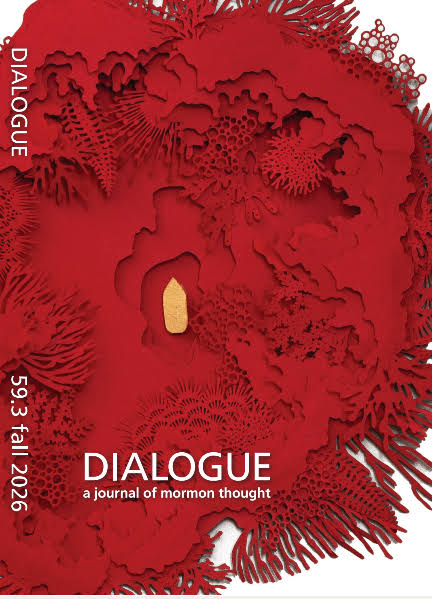
Check out the short fiction, reviews, poetry, and essays in new Fall 2026 issue of Dialogue, and its attendant podcasts.
 Short Fiction:
Roger Terry. “Celestial Realty: A Parable of Sorts”
Ryan Habermeyer. “Bring Me the Head of Ezra Taft Benson”
See also Robert Bennett’s review of several of Ryan Habermeyer’s stories here: Mormon Postmodernism: Reflections on Ryan Habermeyer
Podcasts:
Faith, Fiction & the Absurd: A Conversation with Andrew Hall, Ryan Habermeyer, & Robert Bennett
The panel discusses Ryan’s absurdist story, as well as his novel Necronauts, and other stories that have appeared in his collections The Science of Lost Futures and Salt Folk.
From a surreal auction of Mormon historical artifacts to a Utah boy with a cosmonaut helmet grafted to his head, Habermeyer’s fiction delights in the grotesque, the irreverent, and the improbable. But beneath the absurdity lie serious questions about belief, belonging, loss, and the stories we tell to make sense of our lives.
The conversation explores Mormon folklore, literary influences ranging from Brian Evenson to Eastern European absurdists, the uneasy relationship between fact and fiction, and Habermeyer’s journey toward embracing Utah and Mormonism as his literary territory. Along the way, he considers why literature should make us uncomfortable, how humor opens space for difficult conversations, and why faith can be both a poison and an antidote.
Dialogue’s editors introduce the Fall 2026 issue. Explore Todd M. Compton’s research on newly available documents concerning Joseph Smith’s plural wives, Scott C. Richards’s exploration of the Atonement and healing, and Gregory A. Prince’s firsthand account of the LDS Church’s response to faith crisis. The editors also highlight the issue’s personal essays, poetry, fiction, book reviews, sermon, and art, inviting listeners into conversations about Mormon history, theology, identity, and community.
From Odysseus to Nephi: Heroes, History, and Myth
In this episode of Dialogue Unbound, Caroline Kline talks with literary scholar Michael Austin and filmmaker Daniel Foster Smith about The Odyssey, modern adaptation, and the stories cultures tell about their heroes. From Odysseus’s hubris and moral complexity to Nephi, the killing of Laban, and the mythology surrounding Mormon historical figures, they explore what happens when ancient stories are reshaped to reflect contemporary values—and when complicated people are transformed into uncomplicated heroes.
Music in the Old Testament: Gospel Study with Michael Hicks
Michael Hicks uses his extensive musical knowledge in the church to walk us through the Psalms.
Book Reviews:
Whispers from the Poker Table | John Bennion, The Dead Fathers: Grief and Poker in the West Desert. Reviewed by John Engler
Swift River Philosophizing | Ryan W. Davis, Dispatches from Mormon Zion. Reviewed by Fara Sneddon
No Man Knows My Prosody | Zachary McLeod Hutchins, Joseph: An Epic. Reviewed by Michael Hicks
Narrating Mormonism: Perspectives on the American Chronicle | Benjamin E. Park, American Zion: A New History of Mormonism. Reviewed by Cheryl L. Bruno
Rauch Among the Mormons | Jonathan Rauch, Cross Purposes: Christianity’s Broken Bargain with Democracy. Reviewed by Russell Arben Fox
Reflecting on the Mormon Moment | Rosemary Avance, Mediated Mormons: Shifting Religious Identities in the Digital Age. Reviewed by Brenda R. Weber
Desiring Stories, Storied Desires | Rebecca L. Davis, Fierce Desires: A New History of Sex and Sexuality in America. Reviewed by Christine Talbot
Poetry:
Poetry by Christopher Bissett, Nathan Kitchen, Doug Barrett, and Millie Tullis
Personal Voices:
Personal essays by Alison Ash Linnell, Barrie Brewer, and Robert A. Rees
I’m already on the record about Habermeyer’s work, so let me just offer some brief remarks about Terry’s story. It is not as ambitious as Habermeyer’s, but it does exactly what it sets out to do. It more or less tells a somewhat predictable, almost moralistic, fable of sorts about a heaven in which the last shall truly be first and the first last. It sticks to its fundamental theme, embellishing it with creative details and delivering its final verdict in one fell swoop. Nothing extraneous. Nothing wasted. No circumlocuting. It is as if Hemingway had written one of Jesus’s parables. A fastball down the middle of the plate. And we can never have too many stories about how the tables will one day be overturned. Not these days. It would make more worthy reading in our Sunday meetings than many a conference talk. Better written and more thoughtful-provoking than some of its more prosaic cousins.