
 Originally published on Robert Bennett’s Substack, “Mormon Short Stories”
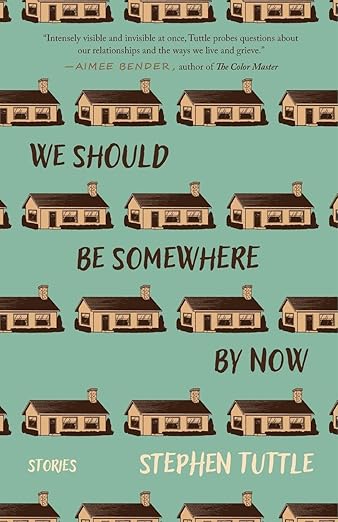
While the overwhelming majority of my substacks analyze short stories ABOUT Mormonism—stories that explore Mormon characters, Mormon situations, Mormon themes, Mormon culture, Mormon theology, Mormon et cetera—this essay will explore a new collection of stories BY a Mormon writer: Stephen Tuttle, a Professor of Creative Writing at BYU. In his excellent debut collection, We Should Be Somewhere by Now, you will not find references to missionaries, Relief Society presidents, or tithing slips—let alone angels with gold plates, wandering Amerindan Jews, or some kind of intergalactic détente between the Mormon prophet and aliens—but you will find some damn (sorry, I mean darn) good stories. So, today I’m not going to talk about the brave new world of Mormonism in all its celestial glory but rather more simply just about straight-up good stories. If you normally come for the Mormonism, please stay this time for the stories. They are simply too good to pass up. So good, in fact, that the collection was awarded this year’s AML Short Fiction Collection award.
And you don’t have to just take their word for it. Most of these stories have also been previously published by some of the nation’s best literary journals, including The Colorado Review, Ninth Letter, Black Warrior Review, Joyland, and the Indiana Review. And the collection as a whole is published by Cornerstone Press, a prominent academic press which specializes in publishing short story collections. So, these stories not only rank among the best stories by, for, and/or about Mormons; they can also hold their own with the best short stories period straight up. Full stop. Normally, I try to limit my posts to two—or at most three—stories at a time, but Tuttle’s collection is so good that I just couldn’t choose between my four favorites, so against my better judgment I will attempt to at least briefly juggle more stories than usual. We’ll see if I can keep them all up in the air at the same time: three balls and a chainsaw.
First up is the story, “Amanuensis” which itself also won an AML award in 2008. In this story, Mr. Dumond is an eclectic—almost Winesburg, Ohio-esque—beloved small-town teacher who mysteriously disappears in a snowstorm never to be found again. Which is perhaps ironic because Dumond is famous precisely for making science fun by taking his students out on snowy days to observe the delicate “hexagonal symmetry” of snowflakes which he helps capture for them in photographs. It is only after his death, however, that the town discovers Dumond’s secret: In his basement he has constructed an intricate scale model of the entire town, complete with “miniature churches and miniature stores and miniature houses in cul-de-sacs.” Not only that, but he has also marked this model with an inexplicable “network of colored dots” and other mysterious symbols whose enigmatic meanings are perhaps not quite actually explained in what can only be described as a less than reliable “key” to their interpretation. This sets up the story’s basic scenario, already delightfully rich in possibilities, but I will leave the reader to fully enjoy the wild ride of attempting to disentangle the town’s, at times chaotic, attempts to disentangle the meaning of this mysterious map, its curious codes, and its capricious key.
But what makes this such an exceptional story? I begin with the story’s primary features: its eclectic protagonist and imaginative premise. What could be more enigmatic than a character who constructs such an intricate scale model of his own town complete with elaborate codes and ciphers? Who would not only envision, but actually execute, such an undertaking? Why would he do it? What does it mean? What would such a creation reveal about either its creator or his hometown? And this character’s mysterious model, the story’s creative premise and complex symbol, immediately engages the reader in the story’s central plot by challenging the reader to figure out—together with the town itself—the model’s mysterious meaning. After all, you can only understand the character of Dumond by uncovering the hidden meaning of his magnum opus, which given its complexity proves to be an essentially Sisyphean task. The story’s characterization, plot, and primary symbolism all coalesce around its brilliantly imagined central mystery.
I have always considered Winston Churchill’s description of the Soviet Union as a “riddle, wrapped in a mystery, inside an enigma” to be the perfect description of Joseph Conrad’s character Kurtz in Heart of Darkness, one of the more enigmatic characters in world literature since Hamlet. And Tuttle’s story similarly describes the riddle of Dumond’s model town wrapped in the mystery of its coded ciphers inside the enigma of the unreliable “key” the town uses in its often bungling attempts to decipher Dumond’s far from simple code. Any layer of this mystery alone would have been enough to make an interesting story, but with each complex layer embedded inside the next one, Tuttle creates a virtual nesting doll of stories within stories and mysteries within mysteries only to be untangled with great effort—if at all.
I will leave it to the reader to discover whether the town—or the reader themselves—can ever ultimately decipher the hidden meaning of Dumond’s microcosm of this town or not, but either way, the complex ambiguity of the town’s convoluted process of interpretation and meta-interpretation draws the reader into a fascinating story which is much more interesting than some kind of simple model with a one-to-one correspondence to reality and an accurate and authoritative key ever could be. Calling it outright Crying of Lot 49 level intrigue might be a bridge too far, but when someone is saying that you aren’t quite Thomas Pynchon, then I think that you can legitimately take that as a genuine compliment. I certainly would.
In short, Tuttle’s main character of Dumond is delightfully eclectic. His story’s imaginative premise/symbol of the model town is cleverly crafted and deeply mysterious. Its central plot of disentangling the model’s mysterious Kurtz-like meaning is engaging, especially given its many unexpected twists and turns. And Tuttle tells this whole tale through an ambiguous layering of stories within stories. Taken collectively, this all makes for one hell (I mean heck) of a read.
Next up, in no particular order, is “The Two Mr. Greens.” This story was originally published in the Black Warrior Review, which has a reputation for publishing if not quite outright avantgarde, then at least slightly more innovative and perhaps even somewhat experimental, stories than most literary journals, even the best ones. This story is no exception. The premise of this story starts off largely unexceptionally: Two men, who both happen to be named Mr. Green—so they are referred to straightforwardly as the first Mr. Green and the second Mr. Green (much like Dr. Suess’s unforgettable Thing One and Thing Two)—are simply attempting to negotiate the various city regulations required to build a fence between their respective properties. Not unlike in “Amanuensis,” however, the seemingly indistinguishable Tweedledee and Tweedledum’s mundane task is interrupted when the second Mr. Green digs up another mysterious secret: “a small metal box” containing “plastic bags covering more plastic bags covering a book.”
More nesting dolls which ultimately contain a twelve-page diary which turns out to be another Kurtz-like riddle, wrapped in a mystery, inside an enigma. Who wrote it? What mysterious message does it contain? Do his neighbors know about it? How long has it been buried? Was it purposefully meant to be discovered, or has the second Mr. Green uncovered a secret that was never meant to be revealed? Should he rebury it? Will his neighbor see him if he does and wonder about what he is doing?
And that’s just to get started. As the story progresses, the questions continue to proliferate and escalate, spinning wildly out of control, as their possible, but impossible to verify, answers and startling implications pile up. As the second Mr. Green contemplates this endless web of possibilities his mind spirals into something resembling a paranoid conspiracy theory. (Need I mention Pynchon again?) Ultimately, the final paragraph so creatively encapsulates these numerous questions and their seemingly endless corollary implications, that it takes all the restraint I have not to quote it in its entirety. But that would entirely spoil the delight of reading it for yourself. Had this book been published fifteen years ago, I would probably quote it anyway, but this book was only published last year in 2025, and in December of last year at that. So, it is certainly quite understandable that you may not have read it yet, but come this time next year, it will be entirely inexcusable if you haven’t. It is now required reading.
As the next story, “Keepers of Bees,” demonstrates, however, not all of Tuttle’s stories follow the same pattern of uncovering some secret neighborhood mystery, although he is a true master of that genre. This story might more accurately be described as a simple comedy of errors. Dressed in a beekeeping suit, of course. And like so many of Tuttle’s stories, it all starts out innocently enough: the narrator’s “wife wanted bees,” as in a “kit” of three pounds—or about 10,000—bees that “comes in the mail.” What could go wrong? I’m sure that you can already hear the other shoe starting to drop.
So, the overall direction of the story—its central plot—is perhaps somewhat predictable. The couple’s investment in bees gradually escalates until their beekeeping begins to overtake them as the hive becomes “more work” than the wife first expected. You could probably see this coming, but what makes this a masterful story are the details and the dialogue. How exactly does one determine that 10,000 bees make three pounds of bees? According to Tuttle’s narrator, “When I asked about weighing a bee, I said I thought it was funny to imagine a beekeeper with a little scale, lining up bees like prize fighters before a bout.” Now that’s clever, and that one I didn’t see it coming. Nor did I anticipate Tuttle’s description of the bees flying in and out of the hive as “like planes at the world’s busiest airport.”
Throughout, Tuttle deftly turns witty phrases and comic images into delightful banter between the narrator and his wife—“What I really wanted to say was that while the shape and size of the box was something I could be indifferent to, the bees themselves gave me pause”—as they humorously negotiate the at times troublesome quotidian mechanics of beekeeping: whether to get a plain hive or a decorative one, whether bees are a danger to the neighborhood children, or even the narrator’s belatedly remembered childhood memory of being allergic to bees. What do they do now? Do they have to return the hive? They have, after all, already “bought all the stuff.”
By spring, the 10,000 bees could become ten times that, so the wife is already planning where to set up more hives. Increasingly sympathetic to his wife’s many apiarist responsibilities, however, the narrator eventually gets involved in “checking for lost wax” and “protecting against pests and predators.” He even reads “up on woodlice and mites” and finds “tips for fending off mice and raccoons and skunks” until their roles eventually begin to reverse, and the wife grows increasingly lackadaisical before she ultimately just starts sitting “in the lawn chair and looking on as I checked the hive.” Then finally, the very same bees that the wife had once purchased with such loving care, she actually swats with a flyswatter when they bother her in the house. The very next morning, the wife decides to “sell her hive and colony” to the friend that got her interested in the bees in the first place. All’s well that ends well, or at least so it seems. A nice tight little story wrapped up with a little bow, all ready to put under the Christmas tree.
But that’s when the actual trouble with bees begins. There is a whole second part to the story. One that you never saw coming. One much more complicated and humorous than the first. One that takes beekeeping and bee-unkeeping to a whole new level. In other words, like a good comedian, Tuttle’s whole first joke is just the set up for his second: His first joke scores a laugh; his second one delivers a gut punch. You only thought you understood the trouble that bees can get you into, but like the master writer and comedian that Tuttle is, he never misses an opportunity to escalate.
Last but not least, “The Hidden Curriculum” is so extraordinary that I’m not even going to explain its premise, let alone spoil its best lines. But I just couldn’t conclude my review of Tuttle’s collection without mentioning it, recommending it, and all but assigning it as homework. Not only is it my favorite story in the collection, but it is simply hysterical. Not LOL funny, but ROTFL or even LMFAO funny. Straight, no chaser. Go read it for yourself. Now. It alone is well worth the price of admission.