
Review
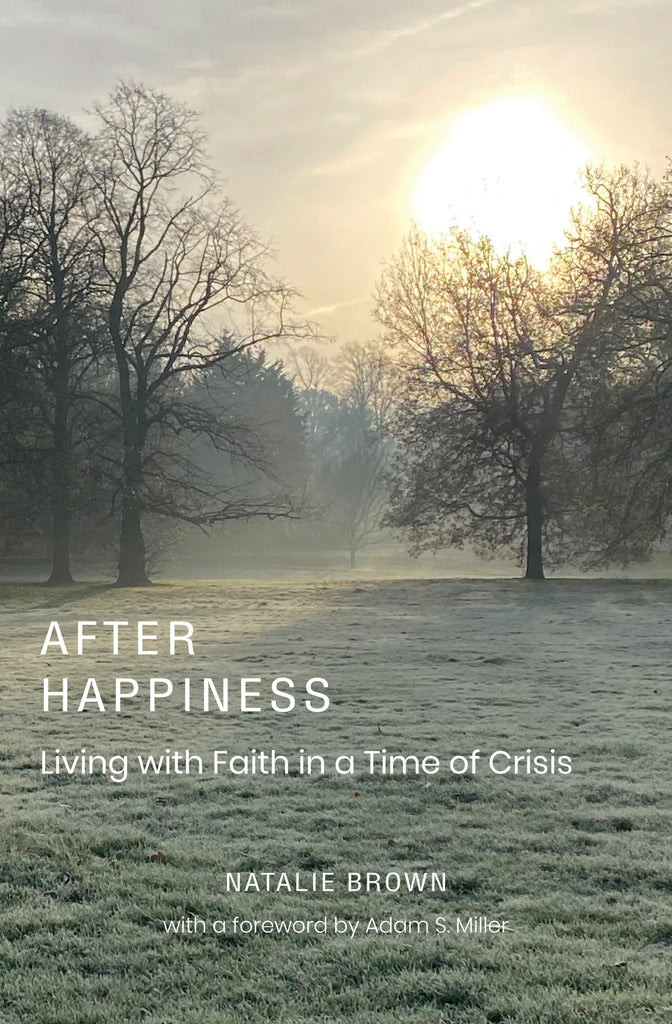
Title: After Happiness: Living with Faith in a Time of Crisis
Author: Natalie Brown
Publisher: Greg Kofford Books
Year Published: 2026
Pages: 152
Genre: Religious non-fiction
Binding: Paper
ISBN: 978-1-58958-846-2
Price: 19.95
Reviewed by Conor Hilton for the Association for Mormon Letters
In After Happiness: Living with Faith in a Time of Crisis, Natalie Brown offers a foundation for faith and the religious life when simple formulas and hoped-for promises of happiness following righteousness fail. Brown’s thinking is a valuable anchor for our current moment of weak communal ties, widespread economic precarity, and a rotating cast of other crises.
Throughout the book, Brown thoughtfully roots her ideas in her own experience and witness of the world, weaving in a wide range of other thinkers and texts. As part of this work, Brown draws on her expertise in nineteenth-century literature to bring our collective attention to the theological and spiritual insights of literature, notably including John Stevens’ Courtship by Susa Young Gates. I don’t think I have ever read a work of religious non-fiction like After Happiness that included Mormon literature as part of its referenced texts, and that’s a shame—I hope that Brown’s work here inspires other thinkers and writers to turn to the underread treasures of Mormon literature as we go about imagining new spiritual and theological frameworks suited for our present moment.
Brown’s years of academic training in close, careful reading, in both English literature graduate programs and law school, show throughout the book as she guides us through different ways of seeing and thinking about happiness. Brown writes that “The term ‘happiness’ slips between a feeling we experience, a signifier of righteousness, an aspiration, a promise of future salvation, and a label that we assign to thoughts and possessions that are socially desirable. Each of these meanings coexists within the Church’s official and cultural discourse” (38). In the sections surrounding this, Brown includes a list of many of the pathways sketched out for happiness in General Conference, paying careful attention to one of the origins of the broken script for happiness that she had inherited.
Importantly, the book is not simply concerned with definitional questions and splicing authoritative quotations. Indeed, Brown’s work is primarily pastoral in its orientation, striving to offer a new way of thinking about happiness because that may empower us as individuals to actually live more joyfully and as a community to care more for the unhappiness that those around us experience. Brown’s own experiences shape this perspective. Near the opening of the book, she writes, “The potential I once felt has faded into the burden of unfilled expectations and the mandate to build a joyful life within the harsh realities of the now” (2). Brown attentively mines this experience to offer a way of thinking about happiness and faith that may not lead to the same destabilizing experience of disillusionment and unfilled expectations that she has navigated. Perhaps because of the rhymes with my own academic and professional journey, I felt the weight of this thread quite palpably as I was reading.
One piece of Brown’s proposal for a new way of thinking about and living joyfully in the midst of crises and unhappiness is tied to embracing discomfort. She writes, “Yet while discomfort can be an important signal to avoid or end a relationship, at other times it is important to assess whether the discomfort we feel is truly warranted and whether discipleship instead requires us to embrace and work through our discomfort” (59). Brown ties this idea of discomfort to broader conversations about mourning with those that mourn, cultural unease with unhappiness, and even an engaging, moving reading of some scriptural passages surrounding Nephi.
If you find yourself carrying a burden of unfilled expectations and wondering where the happiness you expected is, After Happiness: Living with Faith in a Time of Crisis is for you. May we see many thinkers and writers build on the insights and foundation offered here by Natalie Brown to continue to breathe life into Mormonism and have it leaven our own lives and suffering.