Review
———–
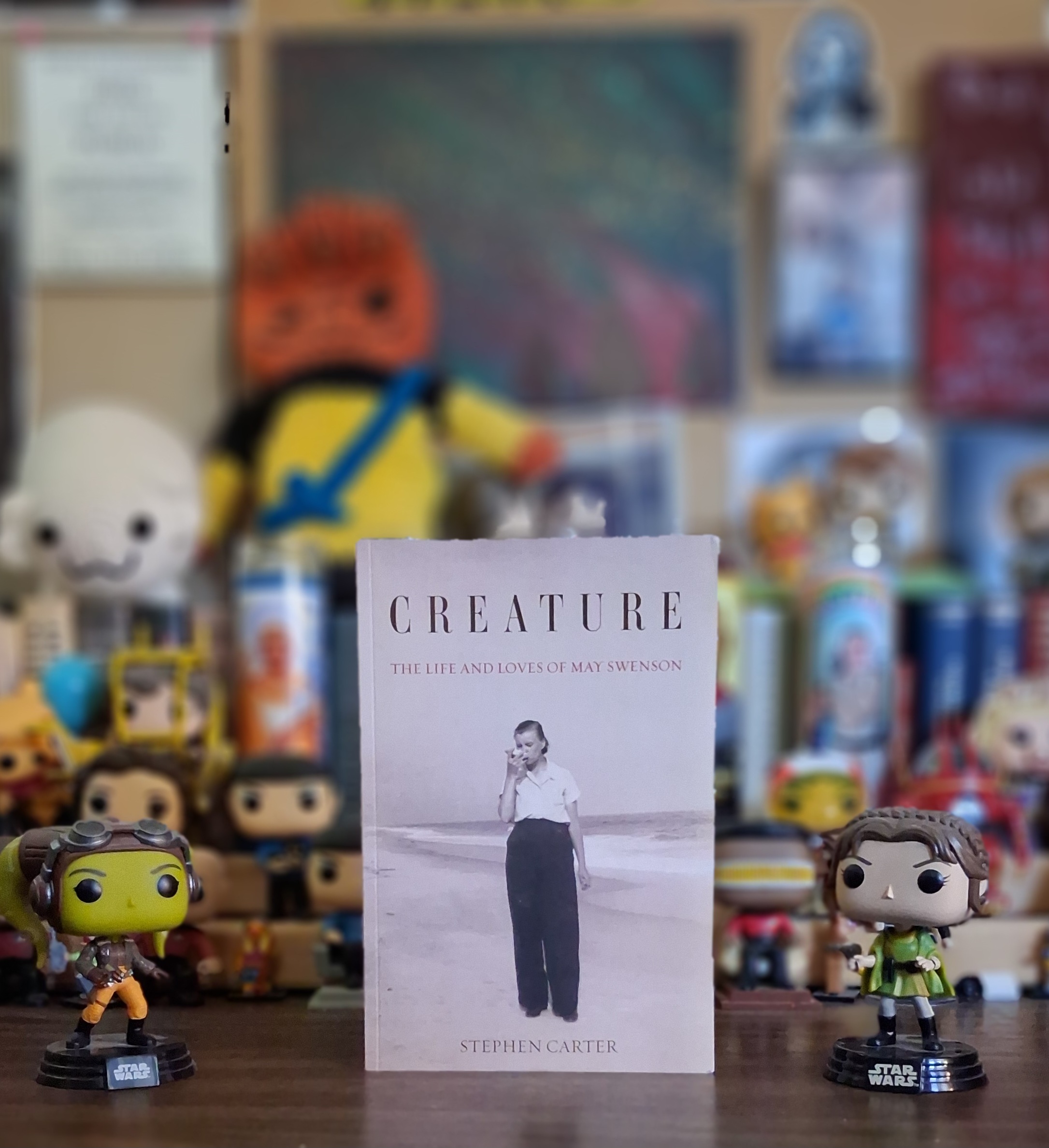
Title: Creature: The Life and Loves of May Swenson
Author: Stephen Carter
Publisher: Signature Books
Genre: Biography
Year Published: 2026
Pages: 139
Binding: paper
ISBN: 978-1560855392
Price: 21.95
Reviewed by Conor Hilton for the Association for Mormon Letters
Stephen Carter’s Creature: The Life and Loves of May Swenson is a quick primer on the Mormon poet May Swenson and her work. The book has two parallel goals–to offer a biography of Swenson and to provide a critical (as in literary criticism, not negative) introduction to some of Swenson’s poetry. The two goals are accomplished largely sequentially, though the chapters more devoted to biography are certainly inflected with Carter’s literary-critic sensibility, and the chapters more devoted to literary criticism are peppered with biographical detail.
I knew of May Swenson, but only in the vaguest of terms. Carter’s book is easy to read and unintimidating, though I wanted the two parts of the project to be a bit more intertwined. Partially because of my own literary critic training and bent, I was much more interested in the second portion of the book than the first–it was in these later chapters that May really came to life for me, in the discussion and analysis of her poetry and approach to writing poetry. If you come to the book with a love of May’s poetry already, I imagine that the more biographical chapters that open the book will already be engaging because of your knowledge of how these details get worked out or inform her poetry.
In one moment of engagingly describing Swenson’s work, Carter writes that “A May Swenson poem is constructed to be endlessly beguiling. To circle you back to its beginning again and again so you can play with it once more” (103). Carter teases her about some of the Mormon-ness of May’s poetry, something that he returns to in the book’s final chapter, but I see even more in this quality–an eternal round of poetry, a very Mormon way of viewing and engaging with the world, at least as picked up and explored by other Mormon artists like Steve Peck. Even more importantly, this description is insightful and unlocks ways of understanding May as a poet that help me approach her work more openly and clear-eyed.
Throughout the book, Carter makes use of May’s diaries and letters and other written ephemera to write his portrait of the poet, also his great-aunt. These details help give voice and life to the factoids of Swenson’s life that are used throughout the book. As Carter describes her time teaching, he opens this way: “May Swenson did not believe that poetry could be taught. In fact, ‘I tend to think that the formalized study of how to write poetry…cannot be relied on to produce either poets or poetry,’ she said” (91). This kind of delightful, playful juxtaposition seems to have filled May’s life, at least as seen through Carter’s eyes. Carter details the way May taught, building on her belief that teaching poetry was impossible. But rather than not doing it, she strove to provide experiences to the students so that they could learn to write themselves.
The final chapter of the book explicitly tackles the question of whether May Swenson is a Mormon poet. Carter details the biographical details of her childhood in the church and subsequent departure from activity, alongside the critical debates that have often included May but only with qualification in the world of Mormon poets. Carter moves through these conversations deftly before settling on a position by looking to Mormonism’s origins. Carter says, “Perhaps May is a Mormon writer the same way Joseph Smith is a Christian writer. They both looked at the same questions their home cultures looked at but came up with different metaphors to give shape to those questions. And, like May’s Mormonism, Joseph’s Christianity is constantly under question–for good reason. The two seem to be fellow-searchers and fellow-beholders” (110). Carter’s reasoning is compelling and generous to both the critics he differs from and May’s own complicated relationship to Mormonism. It also, importantly, feels true to May’s poetry, at least as presented in the book itself.
Creature: The Life and Loves of May Swenson, by Stephen Carter, is an engaging, deft introduction to the life and writing of a fascinating Mormon poet. Those interested in Mormon poetry should certainly give it a read, as should those interested in intersections of queerness, creativity, and community. I hope others will join me in (re)reading May Swenson’s poetry in light of Carter’s ideas and thinking about May alongside the flourishing of poetry, Mormon and otherwise, we have in our own day!