 (We are pleased to reprint the first two posts from Robert Bennett’s Substack “Mormon Short Stories”: his introductory post and “Mormon Speculative Fiction”.)
Mormon Short Stories: Introduction
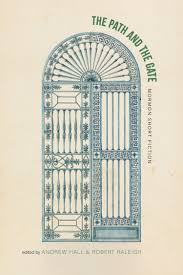
I am a Mormon short story writer and an English professor at Montana State University. Given the recent resurgence of great Mormon short stories, perhaps best exemplified by the high quality of writing in Andrew Hall and Robert Raleigh’s 2023 anthology, The Path and the Gate, I want to create a focused forum for discussing the specific genre of the Mormon short story. I intend to write short form analyses—longer than a blogpost but shorter than a journal article—with the expertise of a literature professor but addressed to an engaged but non-specialized general readership, analyzing what I (and others) consider to be some of the best short stories written within the broadly construed universe of literature written by and about Mormons. While my choice of stories will ultimately be inescapably subjective, I intend to explore stories broadly recognized by the Mormon literature community through venues such as the AML awards and recent publications in anthologies, collections, and journals such as Dialogue and Irreantum. My personal selections and analyses are not intended to be authoritative or definitive, but rather to create dialogue among all aficionados of the Mormon short story and inclusive of a wide range of stories. In the spirit of big tent Mormonism, I intend to explore both stories for saints with temple recommends and fiction for Mormons who drink coffee.
 Mormon Speculative Short Fiction
The Path and the Gate: Todd Robert Peterson, Danny Nelson, and Ryan Shoemaker
First, I want to focus on the three stories that interest me the most personally: Todd Robert Petersen’s “The Investigator,” Danny Nelson’s “Narrow is the Gate,” and Ryan Shoemaker’s “Barry Dudson: The God Journals.” It is not even necessarily that I find these the three best stories in the collection, though they are certainly among them, but rather that they share a thematic or generic similarity that I believe deserves more serious consideration. Unlike most of the stories in the anthology, or in Mormon short stories in general, they stand out because they are explicitly non-realist. In fact, they could loosely be described as speculative fiction in that they deliberately venture beyond the confines of everyday reality in ways that do not even attempt to present a remotely realistic narrative. They could even be described as genre fiction, representing horror, science fiction, and fantasy respectively, and we could simply end our analysis there.
And yet, I want to argue that all three of these stories are a kind of speculative fiction that is not strictly speaking, or at least not merely, genre fiction. Petersen’s story is clearly a post-apocalyptic zombie story, but it does little to really develop the horror aspect of the zombie figure or depict gory showdowns between humans and zombies. The post-apocalypse is certainly its setting, but not exactly its raison d’ȇtre. Similarly, Nelson’s story is inescapably an alien invasion story, but its primary focus is not to depict a detailed picture of aliens or their spacecraft or weapons or other advanced technology, let alone some kind of all-out military conflict between species. Finally, Shoemaker’s story explores the creation of another world, but its primary focus seems to be on the mind creating that world, and the choices it must make to do so, rather than on simply depicting an alternative reality. It may ultimately explore aspects of fantastical world-making, but it is in no sense merely an example of the fantasy genre as traditionally understood. In short, all three stories are in some sense genre fiction, but none of them are specifically, or at least solely, focused on world-building their respective genres. They use those genres, and do so effectively, but for other ends, or at least not as ends unto themselves. In this sense they are more properly understood as speculative (beyond realism) but not solely genre-based or at least not genre-bound.
More specifically, especially from the perspective of Mormon fiction, each story complicates its speculative or genre fiction from a decisively Mormon angle. For Petersen, the central conceit of his story, and what makes it so original and delightful, is that it focuses not on zombies, or even on a post-apocalyptic world per se, but rather on the discovery of a “Stake Map” and the value it might have in locating supplies of food stockpiled by Mormons in such a post-apocalyptic world. Similarly, Nelson’s story is not simply about aliens, but more specifically about aliens who are determined to converse with the Mormon prophet about certain aspects of Mormon theology. The primary focus of the story is on that transplanetary theological conversation not on the aliens themselves. Finally, Shoemaker’s new world is not simply a generic fantasy world, but rather a world created specifically by a recently exalted human, now a God, who has completed Celestial Kingdom University and begun creating his own world. In short, each mode of genre fiction is used specifically to explore a fundamentally Mormon theme: food storage, prophesy/theology, and deification. In each case, the Mormon element is foregrounded as central and primary to the logic of the story, while the speculative genre is perhaps more incidental or mere background setting, or at the very least creatively reimagined through an engagement with Mormon tropes or issues. This, I believe, represents the best, or at least to me the most interesting, kind of Mormon speculative fiction because it allows Mormonism to fundamentally alter narrative and generic conventions while simultaneously using the genre of speculative fiction to really explore and reconceptualize Mormonism itself from a highly unconventional and unpredictable perspective. These three stories, perhaps more so than any others in the anthology, simultaneously reconceptualize both literature and Mormonism.
Let me now propose a more granular analysis of each story individually. Peterson’s story (also published in Dialogue 57.1) is perhaps the story that most fully explores its genre as a horror, or at least a post-apocalyptic, story. Substantial effort is devoted to world-building the specific details of its post-apocalyptic setting, but in many ways this is something of a red herring or even a bait and switch because Peterson draws the reader into the prototypical elements of this genre only to surprise them with a crucial plot twist that seems completely out of place in a zombie story: the discovery of a “Stake Map.” What makes this twist so delightful is that this map is simultaneously so foreign to a zombie story and yet so unpredictably relevant. What could be more useful in a zombie apocalypse than a map to all the houses that have stockpiled a year’s supply of food and possibly other useful items? And yet who has ever thought of the usefulness of such an artifact in a post-apocalyptic story? Maybe a stake map is so useful that it should even become a stock staple of zombie narratives. And from a Mormon perspective this story asks if we really know why we are stockpiling a year’s supply of food and other necessities anyway? Is it possibly for a zombie apocalypse or some other radically unpredictable event other than what we expect it to be? It is this confluence of the speculative and the Mormon that makes this such an interesting story. Without the map, it is just another run-of-the-mill zombie story. Without the zombies, it might be a realistic story about the need for food storage in case of unemployment or maybe even nuclear war, but a story that envisions food storage in the predictable manner for which we think we are stockpiling it. When you combine the zombies with the food storage, however, you get a fascinating speculation on both what might really come in handy in a zombie apocalypse (maybe a stake map more than guns or maybe a stake map is the best way to find guns in some locales) and for what purposes food storage itself might come in handy (if not a zombie apocalypse then maybe an unforeseen pandemic like COVID-19 rather than nuclear war). Are Mormons really stockpiling the right stuff for the right disaster (say N-95 masks and toilet paper rather than 25-pound cans of wheat)? In both cases the story makes us think more seriously and more creatively about both zombie narratives and Mormonism from unpredictable, original, and creative perspectives.
In contrast, Nelson’s story perhaps develops its genre narrative the least. The story obviously engages the inescapably science fiction genre of an alien invasion, but it spends little time exploring exactly who aliens are and what they do, except for apparently travel across the galaxy not to invade another planet but to converse with the Mormon prophet. Consequently, the Mormon angle quickly takes center stage to the exclusion of anything specifically or dramatically alien. But once again, the Mormon element is a bait and switch, since the last thing we expect aliens to do is to seek a theological détente with the Mormon prophet. With this surprise twist, this isn’t really an alien story after all. Instead, Nelson turns the science fiction genre story into a fun and clever meditation on two core deep doctrines in Mormonism. First, every Mormon knows that modern revelation reveals that God has created other planets, but absolutely nothing has ever been remotely revealed about those planets—except maybe that Kolob is the planet closest to the throne of God. (Joseph Smith’s alleged prediction of Quaker-like inhabitants on the moon didn’t age too well.) Nelson’s story, however, speculates on what inhabitants of those other planets might be doing, and whether we might ever have contact with each other, which in turn brings us to the story’s second deep dive into Mormon doctrine: what is the relationship between the theological histories of diverse planets? Mormons love to speculate on whether Jesus’s atonement applies just to our own planet or in a transplanetary cosmic sense, and they have genuine opinions about whether our planet is the only planet evil enough to kill its Savior. Ultimately, Nelson’s story raises the question about whether other theological principles from our planet might apply to other planets—and vice versa. Once again, however, it is the speculative genre of science fiction which enables this unconventional exploration of Mormon theology, albeit on sort of the deep-dive theological fringes. And it is the core Mormon elements that make this alien invasion story so unlike any other. While several Mormon science fiction writers have explored the Mormon doctrine of other planets, Nelson’s delightful final twist on what specific theological questions the aliens want to address with the prophet is not revealed until the end of the story, so I will leave it to the reader to discover.
Finally, Shoemaker’s story develops perhaps the most profound and far-reaching speculative engagement with Mormonism. After all, food storage is a practical but not exactly theological principle of Mormonism. Meanwhile, the existence of other planets and our relationship to them are interesting but perhaps fringe theological doctrines. Shoemaker’s story, however, directly speculates on what is really an almost completely unexamined but core element of Mormon theology. Mormons certainly believe in an afterlife, but they have a very thin description of what it might actually be like. After decades of church instruction, all I have basically learned is that we will live with our families, do missionary work, bear and raise children, and create planets. The first three activities, however, are essentially simple extensions of some of the most basic tasks that Mormons already do every day here on earth. It is only the last one that involves anything not only new but unfathomably different from any earthly activity imaginable. And yet, there is absolutely no revelation whatsoever about what this might actually entail beyond maybe the first two chapters of Genesis, which aren’t much help at all as far as specifics. This is supposedly the grand purpose of our entire destiny (as gods no less), and yet nobody has really ever even imagined, let alone revealed, what this really means. I’m not going to pretend that Shoemaker’s story does anything like reveal the true nature of what it means to create and populate planets, nor does it pretend to, but it at least begins to ask the question of what creating planets might be like and explore its possible answers. While its creative and imaginative narrative isn’t at all intended to be realistic, even in a heavenly sense, it does seriously engage a wide range of questions, predicaments, and practical realities that a would-be creator might face. It provides perhaps a first sketch rough draft of what it actually might mean to create planets, as an omnipotent being, while simultaneously offering a cautionary tale that it may not be quite as simple as we often portray it. As such, this story does something that only fiction can do—at least at present: truly speculate on some of our most profound Mormon doctrines. That it does so with a profound sense of humor and playfulness only adds to its charm. The Maxwell Institute can publish all the speculative theological interpretations of scripture that it wants, but none of these works can even begin to consider what gods really do in creating planets because there are no scriptures that even address such subjects to interpret. The only real avenue for such theology is fiction and speculative fiction at that, since it is clearly—by definition—beyond the confines of both everyday reality and current revelation. Could fiction writers more seriously and collectively explore what our most profound theological concept of deification really means, even if only in a speculative and fictional sense? As Shelley might have asked, are poets the theologians of the cosmos?
So glad you liked these stories, and thanks for your kind words about the collection in general! Andrew and I had a really enjoyable time vetting stories for the collection. There’s so much good Mormon-themed short fiction out there, but nearly enough venues for it, so I’m glad to see interest like yours.