Review
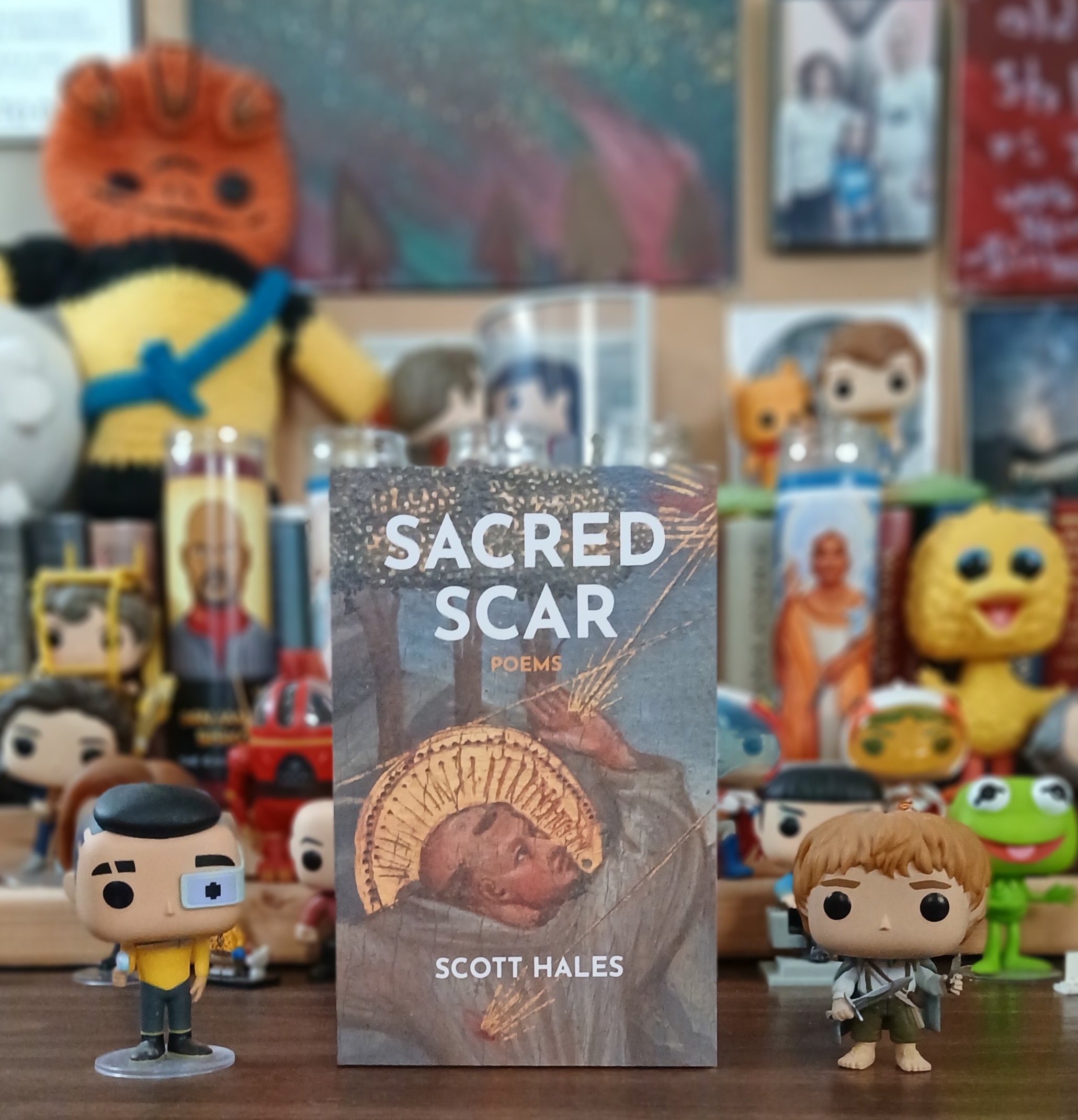
Title: Sacred Scar: Poems
Author: Scott Hales
Publisher: Greg Kofford Books
Genre: Poetry
Year Published: 2026
Number of Pages: 78 pages
Binding: Paper
ISBN: 978-1-58958-836-3
Price: $9.99
Reviewed by Conor Hilton for the Association of Mormon Letters
Scott Hales’ Sacred Scar: Poems derives its strength from the ecumenical and deeply personal nature of the poems. They are always grounded in some emotional truth/kernel that matters to Scott, in a way that you can feel as you are reading, even if the allusions and references that Scott invokes are beyond your grasp. The poems pull from a large variety of sources—Christian history, family history, Scott’s life, and more—and use each of these sources to demonstrate the idiosyncratic influences at work on Scott’s spiritual life.
The collection is divided into five named sections, with a poem preceding the first section. That first poem, “Compilation”, is a powerful, striking opener. The poem and collection opens with: “When faith snaps at my neck/like a mousetrap, I refuse to learn/my lesson. I take the risk/and return for the cheese.” Wow. This blend of striking, evocative images, paired with surprising emotional turns, and Scott’s deep sympathy for unexpected figures and creatures, is indicative of the collection. I love the way Scott describes this physically painful relationship to faith, yet insists that suffering exists alongside the choice and desire for what faith promises. I will be thinking about that particular phrasing for some time.
In a few poems, Scott plays with theological and historical speculation, rooted in scripture, history, and human emotion. Perhaps my favorite of these poems is “Third Witness”, which imagines Martin Harris in the afterlife and some of the events that might have followed. The final stanza opens with two questions from the speaker, “Brother Martin, wicked man, who came for you?/Or are you still waiting at the roadside?” The use of “wicked man” is a scriptural reference, played with earlier in the poem, so that here it carries a longing, but also a somewhat playful tone. The stanza concludes with the speaker insisting that if Brother Martin is still waiting, he will come for him. I love the way that Scott works to reimagine the place of Martin Harris in the Mormon imagination here (and also does some interesting work playing with Mormon heaven possibilities).
The poem that surprised, delighted, and moved me the most, perhaps in the entire collection, is “The Mouse I Killed.” The poem has a somewhat surprising narrative shape, but one that works incredibly effectively for the emotions that Scott seeks to share with the reader. A turn partway through occurs after the speaker imagines a different outcome had he encountered the mouse elsewhere, saying, “But fate dealt us a different hand.” This is where the tragedy and violence of the poem’s title begin to come through, followed a couple of lines later by, “I wanted you dead”. There are chills here at this point, but again, somewhat playful chills, as the gravity and intensity of the poem’s language exceeds what we might expect from trying to kill a mouse. There is also a sense of recognition that I felt, where in other circumstances, perhaps I would respond gently and kindly, but in some particular scenario, who knows what violence might unfold? The poem continues until its final two lines that function as another twist of sympathy, with the speaker collapsing the distance between him and the mouse (which perhaps should not be surprising given where the collection opens!): “And isn’t that what we all want in the end—/a warm, quaint place?” Beautiful work here. Love the honesty of the poem and the gentle self-indictment of the poem’s resolution, calling the violence and anger that we may feel towards others into question.
Sacred Scar: Poems offers a glimpse of how Scott Hales pursues spiritual truth through his poetry, and the result is lovely. May we all enjoy the emotional depth and playfulness coexisting in the spiritual life on display in Scott’s work.