 From Robert Bennett’s Mormon Short Stories series on Substack.
“Away with stereotyped Mormons” is a sentiment shared by many, including most notably the Mormon prophet Brigham Young. Arguably, nothing today demonstrates this fascination with the non-stereotypical Mormon more dramatically than the wild popularity of Hulu’s reality television series The Secret Lives of Mormon Wives. Certainly, the show’s many viewers, both inside and outside the faith, are drawn to it by the open contradiction between its superficially innocent, even naïve, Mormon housewives primarily from Utah and their lurid swinging, soft or otherwise, not-so secret anymore sex lives. Whether it is something as small as a diet Coke drinking apostle or something as dramatic as Sonia Johnson’s public opposition to the church’s position on the Equal Rights Amendment or Charlie Bird (Cosmo) and Ryan Clifford’s recent gay marriage, Mormonism has produced more than its fair share of unconventional moments and characters, and it, like perhaps many other cultures, is arguably most interesting, perhaps even most relevant, when its contradictions and paradoxes are on full display.
This may be above all true for Mormon literature as demonstrated by what is indisputably a, if not the, ur-text of contemporary Mormon fiction: Levi Peterson’s The Backslider. While the entire novel, like much of the best Mormon fiction, explores both the inherent and the accidental tensions within Mormon life and culture, its iconic image of the cowboy Jesus provides one of Mormon literature’s most memorable images of these paradoxes and incongruities. Consequently, The Secret Lives of Mormon Wives is not exploring terra incognita as much as it might purport to be, but rather simply adding to a long tradition of unorthodox figures in Mormon and Mormon adjacent culture. Jack Harrell’s heavy metal hitchhiking Jesus, Tony Kushner’s Joe Pitt, and the delightfully eccentric characters in James Goldberg’s Tales of the Chelm First Ward are only the first, and themselves widely diverse, characters that pop into my mind. Art is always a medium for exploring ambiguity, and Mormon culture has provided it with a perhaps unexpected mother lode. The entire history of cultural representations of unconventional Mormons, from both inside and outside the faith, is a topic worthy of a dissertation or two.
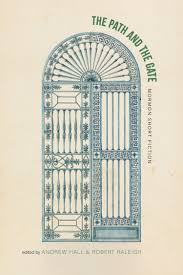
With that large backdrop in mind, my current discussion, at least initially, focuses more narrowly on two stories again from Hall and Raleigh’s seminal anthology The Path and the Gate: Joe Plicka’s “Natural Causes” and Annette Haws’s “Planting Iris.” As with all my analyses, I highly recommend that you read the stories themselves before you read my analysis, but with these two stories, in particular, I want to talk about them in very general terms because the specific details of their climactic moments really spoil the joy of the stories if revealed in advance. Like with much art, the pleasure of these texts lies in the intricate specificity of their central conflicts. In vague, general terms, however, Plicka’s story depicts a high-ranking Mormon breaking a common rule that a Mormon of his standing is supposed to be above, while Haws’s story depicts an unexpected agitator rebelling against standard Mormon protocols and authority. In both cases, the figure of the disobedient saint, whether through transgression or rebellion, strikes the reader’s fancy because of the character’s unexpected behavior and how it reverberates throughout the community. While such unstereotypical behavior is often seen as uncharacteristic of Mormonism, Plicka and Haws remind us that it is much more common and plays a much more significant role in the larger dynamics of Mormon life than we generally acknowledge. It is part and parcel of the Mormon experience which is what makes these unconventional Mormon characters and situations fit entirely within the conventions of Mormon literature.
But why are such contradictory characters, like Hulu’s wives, so appealing when presented in a specifically Mormon context? I would suggest that the first reason is because of Mormonism’s seemingly ironclad homogeneity. Like Malvina Reynolds’s little boxes made of ticky-tacky, little boxes all the same, modern Mormonism emerged out of the crucible of the 1950s culture of corporate men in their grey flannel suits, their dutiful stay at home wives, and their leave-it-to-Beaver children combined with a strong dose of nostalgia for the conservative Reagan 80s, all the while trying as hard as possible to keep its nose clean of the radical 60s or Generation X’s grunge ethos, let alone today’s post-Obergefell LGBTQ identity politics. Arguably, today’s ur-text of this homogeneity is the opening Hello set piece from the Book of Mormon musical. With its dozen identical youthful white male missionaries, dressed in identical white shirts, black ties, and black nametags, holding identical copies of the Book of Mormon, and repeating the identical refrain hello—not to mention the not-so-subtle subtext that these missionaries are essentially salesmen for the Mormon religion—this scene represents Mormon culture at its apex homogeneity. The figure of the unconventional Mormon only works artistically or culturally because it is situated, either explicitly or implicitly, against this homogeneous background like the secret Mormon wives repeatedly depicted against the backdrop of Mormonism’s iconic temples. The juxtaposition depends on the always already accessible image of widespread bland conformity, and both Plicka’s and Haws’s stories follow this same pattern by developing a series of scenes and characters drawn from a relatively calm, comfortable Mormon world before their protagonists suddenly break the mold. The narrative technique is ultimately a kind of bait and switch, or simply put a plot twist, but it depends upon having a strong bait or plot from which to switch or twist. Mormonism, perhaps a shade shy of ultraorthodox Judaism, provides that uniform cultural background in spades.
But the figure of the unconventional Mormon likewise depends on the very real cultural diversity of big tent Mormonism. The bait and switch wouldn’t work, or at least wouldn’t feel compelling or even artistic, if we didn’t all already know our fair share of secret Mormon wives, sinful saints (in ways both big and small), and outspoken Mormon rebels challenging the church’s protocols from within. It seems as if every ward has its fair share of token Sunstone or Dialogue or Exponent II liberals, clandestine marital affairs or at least coffee drinkers, PIMO lurkers on the margins attending just to make a spouse or parents happy, multiply-pierced and tattooed teenagers (if not adults), LGBTQ saints, and simply lovable Chelm-level eccentric fools of every stripe. The unconventional Mormon appeals because he or she or they are very real, perhaps even ubiquitous, or at least far more prevalent than the stereotype suggests. So, when an artist depicts the unconventional Mormon, he or she or they give voice to the cacophony of voices of real lived Mormon experience. You may love them or hate them, but no one can deny that these misfit Mormons readily exist within Mormonism both openly and secretly. They may not outnumber the more mainstay orthodox members who line the pews, but they at least occasionally anchor the ward basketball team or even become stealth Gospel Doctrine teachers. I’ve personally even known at least one bishop in Birkenstocks.
The real heresy of Secret Lives is that its Mormon Wives are perhaps just as stereotypical as their orthodox counterparts, standing as comfortably outside the faith as their Molly Mormon sisters stand within it. Arguably, the real unconventional Mormons—equally unconventional and Mormon—are more liminal figures, straddling uncomfortably between the lines rather than simply drawing them in black-and-white chiaroscuro and choosing between them. Once again, this liminality is brilliantly depicted in the Book of Mormon musical because its two protagonists, Elder Price and Elder Cunningham, simultaneously couldn’t be more similar (both identical Hello singing missionaries holding identical copies of the faith’s signature scripture) at the same time that they couldn’t be more different in personality and approach to proselytizing, let alone their divergent understandings of the restored gospel’s relationship to Star Wars. Obviously, given the rigid confines of mission life, there are natural limits to their diversity, but what makes the show successful is neither its representation of black nametag homogeneity nor its representation of Lord of the Rings-inspired diversity taken in isolation, but rather the clever way in which it juxtaposes sameness and diversity within the same narrative. Those most attuned to Mormon culture, and especially its artists, have always been keenly aware of the presence of both polarities within the same culture and the productive—and at times destructive—tension created by placing them in close proximity to each other.
A simple case in point is your average fast and testimony meeting. What could be more homogeneous than every member’s monotonous monthly rote repetition of the faith’s central tenets: I know the church is true, I know that President So and So is a prophet, and I love my family. And yet, the testimonies that are actually remembered longest by individual members are the ones that go off script: I’m thankful that the church has saved me from a life of prostitution, I know that Bo Gritz is a true American patriot, I think I’ll sing my testimony for you today. This granular eccentric diversity within what is usually experienced as a tight-knit unity is both more interesting and more Mormon than any soft swinging scandal. Or to be more precise, what makes the swinging scandal so interesting is that it emerges straight out of a bunch of Mormon influencers’ MomTok culture. What attracts viewers to the show is neither the swinging nor the MomTok in isolation, but the close connection between these opposing forces.
To return to Plicka’s and Haws’s stories, again without giving too much away, both embody this granular tension between the orthodox and the heterodox. Obviously, the opposing poles in these stories are not as widely disparate as they are in Secret Lives, but the deftness with which each author weaves a narrative that crosses these boundaries is much more skillful and precise. And it is precisely this granular attention to detail that most distinguishes reality television from literary fiction. The broad contrast between Utah Mormonism and soft swinging is perhaps interesting as a conceptual paradox, but the granular details of how these two narratives are juxtaposed in the television series are generally sloppy and haphazard, though admittedly occasionally entertaining for all their garishness. In short, the story is perhaps interesting at some level, but it is told without much artistry or even imagination really. Plicka’s and Haws’s stories, however, repeatedly and carefully work and rework this tension between orthodoxy and heterodoxy with a soft touch throughout their stories, teeter-tottering precariously between events and characters that move back and forth seamlessly from one side to the other. Their ultimate acts of transgression and rebellion are dramatically less dramatic than soft swinging, and yet they somehow depict both the homogeneity of Mormon culture (its strict prohibitions against sins so much more minor than swinging, the shocking audaciousness of even the most seemingly tepid opposition to church authority) and also the diversity within that culture (that even the most seemingly faithful saints ultimately transgress or rebel at least on occasion).
Plicka’s and Haws’s stories are not the only explorations of the unconventional Mormon in the anthology, but they are some of the most clever and well-crafted. Obviously, the short story works on a smaller scale than the novel, but both stories depict characters with the ring of truth of Peterson’s Cowboy Jesus more than the chaotic clamor of Secret Lives—even though both protagonists live secret Mormon lives in their own unique ways, and perhaps even remind us that in the end every life, even a Mormon one, is in some sense secret. Ultimately, however, both stories remind us that representations of the unconventional Mormon may be one of the most tried and true conventions of Mormon and Mormon adjacent literature. After all, who wants to write little stories made of ticky-tacky?

(Please also see this video of a conversation between Joe Plicka, Annette Haws, and Ryan Shoemaker about their stories in The Path and the Gate).