 Originally published on Robert Bennett’s Substack, “Mormon Short Stories”
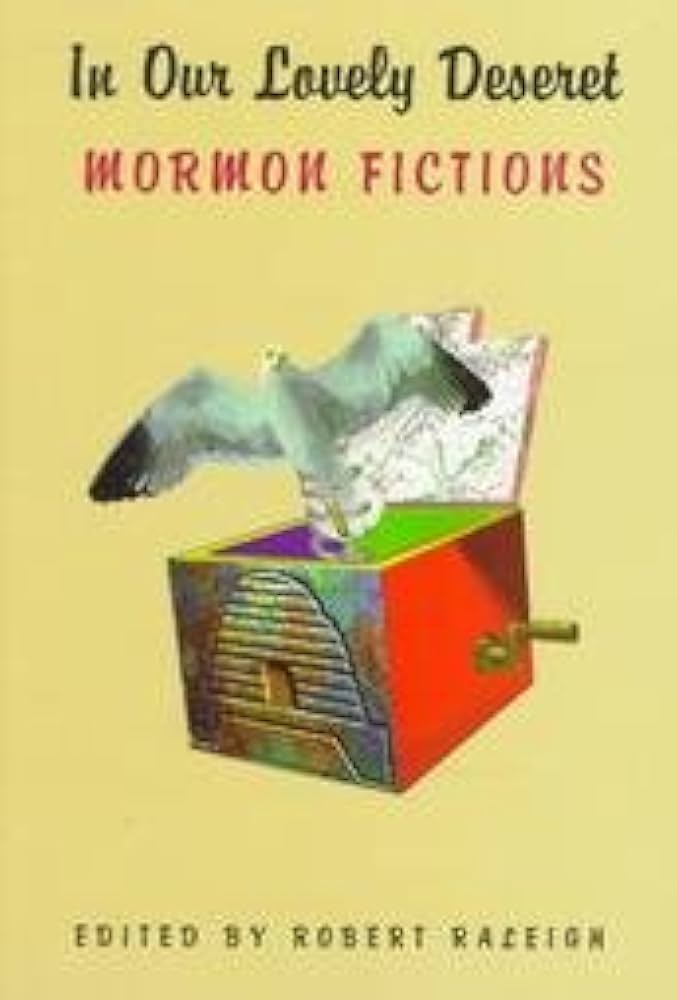
If Eugene England’s anthology, Bright Angels and Familiars, is pretty much a gimp horse limping out of the gate, Robert Perry Raleigh’s anthology, In Our Lovely Deseret, is the Kool-Aid man busting through walls. I’m not going to argue that it should be everyone’s cup of tea. Not that any of you good Mormons should even be drinking tea, but mostly because this anthology is more like a shot of whiskey. Straight, no chaser. It probably goes without saying, therefore, that not every Mormon reader is going to like it. Many, in fact, may not even be willing to drink it. But I raise a glass to the stalwart and the hardy who will. To my intrepid fellow travelers. Cheers!
This immediately raises the question, however: Is there a Word of Wisdom for Mormon fiction? Are there literary anathemas that simply lie beyond the pale not only of orthodoxy, but even of tribal membership? Are there apostate narrative heresies and blasphemies which must be disciplined or even punished? Is there a special place in hell (I mean outer darkness) reserved for writers who deny the Holy Ghost? Maybe I’m being melodramatic, but I’m also trying to raise a serious point: Just how faithful does literature need to be in order to be classified as Mormon? Can its characters drink coffee? Can they drink beer? Can they smoke weed? Can they “let themselves be fucked in the ass by saintly motorcyclists and scream with joy” a la Allen Ginsberg? When does the edgy, the provocative, the I’m having a bit of a faith crisis, the non-temple worthy, the I might be gay, or even simply just the “it’s complicated” cross over the line into an excommunicable offense, let alone an unforgivable transgression. When is a transgressive story no longer literature? Or Mormon? Or both?
There are, of course—to my knowledge—two canonical controversies in the history of the Mormon short story: Walter Kirn’s infamous reading of “Planetarium” in one of Eugene England’s literature classes and Brian Evenson’s fateful public reading of “Killing Cats” in the Maeser Building. AI tells me that there is “no verifiable public record” of Evenson reading “Killing Cats,” but I was there, or at least I remember being there unless my memory fails me. Chime in if you were there, too, and maybe we can collectively create a verifiable public record.
But controversial as these readings may have been, neither one actually rose to the level of outright scandal. Neither story was quite the Armory Show, let alone Duchamp’s Fountain, and the public outcry against them was clearly a hysterical overreaction—mere pearl clutching if not a latter-day Salem witch trial. No serious professor of literature, or even simply any well-read person, could have reasonably objected to either story. Either as literature. Or as Mormon. England may profess that he didn’t preapprove Kirn’s reading, but he didn’t stop it either. And even as a naïve returned missionary who hadn’t even read The Catcher in the Rye yet, I couldn’t comprehend why anyone would claim that Evenson’s story crossed some kind of imaginary line of moral rectitude. Even if you didn’t get its admittedly complex more profound meditations on the nature of violence, you would have to be willfully ignorant to think that Evenson was actually condoning, or even glamorizing, killing anything, let alone real kittens. But then again, not everyone really gets the point of literature: Some BYU students did literally start their own fight club after all.
But I’m not here today to re-adjudicate these two controversial, if not quite scandalous, stories whose canonical status has long since been vindicated by history. I am simply referring to what these stories are not in order to call attention to what In Our Lovely Deseret most certainly is: a true literary gauntlet, a Rubicon, an acid test. Legitimately a scandal. Or at the very least a clear, definitive line in the sand. You don’t have to get past the anthology’s first story, Robert Hodgson Van Wagoner’s “Staying Away from Blake,” to encounter what Ian Dunlop’s study of modernist art describes as the “shock of the new.” I still have never read a Mormon story that was more shockingly new, and it is almost three decades old by now. Ahead of its time. Avantgarde. Pushing the envelope. All understatements. If Raleigh wanted to immediately set a provocative tone for his anthology, his first note was pitch perfect. This story’s plot twist, in fact, is so shocking that to even mention it obliquely would spoil the experience of encountering it firsthand, so I will leave it alone for you to read for yourself—aside from admitting that if someone wanted to declare it not only controversial, but even scandalous, I’m not going to try to stop them. However, if you want to take things a step further and declare it either not literature or not Mormon—or even categorically on the surface simply bad or unethical literature—I would have to stop you right there and point out that such charges are legitimately open to debate. Not that I would shut you down before letting you make your case, but I’d certainly want to add my own personal rebuttal.
In fact, one of the reasons why I wanted to analyze this anthology was precisely because I had heard that it provoked an open debate between dueling reviews: Eugene England’s “Danger on the Right! Danger on the Left! The Ethics of Recent Mormon Fiction” in Dialogue 32.3 (Fall 1999) and Todd Peterson’s “In Our Lovely Deseret” in Sunstone (Dec. 1998). I will assume that even a cursory acquaintance with these reviews’ respective authors and venues of publication will immediately disclose who took the pro side and who took the con, but let me clarify the general parameters upfront. While Peterson praises the anthology as “vital for the development of a true and serious Mormon literature . . . because it lays the artistic and aesthetic groundwork for that first great Mormon novel when its day finally does arrive,” England pans it for its “in-your-face impiety.” When England adds only moments later that its stories are “aggressively, didactically, unmannerly, in-your-face, and yet sentimentally manipulative,” he just seems to be piling on. But his churlishness aside, he does set the stage for a real fight: the reigning heavyweight champion of Mormon literature in one corner, our upstart challenger (Nacho Libre) in the other.
But let’s call a spade a spade here. England is certainly doing a little pearl clutching and a lot of gate-keeping all with a whiff of hypocrisy. “Danger” is arguably too strong a word to describe any work of literature, mere words on a page. And England obviously has a vested interest in maintaining the preeminence of his own earlier anthology—with both its central texts and its literary sensibilities, including its devotional overtones—as the gold standard of contemporary Mormon short fiction. Methinks the professor doth protest too much at least in part because he—rightly so—feels that Raleigh’s anthology threatens his own authority. As it arguably should.
And I’ll throw in the charge of hypocrisy to boot because England and his anthology clearly fancied themselves as the latest word in contemporary Mormon letters. The au currant arbiter of the new. The progressive tastemaker of sophistication. It is more than a little ironic, therefore, that England hides behind the imprimatur of The New Yorker to elevate Virginia Sorenson’s 1953 story (about water rights disputes) in his own anthology only to trash on Walter Kirn’s 1997 New Yorker story, which is included in Raleigh’s anthology, because somehow now The New Yorker “ought to be ashamed” of itself for simply “bash[ing]” on Mormonism.
While perhaps no one other than Richard Cracroft was attacking England from the right, Raleigh’s anthology clearly left his left flank glaringly exposed. Perhaps England’s anthology genuinely tried to open up the gate for a broader range of new and more contemporary voices, but he also wanted it to have the last word and slam the gate behind him to lock out any rival parvenus. He had no intention of opening up a Pandora’s box which might unleash anarchy into the world of Mormon letters. And make no mistake about it. England made frequent, if perhaps at best only partially successful, efforts to police both the boundaries of literature and the boundaries of Mormonism. So, while Peterson’s grandiose claims may ultimately prove overly effusive—Raleigh’s anthology is probably closer to one small step for man than a giant leap for mankind—I’d certainly take England’s bitching and moaning with a grain of salt.
I don’t have the time or space—let alone the patience—to recount England’s arguments in full, other than to largely dismiss them as generally obvious self-justifications for his own largely conservative personal preferences rather than any kind of well thought out principled critical perspective. Simplifying to the extreme, however, aside from petty griping about stories not getting the intricacies of fly-fishing right, England’s arguments largely boil down to a fundamental complaint about the “in-your-face impiety” of Raleigh’s anthology. Guilty as charged. The anthology is both undeniably in-your-face and impious. Deliberately and self admittedly so, but does that alone make it bad, or what England’s diss track calls unethical, literature?
There are no stories about wandering immortal Amerindian Jews, bishops, pioneers, or missionaries. Or at least not straight ones. There is the same number of blow jobs as baptisms for the dead, and the lone baptism is a bit tongue and cheek—for and in behalf of Marilyn Monroe. The anthology is packed chock full of a motley crew of infidels: couples married outside the temple, illegitimate children, homosexual missionaries, beer drinking missionaries, divorcees, hormonal BYU coeds, a prostitute, a snarky teenager who claims to know more about church history—including its distortions and misinformation—than his youth leaders, and even a group of ward members who throw mysterious after parties that could quite possibly land them a major reality TV deal on Hulu. One guy even digs up the corpse of Ezra Taft Benson. I won’t tell you what he tries to do with it, but you can read Brian Evenson’s “The Prophets” to find out. And they thought “Killing Cats” had a macabre sense of humor.
It is not at all hard to imagine why the anthology gave England fits, but is that an it problem or a him problem? Maybe the anthology does depict bad Mormons, at least in Heather Gay’s clever reappropriation of the term, but is it really bad literature, or is it just not the particular flavor of devotional literature that England prefers? And aren’t bad Mormons, jack Mormons, and even apostate Mormons still Mormons? Is it too much to ask that America’s homegrown religion be large enough to contain Whitmanian multitudes? We are a vast and wild tribe with a complex past, a rapidly fraying present, and an uncertain future—not a cloistered monastery—after all.
I would argue that England simply, and simplistically, equates impiety with bad (or what he calls unethical) literature or at least bad Mormon literature. To be fair, England attacks both those on the left and on the right, but his reasoning essentially advocates that every story must be some variation on Goldilocks and the Three Bears. Or to be more charitable, some idealization of the Golden Mean. Anything left—or right—of center is summarily dismissed. Anything too hot or too cold is declared unpalatable. Anything that paints Mormonism in anything less than a flattering light—such as a surly teenager perhaps poking fun at the idea that Mormons believe that the Garden of Eden is in Missouri—is decried as “vicious fun, through extreme caricature.”
Get a grip. And grow a pair. What England wants is a sermon not a short story. And a general conference address at that. Everyone is entitled to their own preferences, but England’s attempt to disparage impious literature simply for impiety’s sake—which at the end of the day is what I believe he’s doing—smacks me as mere ecclesiastical discipline rather than sound literary analysis. Nobody says that he has to like it personally, but his efforts to render his subjective opinions of impiety objectively valid as ethics entirely fall flat. At least for me.
So, leaving aside the specifics of England’s whining, let me return to his real issue. As a literature professor, I suspect that if you pinned England down, even he would admit that some literature can be impious. What really gets stuck in his craw is the idea that Mormon literature itself can be both impious and still Mormon. Like I suggested before, it is as if England believes that there is some kind of Word of Wisdom for literature which prohibits any kind of “negative stereotyping”—except perhaps as “irony” or to “reveal an unreliable narrator.” Because, of course, a truly reliable narrator would never see, let alone say, anything negative about the church, except maybe ironically. I say ironically, or perhaps to be more precise sarcastically, although I’m not sure that England really even understands, let alone fully appreciates, irony—not to mention sarcasm.
For example, he complains that Johnny Townsend’s “Almond Milk” depicts a “zone leader from hell, a one-dimensional Nazi Mormon” just because the zone leader orders the Elder to wash his hands before leaving the apartment. Obviously, Townsend was indeed suggesting that the zone leader was a little controlling and even condescending, but England is being a little too sensitive here. I wouldn’t exactly call this reasonable depiction of an overbearing missionary a Nazi. Sure, the details may have differed, and Townsend—like any good writer—takes some poetic license, but who didn’t have a zone leader from hell or two. I had a zone leader who literally spoke with a Bruce R. McConkie accent and another who insinuated that he had the gift of the visitation of angels. At least until my companion called him on his crap. I wish that they had only reminded me to wash my hands. Sure, mission leaders aren’t all like that, but that doesn’t mean that any negative portrayals of pretentious missionary leadership are extreme stereotyping, let alone that they offer nothing more than “didactic and ethically sterile conclusions.”
When Townsend’s gay elder, who legitimately seriously struggles to reconcile his homosexuality with his Mormonism throughout the story, finally expresses what England calls “direct and bitter denunciations” of church doctrines, England insists that this character has somehow lost all his “complexity,” turning into nothing more than an “ideological” reflection of the author’s personal beliefs. Why doesn’t he just come right out and say it: he projects the author’s gay lifestyle. Surely, England’s criticism here is some variation on the intentional fallacy, mistaking the biographical author for the literary character, not to mention arguably latently homophobic to boot. Does this mean that when the literal Three Nephites show up with johnny cakes in a story in England’s anthology that they are somehow complex and multi-dimensional? Why is it that anything direct, bitter, or denunciatory must somehow be inherently flawed? Or unethical?
Ultimately, I can draw no other conclusion than that England is simply incapable of allowing authors to truly legitimately criticize the church. Or if so, then only under carefully controlled and ultimately safe circumstances. What England is doing here is nothing less than trying to squash any Mormon literature that legitimately attempts to wrestle with the complexity of being a homosexual missionary—at least from the perspective of a gay missionary himself rather than from the perspective of the General Handbook of Instructions. I’m not going to call it a perfect story. After all, only Donald Barthelme’s “The School” is, but “Almond Milk” is certainly the best—the most complete, the most insightful, the most literary—story that I have yet read from the perspective of a gay missionary. And it’s thoughtful. And it’s funny. And it’s much more complex, even generous to the church, than England admits. It even has a little creative shock of the new, but you’ll have to read it to find out what that is exactly. Moreover, I would suggest that it was this story’s shock of the new rather than any kind of ethical lapse that really caused England to gag on this story.
And England’s specific complaints are entirely laughable. IMHO. One egregiously offending passage is that “the whole idea of the mission was to use other people, to baptize others to prove ourselves to God that we are worthy of the Celestial Kingdom.” I thought every missionary at least considered, if not lost sleep over, such thoughts at some point during their mission. Putting this concern into the mind of a missionary is hardly evil speaking of the Lord’s anointed. The other offending comment: “I remembered my Sunday School teacher telling our class of fourteen-year-olds that if for no other reason, we should stay in the church and be good so we could have eternal sex. It was a way of keeping us in line sexually, to threaten to take sex away from us.” I mean my Sunday School teacher may not have used those precise words, and certainly no general authority has ever put it quite so bluntly over the pulpit, but I have a hard time believing that I and Townsend’s character are the only people who ever got the vague impression that this was essentially Mormon doctrine more or less. Or at least an implied threat to keep our hands—and our genitals—in the right place.
If this is what England takes as in-your-face impiety—and I’m being serious here and not just trying to stomp on the man’s grave—what business does he have teaching literature? Let alone policing Mormonism. Let our bishops and stake presidents determine who is temple worthy, but when it comes to the Mormon experience at large, and especially Mormon literature in particular, let us make more of an effort to develop some kind of big tent Mormonism that includes the entire range of Mormon experiences. The good, the bad, and the ugly. The faithful and the faithless. The pious and the heretical. The polite and, shall we say, the snarky alike. Both ironic and unironic negativity. Let all be alike unto God. Or at least Walt Whitman and Emily Dickinson.
After all, church leaders can excommunicate anyone they want from the church, but only you can excommunicate yourself from the tribe. And the canon of Mormon literature should be at least as wide as the tribe itself. Or what’s a canon for? Even the Association for Mormon Letters defines Mormon literature as literature “by, for, and about” Mormons without trying to police whether those Mormons, either in real life or in literature, are worthy to hold temple recommends.
So, if you’re keeping score, score one point for Raleigh and Peterson. Simply put, it is possible to write good literature, even good Mormon literature, that is impious. Even aggressively impious. It may not be England’s preferred beverage of choice, but as far as I am concerned England’s review of Raleigh’s anthology is just throwing around a lot of hot air about ethics, ideology, and artistry, when he is really just stating a personal preference about his ultimate religious beliefs and desire for what I would call essentially a devotional literature. Nothing wrong with that, but let the real debate be between devotion and impiety instead of trying to hide behind misleading accusations about ethical blindness and sophisticated aesthetics.
Tamayto, Tamahto. Let England choose his own flavor of pie, but his flailing attempt to police the boundaries of Mormon literature really is childish. Ultimately, England’s anthology is far superior to his attempt to defend it—by denigrating Raleigh’s. Let the canon be wide enough to include both anthologies, and let each reader have their own take on their individual stories, but England’s criticism qua criticism is deeply flawed. Even embarrassing. Certainly passé. Definitely neither shocking nor new.
And if you want to fill in the rest of the box score, everyone needs to call their own balls and strikes. England and Peterson—or even myself—can only provide an entry point into what needs to be a much wider conversation. But if I’m behind the plate, the stories in Raleigh’s anthology—pound for pound—are certainly as well written, even as religiously thoughtful, albeit certainly not as orthodox, as anything in England’s. Personally, I found three exceptional stories that interest me enough that I would be willing to write about them in England’s anthology, while I found five in Raleigh’s. Both anthologies have a very solid Indian Placement story. The prostitute story in Raleigh’s anthology is more emotionally developed than the one in England’s. I’d say that not including a Three Nephite story, or at least a simply straightforward and non-ironic one, goes in Raleigh’s column, too. I do like Virginia Sorenson’s New Yorker story in England’s anthology, but I like Kirn’s New Yorker story in Raleigh’s much more. It is almost a half century more current after all. Peterson is probably correct that Raleigh’s anthology perhaps leans too far into sexuality as a dominant motif, but England’s is almost entirely sexless. You can call it a toss up if you want to, but it is hard to overstate the centrality of sexuality to Mormon theology and practice, England’s protestations to the contrary notwithstanding. England’s anthology does have several truly remarkable stories about Sunday School lessons and ward talent shows, but nothing that is going to land you a Hulu series. There is even an occasional modernist shock of the new in Raleigh’s, but none in England’s, aside from perhaps Chandler’s benediction if I’m being charitable.
With a gun to my head, I’d probably give the nod to Raleigh, but maybe neither fighter really throws a knockout punch either. I’d let the anthologies go the full twelve rounds at any rate, but I would never let England judge the fight. He simply is not impartial enough to see his own blind spots. I’m not going to pretend to have the final say about these anthologies either, and I certainly encourage everyone to weigh in in the comments. I’d much prefer to start a conversation here than to claim some kind of infallibility. But we all have to call them as we see them, England included. He’s said his piece; I just don’t buy it. I do believe, however, that he could have been a little more upfront that what he was doing was merely stating a preference rather than policing the ethical boundaries of literature. And if you want to point out my own blind spots have at it. I welcome all comers, and we all have them.
I do have a final exploratory comment about Raleigh’s anthology in particular and perhaps even about the future of impious Mormon short stories at large. For all that I defend Raleigh’s anthology as an important, even very important, branch of the tree of Mormon literary history, I believe that it still remains the road less traveled. If we compare England’s anthology, Angela Hallstrom’s Dispensation, and Andrew Hall and Raleigh’s The Path and the Gate together with Raleigh’s anthology, Raleigh’s is clearly the odd one out. The other three form a very coherent whole, with notable, perhaps even predictable, evolution over time, but largely following a common trajectory. Raleigh’s anthology, however, really explores something more like terra incognita for the Mormon short story. Possibly even what might be better called the ex-Mormon or post-Mormon story if you still, this late in the game, feel the need to police the boundaries of the tribe or insist on doctrinal purity or even piety. Raleigh’s anthology is certainly the redheaded stepchild, the black swan, and the outlier several standard deviations from the mean. Even nearly three decades later.
But I wonder why. Have critical and disaffected Mormons simply left the tribe and finally left behind the religion that they have long since left, losing interest in Mormonism altogether? Or have they simply stopped writing literature and taken up other hobbies? Podcasting comes to mind. There is certainly no shortage of podcasts—or reality tv shows and docuseries—that would make perfectly fine bedfellows with Raleigh’s anthology. Or are these writers simply lying dormant, biding their time until another impious anthology of the future is eventually published? Which it inevitably will be someday.
What makes this question particularly interesting to me is that by far the two most successful works of Mormon literature—Matt Stone and Trey Parker’s the Book of Mormon musical and Tony Kushner’s Angels in America—align much more comfortably with Raleigh’s impious anthology than with the other three more devout ones. So, why is it that non-Mormon writers have been so much more successful at writing Mormon-themed works than Mormon or even ex-Mormon writers have ever been, and how has their easy access to impiety itself influenced, or perhaps even enabled, their success? Is the world hungry for a more impious Mormon literature? Are Mormon or even ex-Mormon writers up for this task, or will it simply be left to those outside the faith altogether? Is Peterson ultimately correct that Raleigh’s anthology will one day prove to be the first stepping stone to the Great Mormon novel? Or at least to one hell of a great short story.
I’m not at all trying to suggest that Raleigh’s in-your-face impiety is the only path forward for Mormon short fiction. In fact, I am at least at some level suggesting that it has been something of a dead end—at least for Mormon anthologies if not quite for Mormon letters in toto. Certainly, it may not have (yet) led to Peterson’s prophesied Great Mormon novel. Moreover, both my religious and literary sensibilities may self-admittedly lean toward the new, at times even the shockingly new, but at the end of the day I am a firm believer that in my Father’s house are many mansions and that all paths eventually lead to Rome. Ultimately, I really have nothing damning to say about any of the other three more traditionally Mormon anthologies—aside from maybe that England’s anthology was perhaps not quite as new as he thought it was or at least not as new as it very easily could have been, even simply by substituting a single story. I just believe that Raleigh’s anthology—different as it may be as the odd one out—deserves its own spot on the Mount Rushmore of Mormon short story anthologies. If for no other reason than that a true Mount Rushmore needs a fourth face. Call it Washington, Jefferson, Lincoln, or Roosevelt. Just don’t call it Trump.
In conclusion, Kirn’s “Mormon Eden,” the last story included in Raleigh’s anthology, may not be the literary equivalent of the Second Coming of the Messiah, but to call it “the worst offender in the kind of surface inaccuracy and bald didacticism that undermines the possibility of ethical insight” says a lot more about England—and his thin skin, his lack of a sense of humor, his deep need to claim final authority, and his crippling conservative devotional bent—than it does about Kirn’s story. And if you compare this Kirn story directly with the Kirn story that England himself also included as the final story in his own anthology—on virtually any literary count imaginable—I would be hard pressed to call it anything less than a knockout punch. Only in the final round perhaps, but a knockout nonetheless.
The “prostitute story” in In Our Lovely Deseret is Thomas Burgess’ “Twinkie”, about a Mormon young man in Hong Kong infatuated with a prostitute. I agree, it is one of the better stories in the collection. Burgess has not published much other fiction, but he has a novel coming out through Signature later this year, that I am excited to read. It is called “Kingdoms of the Night Sky”. Blurb: “It is 2026, and millions of Americans are getting ready to form separate communities so they may live by the principles taught in The Book of Shem. Calling themselves “Fellows,” they revere Isaac Snow, the deceased author of The Book of Shem, as their prophet. To settle the question of whether he’s a prophet, a fraud, or something else, Snow’s son sets out to tell his father’s story. Inspired by the 1960s folk music revival, and his experiences with the beatniks, hippies, and Mormons, Isaac has crafted a unique message that millions of Americans find irresistible, but only after many years of feeling cursed and forsaken. In a story that blends tragedy, humor, and redemption and is set in New York City, San Francisco, and Provo, Utah, Kingdoms of the Night Sky is a rollicking journey of discovery that reminds us of the fractured nature of reality itself.” https://www.signaturebooks.com/books/p/kingdoms-of-the-night-sky
Also, here is a 2007 BYU MA thesis that largely takes the Eugene England position on these kinds of stories. Terrol Roark Williams. “Taking Mormons Seriously: Ethics of Representing Latter-day
Saints in American Fiction” https://scholarsarchive.byu.edu/cgi/viewcontent.cgi?article=2158&context=etd
Thanks for pointing this thesis out. It is an interesting read. But it raises an interesting question. Both England and Williams seem particularly troubled because writers “misrepresent” the facts of Mormonism. For example, Walter Kirn’s “Planetarium” describes a bishop who has the kids in the ward mark Xs in glow in the dark ink on posters for every time they masterbate and then shows the kids all of the Xs lit up in the dark. Hence the planetarium. Williams points out that bishops don’t actually do this. But I don’t think Kirn thinks they do. And I don’t think any of his readers do either. Kirn uses a poetic image to get at how bishops police kids sexuality. It is effective and gets at a real truth indirectly. What does Williams want Kirn to do depict a real bishop asking intensely personal questions about how many times and where you touched, etc. etc. etc. I’m not sure that a realistic account would make the church look any better. And I think that the constant complaining about misrepresentation fundamentally misunderstands how literature works.
Wow, this is the second attack on England in the past month or so. And in both cases the England portrayed seems unrecognizable.
This feels like trying to reduce everything to an ideological battle. May I suggest reading Felski’s “The Limits of Critque”?
I incline to concur with Kent Larsen here — BUT with some qualifications — on “attack,” “unrecognizable,” and “ideological battle.” And I thank him for recommending Felski’s book that I should have read long ago; I might have a copy in hand in a day or two.
“The Shock of the New” does feel more like an attack on Gene England than an “analysis” of (my former student) Robert Raleigh’s anthology. That’s unfortunate. For me, the England it sketches, or implies, is at best or at least partially recognizable. Gene was my colleague and friend (not, however, a confidant, I think I should say), and I think I understand his rather alarmist essay better than “Shock of the New” does. (More on that later, most likely in later comments here.) I don’t think Gene ever meant or expected to get the Last Word on much, if anything, though I suspect that like me, like maybe a lot of us, he often had to resist the all-too-human temptation to try for it (see the first sentence of my 1991 AML swansong). I do believe he was seriously committed to “dialogue,” and if he were still with us, I’d have a few bones to pick with him on his “Danger!” essay.
For one thing, he did set himself up for “ideological battle” by posing two anthologies as (however justifiably) “Right” and “Left” — as if indeed his essay were one more skirmish in the ugly and destructive Mormon/LDS/BYU subculture wars of the 1990s (which I suspect were at lest partly ignited by Elder Haight’s October 1992 general conference talk, which quoted Pat Buchanan’s then-recent 1992 Republican National Convention “culture war” speech; but that’s another tale for another time). Gene may have read the anthologies too much in light of his own recent wounds in those wars, and he wrote his essay less than three years before a brain tumor killed him. (I’ve recently wondered if, at the time, he was already suffering its effects; he mentioned to me — and wrote a poem about — the anhedonia that he couldn’t account for or elude.) In any case he did set up (not using the word) dueling anthologies (did Raleigh intend a sort of rejoinder to Dollahite and Card? I don’t know) — and thus set himself up for “dueling reviews” (had he read Todd Peterson’s? It’s possible, even likely, but I don’t know).
I’d hoped to have time to say more here, but some yard chores demand my time now. To be continued.
bwj