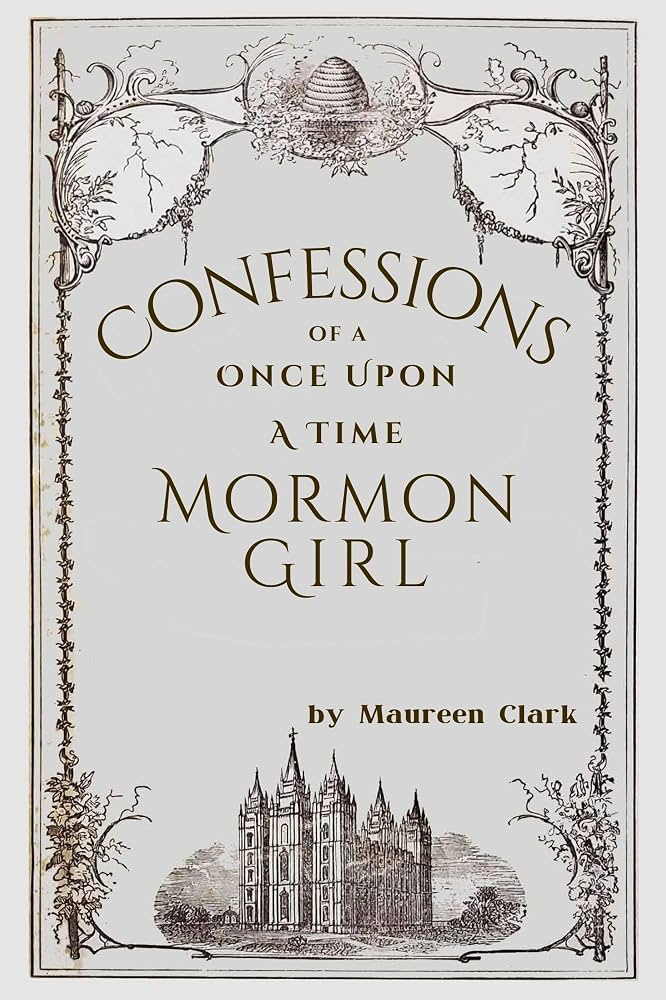
 Maureen Clark introduces her new book Confessions of a Once Upon a Time Mormon Girl from Hypatia Press, a memoir “that examines the difficulty of one woman’s journey out of Mormonism and into her own authentic voice”.
It’s 1975, and like every young Mormon couple, Jon and Maureen will start their life together with a temple wedding. But first, they must participate in the preparatory endowment ceremony which turns out to be full of shocking experiences . . . In spite of this difficult start they go through with their wedding the next day and begin their life together. Thirty years later Jon announces he is leaving the Mormon Church, and all that repressed trauma rises up as Maureen examines how those early covenants affected her. She is battling her own lack of faith in a church that is becoming more conservative every day. Still, the journey to her own decision to leave the Mormon Church is deeply convoluted, unraveling the places where Mormonism controls her and those places where it fills her spiritually. In the search to tell her own truth she finds that in the end the only thing that really matters is her own sanity.
When I first entered an LDS Temple for my temple wedding on August 5, 1975, I was an innocent, fresh-faced girl who believed in the teachings she had been given her whole life. When I left the temple four hours later, I was confused, heart-sick and terrified because of the covenants I had made inside the temple. At the center of it all were the death pantomimes we had performed during the ceremony to represent our complete commitment to the church. It’s easy to say now, 50 years later, that I should get over it, but I can’t. Not only do I remember the horror with which I made those actions, the terror when my future husband and I talked about them that night, there is the continuing damage those oaths do to me personally.
Today you can find the LDS temple covenants online on Wikipedia, but in 1975 the vows of the temple were truly secret. There was no one to talk to before I went, and no one to talk to after. The death pantomime I took was taken out of the ceremony in April 1990. The reasons given by the church were the need to place less emphasis on the literal meaning and more on their symbolic purpose in the endowment ceremony. They also acknowledged that their members were uncomfortable with the graphic nature of the ceremony and that non-Mormons were using those gestures to label the Mormons as a cult. Excellent reasons but not made early enough to make a difference in my life.
I grew up believing in the Mormon church with all my heart and working very hard to be a good Mormon. Now that I am looking at it from a distance, I can see how traumatizing those early covenants where on my marriage and on my own sense of self. I was worth more as a member when I was silenced and afraid of being killed than I was as a person. The trauma of acting out my own death has stayed present in my memory for 50 years now and nothing can remove how it felt.
When my husband announced he was leaving the church, I had to reexamine everything I thought I knew and believed about the church. This was a long, slow process that I did not take lightly.
You might be surprised to hear me say that leaving the church isn’t the only thing this book is about. I have tried to be honest about all the chapters of my life, from being a teenager, to young motherhood, to having an affair, to building a strong and supportive marriage with my husband. This journey to leave the faith was the hardest of my life and the most fulfilling. I’m not exaggerating when I say that the memoir took 20 years to write. When I began, I would scratch a few lines in sacrament meeting and then go home and destroy the pages. I was afraid someone would see my questions and judge me. When I got to the place where I could actually write about my husband leaving the LDS church and my own questioning, the difficulty was trying not to rush through the trauma as I wrote, to gloss over the continuing pain I was dealing with. With each version of the book, I became stronger at speaking my own truth, but the process took a long, long time. Four years passed as I tried to leave and got pulled back into the church. It was not an easy decision. Finally, I allowed myself to take my time in writing the story, going back into the places that hurt me the most and allowing myself to really look at how the church had affected my life. I have learned from others who have left the church that one of the most difficult things is feeling like your exodus from the church means you must give up all the things you believe. I also struggled with this. In my final writing of the book, I decided what things I would take with me, the things that belonged to me, the beliefs that I had a right to hold onto, that I would not allow the church to take away from me.
For anyone questioning the church, or who knows of someone who is, I think my memoir would be insightful and hopefully comforting. I had no desire to build my choices on a pile of negative press about the church. This is my story and my decision of leaving a church that I could no longer put my faith in, a church that would not allow me to be the person I believed God made me to be.
“This book offers a feeling of praise for life and all of its oddities. It is a complex look at the twisting path to find the self in this culture—a refreshingly honest analysis of the sacred journey.” ~Phyllis Barber, author of “How I Got Cultured”
 Maureen Clark lives in Bountiful, Utah. She received her BFA at Westminster College and received her MFA in poetry at the University of Utah. Confessions of a Once Upon a Time Mormon Girl by Hypatia Press from Hypatia Press. Her
  poetry collection This Insatiable August was released by Signature Books in 2024. Maureen was the president of Writers @ Work where she worked with Carol Houck Smith of W.W. Norton, Abigail Thomas, Shahid Ali, Sherman Alexie, David Lee, Thomas Sleigh, Peggy Shumaker, and many others. Her poems have appeared in: Bellingham Review, Colorado Review, Thieving Magpie, Sugarhouse Review, The Southeast Review, Kestrel, Cool Bean Lit., and Gyroscope Review.