Review
———-
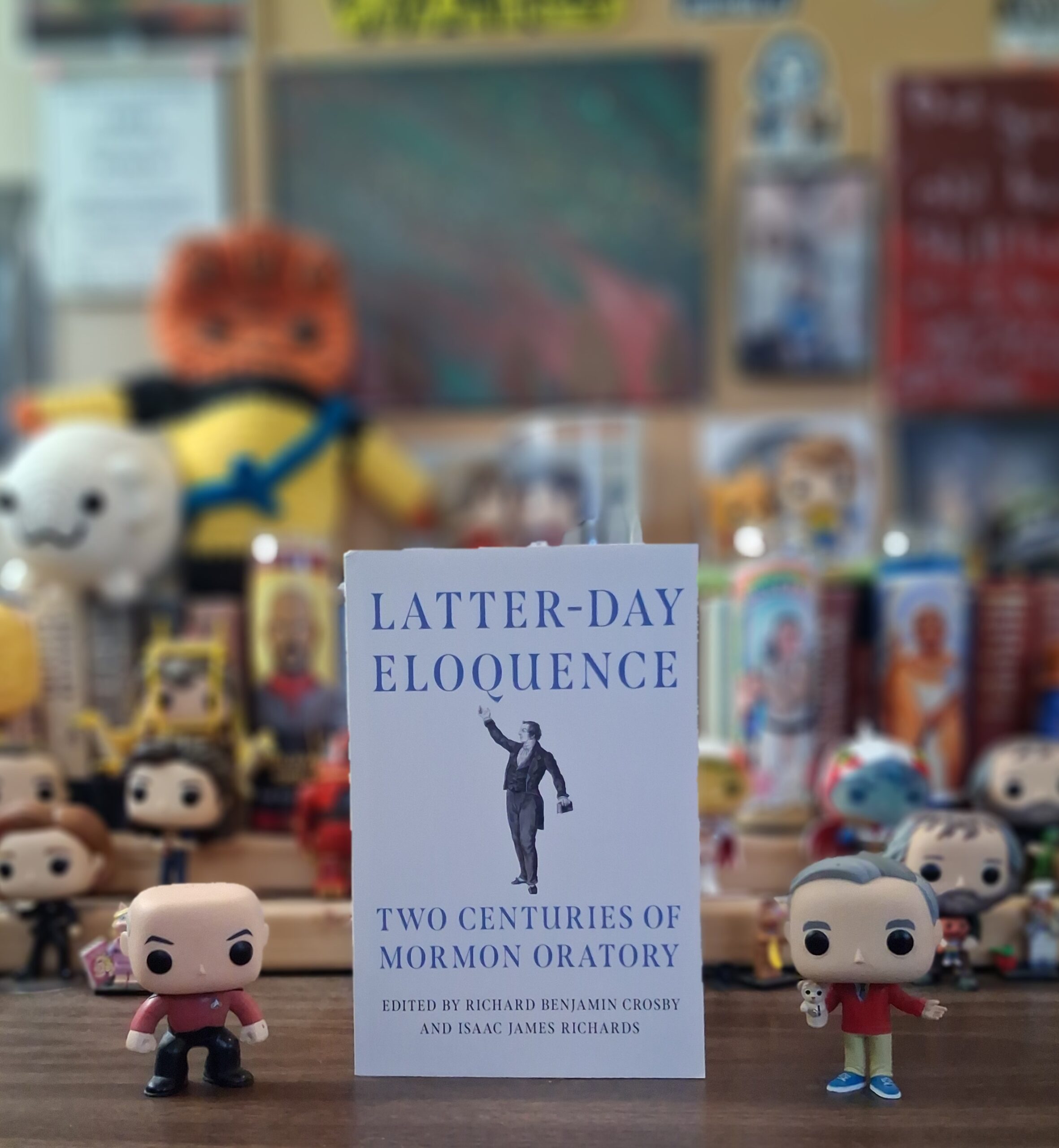
Title: Latter-day Eloquence: Two Centuries of Mormon Oratory
Editors: Richard Benjamin Crosby and Isaac James Richards
Publisher: University of Illinois Press
Year Published: 2026
Pages: 676
Format: Trade Paperback
Genre: Mormon History, Rhetorical studies
ISBN: 9780252089329
Price: $45.00
Reviewed by Kevin Folkman for the Association for Mormon Letters
As a lifelong member of the Church of Jesus Christ of Latter-day Saints, I still remember, somewhat vaguely, my first experience speaking in church before the entire congregation. As best I can recall, I was only eight years old, recently baptized, and asked to speak in Sunday School opening exercises. It betrays my age, but this was a time before the block schedule, when all ward members, except Junior Sunday School kids under age eight, met together. It was a large ward, and I remember a full house. With the help of one of my parents, I had written a “two-and-a-half-minute talk.” With the text held in front of me, I stumbled through the words, shaking with fear, and I am certain tears were involved. It was not a stellar performance. Since then, I have had countless other opportunities to speak in various church meetings, councils, interfaith groups, high school and college debate tournaments, and business meetings. I no longer approach those opportunities with the same sheer terror of that first talk, but there is still a lingering sense of uneasiness in the process. What do I have to say that is of interest to all these people? Will I freeze? Did I prepare enough to fill the time? Or am I rambling along with no particular ending in sight?
As church members, we have a long tradition of public speaking. Our leaders certainly speak, but our normal worship services focus on lay members offering sermons, members who have little formal training outside of the years spent listening to others under the same circumstances. Still, I am often in awe of the eloquence and impact of those talks, sermons, and testimonies.
In Latter-day Eloquence: Two Centuries of Mormon Oratory, editors Richard Crosby and Isaac Richards have collected 56 different examples of that tradition of oral exposition by persons trained through the church in the art of public speaking. Children, as noted above, begin giving brief talks early in their church experience. 20th-century youth participated in speech and drama contests as part of their MIA activities. As the editor’s note in their introduction states, there is a “rhetorical tradition so ubiquitous, so comprehensive, and so vital that, for the want of a niche, easily escapes notice” (p. 2). This collection reflects that ubiquitous practice. The editors sought out a wide variety of voices for this work. A few are church leaders, but the majority are rank-and-file members, representing a broad array of experiences, including women, minorities, academics, politicians, business managers, those who have left the church behind, and others.
Each oration is prefaced with a review essay by authors and scholars who provide the historical context and examine the rhetorical devices used by the speakers.[1] These essays serve an important function of filling in biographical information, contemporary events, and details about the venue and the audience the speakers are addressing. The venues range from the icebound steamboat on Lake Erie where Lucy Mack Smith addressed the wavering faith of the New York Saints headed to Ohio, to the Well of the Senate where Arizona Senator Jeff Flake decried the destructive politics and lack of a moral core in the Trump administration in 2017. Kidnap victim Elisabeth Smart explains how hope helped her survive months of captivity and sexual abuse as a teenager. Melissa Inouye speaks about why she stays in a church that she sees struggling to accept certain marginalized members of society.
These personal orations evoke a myriad of emotions and rhetorical devices. Chieko Okazaki addresses those who are victims of sexual abuse, noting that it is “a problem for all of us, both men and women, whether we have experienced it personally or not” (p. 411). Levi Peterson notes his doubts but otherwise proclaims that he is “a Christian by yearning…longing that the gospel be true” (p. 352). Francine Bennion, in an address at the 1986 BYU Women’s Conference, states that “One function of any religion is to explain such a world as this, to provide a theology that makes sense of love and joy and miracles but also of suffering and struggle and lack of miracles” (p. 335).
The breadth of rhetorical address includes discourses that may surprise some readers. John Dehlin addresses his sympathizers after his excommunication from the church. Lucretia Heywood Kimball, raised in the LDS church, speaks at the dedication of the first Christian Science Hall in Salt Lake City in 1898. Art “Killer” Kane, bass player for the punk band New York Dolls, relates how his conversion to the church was similar to past drug experiences in the biopic of his life, A New York Doll.
Some of these addresses were familiar to me, but I encountered many more for the first time here. Where available, editors Crosby and Richards have provided sources and links to audio and video recordings, multiplying the power of the speakers. Seeing and listening to these speeches provides an opportunity to experience them in a manner that better reflects the actual power of the spoken word.
Latter-day Eloquence is an exemplary collection, reflecting the impact of a church built on lay leadership and extensive member participation. Many of these speeches have invited this reviewer to further study and reflection, providing some powerful examples and ideas for the next time I get called upon to speak before an audience. My copy includes at least a hundred multicolored sticky notes and underlined passages, spurring me to further study. Crosby and Richards have provided us with brilliant examples of effective oratory.
Despite all of this, I found one frustrating issue that persisted throughout the book. It’s a long book, to be sure, and I suspect the editors were under some pressure to keep the size of the volume manageable. To that extent, many of the talks include ellipses in the printed versions, indicating that the text has been redacted. On multiple occasions where such deletions are noted, the speakers often refer back to events or individuals spoken of earlier in the oration that don’t appear in the printed text. Carolina Nunéz from the J. Reuben Clark School of Law at BYU refers to an incident on a train that is missing from earlier in her speech. Church history scholar Kate Holbrook refers to an experience with Mark Staker at the Church History department that is missing in the redacted version. Portions of the King Follett Discourse of Joseph Smith, Jr., are left out. One wonders what else is hidden behind those ellipses. Fortunately, I was able to find most of the deleted portions online, but it happens often enough to be a bit of a distraction. Don’t let that stop you from enjoying the art and brilliance of our LDS oral traditions. Do let it inspire your next speaking opportunity, which will surely come.
[1] As with much academic writing, I encountered a few new words, such as rhetor, one who uses the tools of rhetoric; and hortatory, a speech that seeks to impel action, as in exhortation. I don’t know that I will ever use such words myself, but I feel somewhat enlarged by the experience.