
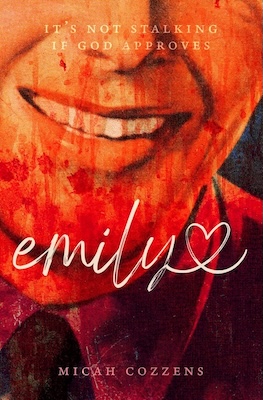
 Micah Cozzens introduces her debut poetry collection, Emily.
A close poet friend, Thew Curtis (pen name M. Anthony C.), upon agreeing to lead the Q&A at the book launch for Emily, my poetry collection, said, a tad tentatively, “I think, given the subject matter, it’s best if we don’t talk about the autobiographical nature of the collection?”
Indeed.
The poetry collection is horror, written as successive letters from the perspective of a female student at a religious college whose parasocial obsession with a male Senator is bloody and grotesque. She wants him all to herself, and if that means killing him, then so be it. Of course, this is all a metaphor for God. Unless it’s not.
No one wants to talk about Mormon women’s power fantasies, but it’s deemed slightly more acceptable if those power fantasies are buffered by fiction. If I can claim that the book is not autobiographical, then everyone, including myself, will be more comfortable.
But that wouldn’t be entirely honest.
The book is autobiographical in some ways. Unlike the speaker of my poetry, I have never planned to murder anyone, let alone a Senator. But I have fixated on male celebrities before, to the point of seriously concerning close friends. I have struggled in ugly, painful ways with the disparity between the power, safety, and sexual fulfillment that I crave and my reality which, as a grad student and now a perpetually underemployed teacher and relentlessly single spinster, is routinely unglamorous and desexed.
So yes, in some ways, I relate to a college student who feels so shut off from normal, happy emotions and fulfillment, or a relationship with God, that she decides fixating on a random politician is the most realistic path to something-like-happiness. But I have learned what my speaker hasn’t quite yet: she is blatantly, obviously seeking to escape her shame by living vicariously through a powerful male celebrity. My speaker wants proximity to power because how else can she claw her way out of the feelings of unworthiness and existential self-loathing that corrupts everything around her?
Her suffering is a product of shame, not some gothic or demonic curse. And victimizing a politician, as satisfying as that might be, won’t cure her.
Shame is a heavy word, and discussion of it has been relegated in modern America to the therapist’s chair. But shame nevertheless has a way of eking into every facet of a person’s life.
My character has no great trauma, no great sin around which her shame revolves. That is an intentional plot decision. Rather, she is simply aware, as I often am, that she doesn’t check every box on the “Criteria List of the Perfect Mormon Woman” or even “Criteria List of the Average American Woman.” Mormon culture has a way of compounding and then refusing to discuss these shames—the way that disparity from the cultural norm can, with the help of tradition and mental illness, become twisted into a perceived distance from God, until the self’s deviation from acceptable norms (though externally, this person may appear like so many others) becomes, to the individual, an unimaginably wide divide. I think of those who were, in times mercifully distant, chucked into asylums for supposed “symptoms” and their diagnoses were written up to justify their separation from society. Without discounting the real suffering of brain chemistry-inflicted mental illness, is there maybe some truth to the notion that we become as deviant as we believe ourselves to be? Or as sinful?
It’s very hard—and I speak from experience—to talk about sexual desire as a Mormon woman (note the transition I just made from “sinful” to “sex”). In the Mormon cultural mainstream, a good woman is a safe woman, “Hallmark-y”: pert and cute, maybe, but never beautiful and never sexy. I got the same Young Women tutelage that many Mormons got: just don’t think about sex, know that men are always thinking about sex, and put God first. At least the last part was good advice.
My titular speaker, Emily, could admit all this to herself: that she just doesn’t know how to handle real romantic relationships or talk about sex in any healthy way, so instead she fixates on a male celebrity onto whom she can project her desires. But that would require acknowledging that she has a body, and because her body is the source of her shame, she can never do that.
What would fix all this, perhaps better than anything else? Relationships—with God, with friends, with family. And humor. I can think of nothing that better punctures the falsities of despair than humor. To laugh with other people is to acknowledge connection and a person cannot simultaneously believe themselves to be a monster while laughing with someone else.
But—and this is the source of horror in Emily—what happens when a person believes themselves to be so shameful, so awful, so wicked, that they have deliberately cut themselves off from every relationship except the parasocial? What happens when they allow despair to stifle every impulse to humor and camaraderie?
I believe real horror, real despair, is a sensation of being trapped within oneself, a genuine belief that change is simply impossible, which is a lie. But it can be a convincing lie because as every horror writer knows, the best monster you can contrive is not something cooked up in a lab (no offense to Mary Shelley), but something that still carries the stench of your own shame. Emily is, I admit it, somewhat autobiographical. It is written about a woman who cannot acknowledge that she has a body because doing so would be an admission of sex, an admission of need, an admission of profound vulnerability in a world that frightens her.
I too have a body and I, too, am frightened by it—its appetites (such a heavy word), its frailty, and, ironically, its heft. As a woman, I can feel, all within the span of 24 hours, too big, too weak, too fat, too incapable, too sexual, too sexless, embarrassingly provocative, and cruelly desexed. All of this leads to a showdown with Mormon doctrine, which asserts purpose in the body—Why, God, did you make me a woman if to be a woman means to wrestle with my body like this?
I cannot tell: am I asking as myself or as Emily?
Excerpt from Emily:
And I want my nails, like birds’, to scrape
and to point, to knife across your shoulders, happy
at your nearness, loving you so much that in my love,
I must hurt you, because there is no other means
to show excess of feeling, except to sink in.
There is so much disrespect shown to those
species who eat their mates, which we humans
disdain as unfaithful, as cannibalistic cruelty,
but what if they do so because they are overwhelmed?
Like a child who hits, not because they hate or are angry,
but to establish contact with a world that is altogether too much.
What if their feelings foment so much reverberation
that they must bite down, or risk imploding?
In your absence, I bite down with a pen and paper.
I chew you with words, and I drink you with metaphor.
And so, though I now, in addition to you, write for others,
I am always, always,
Truly yours,
Emily
Micah Cozzens graduated with a PhD in Creative Writing from Ohio University in 2024. Her work has appeared in Irreantum, Segullah, Jersey Devil Review, and Time of Singing magazines. She was also a finalist for the Fugue annual poetry prize. Her first full length poetry collection, Emily, was published in 2026 from By Common Consent Press. When not writing, she enjoys teaching, spending time with her five nephews and niece, and watching bad reality television.
Advance praise from the publishers:
A young woman believes a distant senator may hold the answer to questions she cannot stop asking. What follows is a sequence of epistolary poems that transforms longing into theology, exploring the perilous line between devotion and obsession. Unsettling in the best possible way, and fiercely intelligent, Emily and Other Poems inhabits a powerful border where faith and desire shape identity. It is a daring work that asks how we create meaning from our deepest longings, and it lingers long after the final poem, like a beautiful disturbance.
—Amy Newman
Professor of English, Northern Illinois University,
and author of Dear Editor and On This Day in Poetry History
Micah Cozzens has created the most amazing speaker-protagonist since Robert Browning. That sounds hyperbolic but you will see: Cozzens’ Emily is crazy (as she herself knows) in complicated ways that sustain the interest of her series of letters through almost ninety pages. Emily’s mixture of idealism and anger and loneliness and sexual frustration and delusion and intelligent self-study is so convincing that the reader eagerly continues from one letter to the next. Emily is a book that should earn lasting national attention.
—Mark Halliday
Professor of English, Ohio University,
and author of Keep This Forever: Poems
This sounds like a very interesting, complex, innovative, and engaging work. Not to mention brave. And brave of you to discuss it so personally. Our lives are so much more complex than they may appear on the surface. Sometimes it takes art for us to understand that. You persuaded me to buy a poetry book for the first time in a long time. Looking forward to reading it.