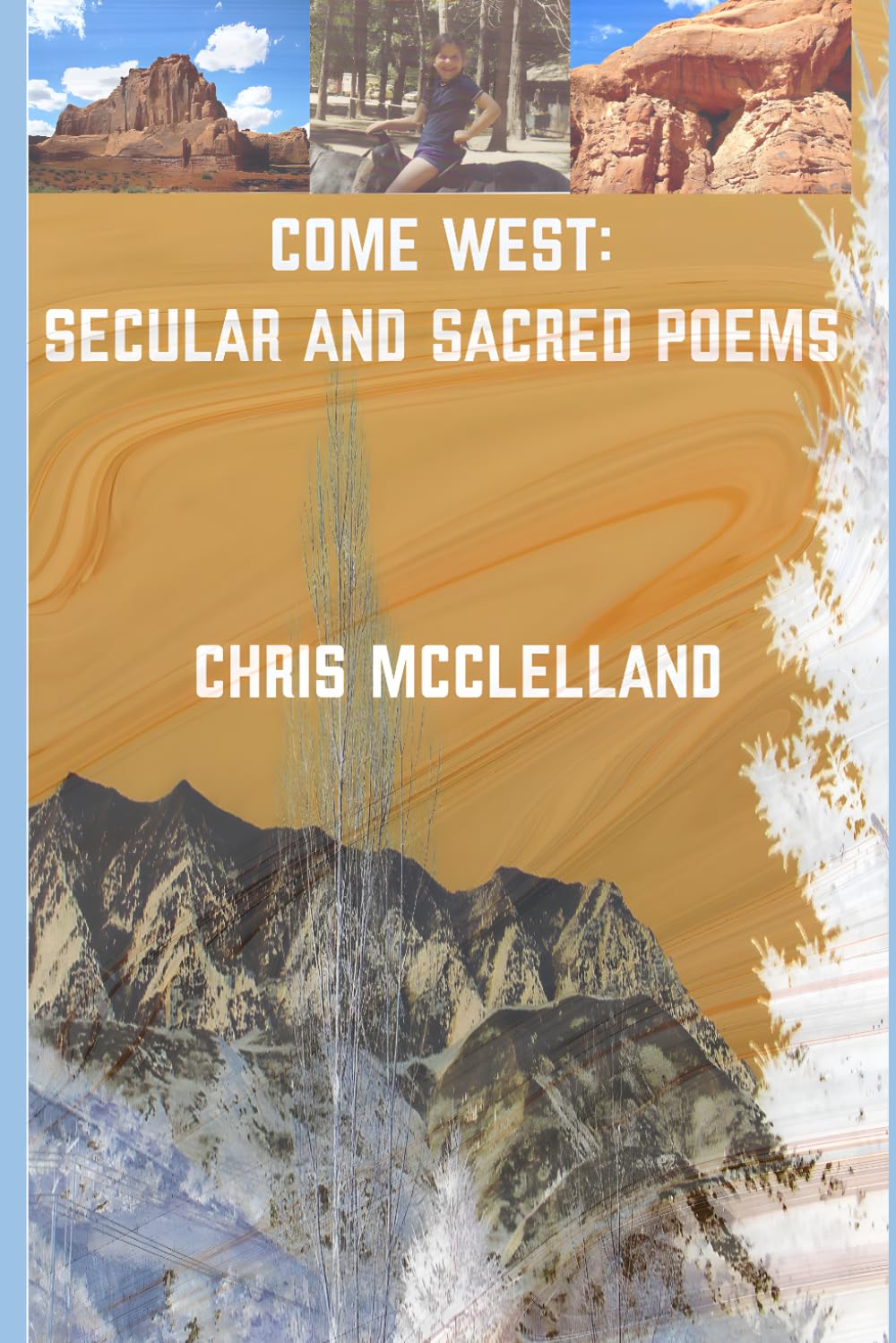
 Chris McClelland introduces his new poetry collection: Come West: Secular and Sacred Poetry.
When I moved from Florida to central Utah in 2011, I had no idea how deeply I would be changed by the culture and the religion of the Latter Day Saints, a culture and faith that continues to move me strongly today. This experience led to a lot of measured prayer and pondering, and the result was, among other things, establishing my family in Utah, my new-found relationship with Heavenly Father and Jesus, and a small book of poems addressed to friends and family left behind in Florida, as well as to everyone else, particularly lovers of the Western United States and landscape poetry. Thus, Come West got its start.
For the longest time I considered myself a fiction writer, not a poet. Poetry for me was akin to journaling and self-reflection, and usually written to celebrate occasions or express tender feelings best kept private. I have known and socialized with poets my whole adult life, mainly secular, academically-grounded writers who have somehow managed to make a career teaching and writing poetry at the university level. But I always assumed I had little to no natural talent with the genre.
I’m not sure what possessed me to send my poetry to literary magazines that I usually send my fiction to, but I did feel, after converting to Mormonism, a certain fire to share my poetry that embraces faith and a more spiritual outlook to the world. The poetry editors at Irreantum showed interest and encouraged me, and then, on one day in August of 2025, I had three magazines accept poems of mine in one day. As I kept getting more poetry accepted by magazines, as the weeks and months followed, it struck me that I had a small book on my hands. I knew in the academic/literary world, getting multiple stories or poems accepted in magazines meant a writer usually put them together as a book at some point. That was what gave me the idea to publish Come West.
The imagery of the West abounds in this slim volume, and sand and blasts of grit and heat and cold all have a part to play in this chiaroscuro dance of light and shadow. We see the divine in the landscape of the high plains and the rocky ranges, and the majestic snow-mantled mountains that scrape the azure horizons all around. Surely, this country depicted is Zion, is God’s Country, and it is also Mormon Country. The relaxed and cheerful attitude of the people of this fine state of Utah resonate in an echo chamber of positive feelings here. Happiness is the golden standard, a gentle and respectful regard for the freedom of will and self-determination of all God’s children.
The following first appeared in Irreantum last year:
A Deeper Baptism
We see space above at night,
And nothing holds us back from engulfing it
Deep blue meridians, violet deeper still,
Keep looking.
The stars unrelenting, charging you,
Multiply themselves in the black empty spaces in billions
The longer you gaze.
Fear not. It is just the Western sky.
Give me a voice, oh Heavenly Father,
Give my words deeper meanings than I can devise
And take me to the Jordan to baptize me in shades of murky
Confused metaphor and meaning
And let me float down gently like an Ophelia
Caught in weeds and her drowning white-netted gown,
Pulled under by grief and insanity.
Lord Jesus, protect me from madness,
Grant me refuge when my mind no longer holds its center
Keep me intact and not tactless
As I struggle to survive this thing called life.
“A Deeper Baptism” is perhaps the best spiritually-based poem I have written thus far. And it is probably the most dynamic poem I’ve done. There is (I am hoping) a sense of movement as one reads the words, a dizzying twisting while looking up at the star-strewn night sky, and falling into water in a struggle with madness, like what Ophelia must have felt. My own baptism into the LDS Church was a truly transcendent experience, and I felt spiritually washed and clean in my whole soul. My friends and family reminded me that now, “God has no remembrance of your sins of the past,” and that was so freeing for me to feel that sense of release. And since I am a convert, I feel the baptism I had in the Mormon faith was much deeper than what I experienced as an infant in the Roman Catholic Church because I was fully cognizant of what was going on and the implications of it.
To purchase a copy of this book, click the link below:
Chris McClelland holds a BA and an MA in English from the University of Central Florida in Orlando. His writing has appeared in Narrative Magazine, Harper’s, Puerto Del Sol, SwimSwam, Irreantum, and Mid-American Review, among others. His novel, In Love and War, was published independently to positive reviews. He has also published Under Old Glory, a YA novella. Contrition, his next novel, is due out later this year. He currently lives in Orem, Utah, with his wife and two sons.
It is not every day that a landscape/spiritual poet, and an LDS one at that, makes so many references to Ophelia, madness, insanity, and the center not holding in such a short poem. As a not so recovering bipolar myself, I’m always intrigued when writers associate spirituality with madness. I’m curious is this a deeper thread that runs through the book as a whole or just a one off? And what draws you to make this connection? And more broadly what other Mormon writers do you all know who associate the divine with madness?
Robert,
Thanks for replying to this article/essay. Mental health (and people’s struggles attaining/retaining it) is a leitmotif in much of my writing, usually not as directly referencing as in “A Deeper Baptism”. Whether fiction (emotional challenges and PTSD in combat vets as described in my debut novel In Love and War, and more fully in an historical novel I am currently working on, titled Contrition), or poetry about dementia or depression/bipolar, it runs in and out of my work. There are few poems in this collection that face mental issues head-on, and some that approach such issues very obliquely. That said, the main focus of this collection in particular is the grandeur of the American West, and my personal connection to Mormonism and how fitting it is that Brigham Young said, “This is the place” to found the religion, as I think Salt Lake and its environs struck him as particularly fertile ground to grow a faith.
The Dryden (or was it Pope?) quote of “madness and genius much allied”, and many Shakespeare quotes, particularly in Hamlet, among others by other writers and thinkers, seems to track certain parallels to the spiritual like you point out. However, these parallels can also come with risks for one not sufficiently grounded emotionally. Some well-known poets of the past, (like British Enlightenment poet Christopher Smart, among others), got so lost in his experience of mistaken spiritual insight and confusion with lack of mental soundness that he could not function and was institutionalized for much of his life as a result. That said, he was also a master of the art when he was stable and functional. Me, I tend to the more stabilizing side of faith than the wild religiousity of Smart’s flights of fancy. So far, my experience with Mormon lit is limited, but what attracts me to the LDS faith and its literature is that most Mormons I befriend and read are very grounded people, emotionally, and I find a deep solace in the faith that is calming and stablizing on a level I haven’t experienced elsewhere.
But you can experience Come West yourself. It’s compact, and relatively cheap. I encourage you to get your own copy and find your answers there. I am always open to further conversation…