
 Work for One of Our Literary Dead
by B. W. Jorgensen
“Ye have not applied your hearts to understanding; therefore, ye have not been wise.”
— Abinadi (Mosiah 12.27)
“Diversa sed non adversa.”
— Peter Abelard to Bernard of Clairvaux
“There is really too much to say.”
— Henry James
Q: In these latter days, does anybody wind up deader than a dead writer?
A: We all wind up the same dead.
But the writers did hope to be read. I could name some good ones in my time who already seem permanently eclipsed into utter darkness, and it’s a rare event when a writer even as fine as John Williams, with novels as strong as Butcher’s Crossing and Stoner and (I hear tell) Augustus, rises into a blaze of posthumous renown — or the plain daylight of readers’ attention — that looks as if it could last a while.1
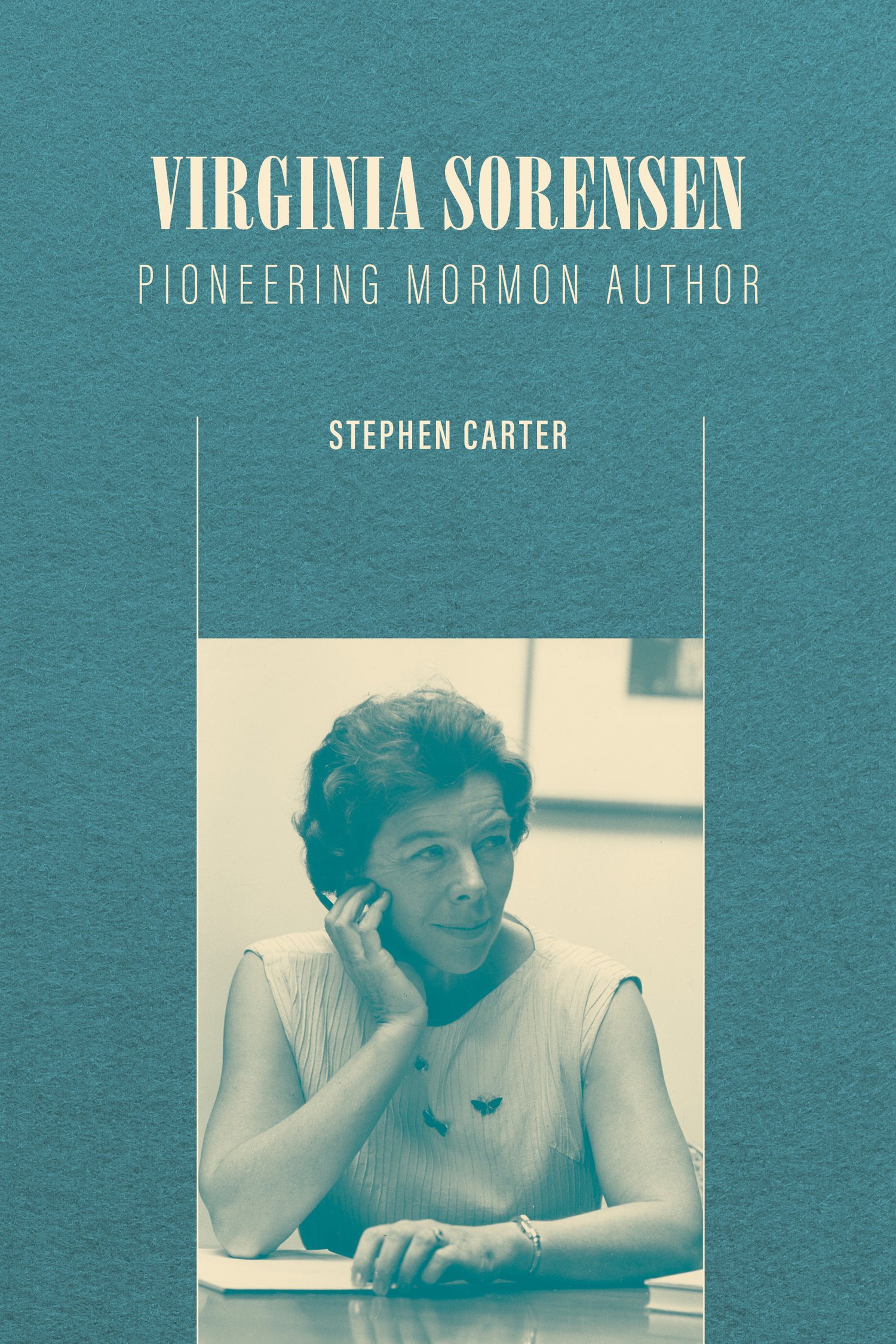
So for me, Stephen Carter’s brief biography Virginia Sorensen: Pioneering Mormon Author brings welcome news: Somebody is paying some attention, at last and once more, to the best novelist of Mormondom’s “lost generation,” the one who least deserves to have been lost to Mormon and other readers, the one who most deserves a volume or two in the Library of America — or at least some handsome and well-edited reprints. As Carter says, “it is time to rediscover Virginia Sorensen” (x). Or to re-re-rediscover, since some of us (in the Association for Mormon Letters) started re- and re-rediscovering in 1979–80 and 1989–90, when Sorensen was still with us. Here we go again, a third of a century farther on. I hope Carter’s book won’t just preach to us already in the choir, but will find some readers who don’t yet treasure Sorensen and who in their turn will read Sorensen and spread the word, so she gets more readers than Carter does (I figure that’s his hope too). May his obvious enthusiasm go viral and infect a host of Mormon and Gentile readers with Caulfield’s Syndrome: “What really knocks me out is a book that, when you’re all done reading it, you wish the author that wrote it was a terrific friend of yours and you could call him [or her] up on the phone whenever you felt like it” (Salinger, 20).
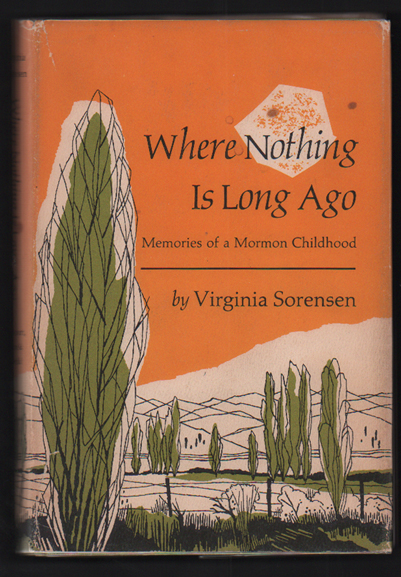 “That doesn’t happen much, though,” says Holden Caulfield. (“Who’s that?” you’re asking? You do get my point about dead writers?)2 Back about 1964, that did start happening to me with Virginia Sorensen when a book titled Where Nothing Is Long Ago: Memories of a Mormon Childhood really knocked me out and woke me back up. Had somebody mentioned the writer or the book to me, or did I in the BYU Bookstore just fall at first sight for its unpretentious dustjacket and inviting title? I was still emerging from my own Mormon childhood, that was one of the first two or three hardback books I bought,3 and when I read Sorensen’s collection of memoir-stories I bought a second copy to give my mother.
That’s by way of disclosure: I’m seriously invested in the (if only it were possible, permanent) recovery of Sorensen and her fiction, mostly because I think our good writers ought to matter more to more of us, and matter longer, but partly because I too belong to the still not utterly lost world of south central Utah Mormondom that some of her fiction remembers for us. My mother was Virginia Eggertsen’s almost exact, and also Danish, contemporary, born less than eight months later and raised about a half-hour down US 89 from where the future writer partly grew up. My own generation of Scandinavian immigrant progeny started to grow up in small towns little changed from mother’s Redmond and Sorensen’s Manti. Then, after The Bomb stopped WWII, came The Cold War, the bikini, TV, Bardot, Buddy Holly, the Interstate Highways (I-70 and I-15), The Beatles, the Sixties, Bob Dylan, and mercury-vapor streetlights that washed the Milky Way out of our warm summer nights. Like Virginia Eggertsen, I slept and woke to the whisper and chuckle of ditchwater, and could not help but see the hills and mountains around Sevier Valley, next door to Sanpete, as “the proper edge of [the] world.” Like her I spent avid hours as a kid curled in a corner with a book (or summer afternoons in the east shade of our house on the strip of lawn between the cool foundation wall and my mother’s row of tangy marigolds). Like her I could check out every week all the books I wanted from my home town’s Carnegie library (see YW 32).4 Virginia had an apostate grandmother, a Jack-Mormon father, and a Christian Scientist mother; I had a silently inactive grandmother, an unbaptized but sympathetic father (an old-style Jack-Mormon, we might say), and an active Mormon mother. Virginia was baptized in the Manti Temple; I and other teens in our ward got baptized there for the dead and shown one of its open-center spiral staircases though not allowed to ascend. One or more of my Danish and Norwegian polygamous great-grandfathers helped build that temple. I identify.
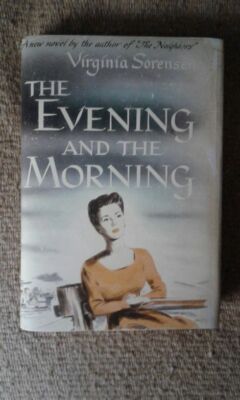 So when I later came upon used copies of two Sorensen novels I bought those too. And at the AML Symposium in 1979 I took part in that rediscovery with an essay on The Evening and the Morning — a too-narrow account of that book, though I still mostly stand by my readings, and still think that’s the best Mormon novel of its generation and maybe of the 20th century (I can name some really close seconds, a couple by Sorensen). In September 1983, near the time she moved from Florida (after her second husband Alec Waugh died there) to Hendersonville, NC, Sorensen visited Provo, and I talked with her an hour or so in Shirley and Monroe Paxman’s parlor about her books, Sanpete and Sevier Counties, a cerebral aneurysm that disturbed her eyesight, etc. (Regrettably, I made no notes, though she did sign my three books.)
Gearing up for this review-essay I checked several of Sorensen’s novels out of BYU’s library to read again or at last, and came home with two signed “Very sincerely, Virginia Sorensen” (identical capital V’s) and dated “August, 1962” — as if each of her books (I later located a couple more signed the same) had been a letter addressed to any reader who might open it.5 Toward the end of August 1962 I’d settled into Chipman Hall and put on a blue & white beanie for freshman orientation; I might have passed Very sincerely Virginia Sorensen on a campus sidewalk, but of course I’d not have given a second glance to a woman old as my mother. From Carter I learn that in June 1962 after her older sister Helen died, Sorensen drove out to stay for “several months” (Susan Howe says eight [xii])6 in Springville with her father, and there she wrote or revised her short stories for Where Nothing Is Long Ago. She sent the manuscript to her publisher the next spring, and the book came out in summer 1963 while I was bucking bales from first light till early afternoon or working graveyard in a sheetrock plant and on breaks reading Conrad, James, Camus, Moravia, Unamuno, and Tolstoy and Dostoevsky (who turned me that fall from Physics to English). I’d come that close to the best Mormon fiction writer alive and working then, writing some of her best fiction, but wouldn’t know it for sixty years.
So I’m no disinterested or impartial reader of either Sorensen or Stephen Carter, rather what we call a stakeholder (got skin in the game, a dog in the fight, etc). I’ll criticise Carter’s book, but solely for the sake of collaborating with his call for rediscovery, his work toward a restoration.
The book is short, just 136 pages including front and back matter. After a 5-page Introduction, roughly half of it narrates Sorensen’s life and career in seven short chapters with signpost titles — “Her Life Begins,” “Her Career Begins,” and so on to “Her Career Ends … And Is Remembered.” Another short chapter sketches Sorensen’s place among “Mormonism’s ‘New Pioneers,’” our “lost generation” of writers from the 1940s, set against the preceding half-century of (almost entirely forgettable and forgotten) “Home Literature.” The longest chapter deals with “Her Novels” (i.e. her books for adults); then a much shorter chapter treats “Her Children’s Novels”; and the book closes with a one-page — and very moving — Epilogue, followed by a 4-page Index.
Meant to re-introduce Sorensen and her work, Carter’s book does not (mostly because it lacks room) tell the whole story of either the writer or her writing. For instance, on Christmas Eve 1991, aged 79, she “died of cancer” (66) — not of the aneurysm that worried her for more than a decade. But what cancer? There is room for that detail — if it’s knowable. But that suggests a larger reason Carter doesn’t and can’t tell the whole story: much of any mortal’s life will be unknowable to any mortal who tries to tell it. So Carter’s book can’t help but leave some of us hungry for more — from him or from anyone who wants to know Sorensen’s books better or to go deeper into the sources Carter has provocatively mined, and then show and tell us what they’ve found.
The story he chronicles may look roughly typical for an American woman writer in the mid-20th century: childhood immersion in familial and communal storytelling and in books, adolescent discovery of vocation, first publication, college (or not), marriage/s (or not) and children (or not), ups and downs in both writing career and personal life, bereavements, eventually declining health and diminishing literary creativity. For Sorensen, a first marriage to an itinerant academic with his own ambitions and frustrations; getting by on meager salaries; the temptation of a “Hollywood contract”;7 two children early on, but also, thanks to a live-in mother-in-law, “Mother S, / Who — like one divine — / Dispenses Truth / And Time,” a decade of help with housework and childcare, thus hours and energy to write, plus Mother S’s family lore to write about; divorce and eventual remarriage; good luck or bad at writers’ conferences and artists’ colonies and with publishers and editors and fellowships and prizes; projects completed or abandoned; a near-amazing series of books, over a dozen from 1942 to 1964, then three more in 1971, 1974, and 1978. How vigorously Sorensen kept at her writing through the 40s and 50s seems little short of heroic. And of course there’s more to it than luck and diligence: you don’t get two Guggenheims by sheer luck and hard labor of love, and The New Yorker won’t take your short story if it doesn’t meet their expectations.8
To compose a version of Sorensen’s story, Carter delved into substantial archival deposits at BYU, Utah State, and Boston U: many letters (to friends, family, et al), an adolescent diary, lectures published and unpublished, interviews, essays, reviews, reminiscences — goldmines, we might as well say, and he came out with nuggets that let the writer’s own sentences tell some of her story. At least once he noticeably and notably misquotes: in a published 1953 lecture Sorensen did not say she was “not interested in Mormonism particularly” (101), but rather “not particularly interested in Mormons. Not particularly” (IT 284); there’s a difference, and the remark with its original context invites and enables further reflection on how “Mormon” Sorensen was or was not, and on what ways she was a “Mormon Author.” On the evidence of her novels, she generally stayed interested in Mormons and Mormonism; but particularly she was interested in particular persons, any kind at all, in their particularity, which often turns out to look humanly “universal” in some ways. The “humanness” of her Mormon people flows somewhere above their “Mormonness,” their particularity somewhere below it — or the inverse. Sorensen might have said, with Katherine Anne Porter, “I am interested in the thumbprint” (455).
So there’s still more gold to be mined and refined, particularly from that 1953 lecture, “Is It True?” and from her 1957 Newbery Medal acceptance speech. Generally, Carter shows a good eye and ear for resonant extracts. From a 1944 letter, on the expectable stresses of being a wife and mother and writer, “Surely I am not a writer now, [. . .] but all housewife. . . . I am lost, wallowing in comfort and beauty, without a soul” (23); or about living on a higher-ed English teacher’s wages, “broke three weeks out of every month” (24). (Been there, done that.)
Often (depending on what a reader brings to them) Carter’s quotations carry implications beyond their immediate contexts. In her Newbery speech Sorensen exclaims at “That breathless, unbelievable inner light!” (278; qtd on 41) of the maples the first fall (1952) the Sorensens lived in Edinboro, PA: a wink toward the Quaker origins of the state. But the phrase also suggests how close she held to her (not unrelated) Mormon roots: her first awareness of “inner light” must have come from LDS discussions of “the Light of Christ” that cite the prologue to John’s gospel: “the true Light, which lighteth every man [and woman] that cometh into the world” (Jn 1.9).9
Some of Carter’s facts or quotations will resonate beyond Sorensen’s life into wider cultural contexts. Her first publication, in 1925, was a poem10 in the Juvenile Instructor. George Q. Cannon founded that magazine in 1866 and owned it till he died in 1901, which makes for a nice historical irony: our best mid-20th century novelist first published a poem in the magazine long edited by one of 19th century Mormondom’s loudest opponents of novels and novel-reading, sometimes in that magazine’s pages (the “novels,” when identifiable, were junk: dime novels, yellowbacks, thrillers, Alger success stories). Sorensen dodged a mid-1940s temptation of a “writing contract in Hollywood” (23) that some notable writers had yielded to (Aldous Huxley, Nathanael West, Fitzgerald, Faulkner [see Dardis]). Yet she did flirt with popular magazine publication (just one story we’re told of so far). Fans of “To Jon — From Astrid,” published in Woman’s Day, “love me,” Sorensen wrote to a friend in January 1944, “because I write sweet love stories without ‘sex interest or triangles, which is all fiction is nowadays’” (think Forever Amber, a fat hot best-seller published later that year);11 and she went on, “They are going to read my novel [A Little Lower than the Angels] as soon as possible. It saddens me to think about when they come to the sex-interest and triangle; they will be disillusioned and go back to believing the world is getting worse and worse” (19). Sorensen could hardly not have in mind John A. Widtsoe deploring a “sex temptation” in her first novel; but could she have surmised how far into the 21st century “the world is getting worse and worse” would resound in LDS General Conferences?12
In trenchant quotations from contemporary responses, Carter lets us glimpse how Sorensen’s books were received both nationally and locally, and prompts questions worth thinking about. Why did Mahonri Young tell her in a letter that Many Heavens (1954) was “completely truthful — too truthful to be popular with the faithful” (39)? What did Fawn Brodie mean by saying that in The Evening and the Morning (1949) “Virginia Sorensen alone has managed to write a completely Mormon novel” (32), yet also, in what Sorensen called “probably the best review” she ever got (32n47), that “the characters are in an important sense completely independent of the background” and “The setting is completely authentic contemporary Mormon but the greatness of this novel is not the least dependent upon it” (32)? How do we sort out such puzzling claims? — “completely Mormon” but also “completely independent”? Sorensen wrote in a letter that her children’s novel The House Next Door was “selling badly on account of polygamy. Lots of raised eyebrows” (48) — maybe grownups didn’t like the prospect of kids reading about it? But did the generally favorable critical reception of both that book and Many Heavens in 1954 owe anything to the outraged public sympathy for polygamous mothers and children that the Short Creek Raid (26 July 1953) had aroused? Polygamy notwithstanding (or maybe thanks to it?), her first novel, A Little Lower than the Angels, had garnered national enthusiasm, but it got at best a mixed reception in Utah. Why did Jarvis Thurston in Ogden wonder, “Is she Mormon or non-Mormon?” (14) — and was that rather perceptive and prescient? Did Apostle Widtsoe’s mixed but mostly negative June 1942 Improvement Era review kill that book for Utah Mormon readers? Mary Bradford’s Foreword (useful but atrociously strewn with errors) to the 1997 Signature reprint tells us more about that novel’s reception, including Deseret Book’s cancellation of an order in May 1942 (x), which must have impacted how “few” copies “reached Utah” (Carter, 14).
Carter’s sketch of Sorensen’s career does suggest what a rough ride for a writer the book business could be, even with a house run by a gentleman like Alfred A. Knopf. He brought out her first book in 1942 with a personal encomium on its jacket hailing “the debut, I believe, of a major American writer” (qtd on 13), and helped her win a 1943 Bread Loaf fellowship (16). But in 1945, when her next two novel manuscripts had not suited his or his editors’ present interests or their sense of how her career should go, he “effectively ended” their relationship: “I am very sorry things turned out like this [. . .]. I really had great hopes for you” (22). Still, though feeling she’d become “all housewife” for a time, she was “soon ‘deeply involved with another novel’” (23), and before long she found a new publisher, Reynal & Hitchcock, “liberal and experimental as well as excellent” (24) — the publisher in 1943 of St-Exupery’s Le Petit Prince and, as would happen in 1947, of Malcolm Lowry’s Under the Volcano. In 1948 Reynal would be absorbed by Harcourt, Brace, but Sorensen remained in “major” (though not always best-selling) literary company, since Harcourt also published James Gould Cozzens, Katherine Anne Porter, Robert Penn Warren, Eudora Welty, Jean Stafford, Elizabeth Hardwick, and Peter Taylor. Harcourt’s steady loyalty to Sorensen through the rest of her career stands in sharp contrast to Knopf’s polite early brush-off, and I think it belies Sorensen’s later joke to Linda Sillitoe that Reynal must have listed her “with the liabilities” (vi; Carter, 31n40) when Harcourt acquired that firm.
With all it does offer, what more does Carter’s book leave me (one reader) wanting?
First, please, better editing and more scrupulous scholarly care, because simple typos and other, more substantive errors too often mar the book. An overzealous illiterate spell-checker might have twice altered Terre Haute to “Terra Haute” (12, 15), might have conferred quasi-statehood on Laurie Illions Rodriguez with “Illinois” (xi), and might not have discerned that “Addition” (in the subtitle of a Michael Pollan book) should be Addiction (110n9). Erik Eriksen from On This Star morphs into Erikson (70), then Erickson (72). Did Virginia Eggertsen’s “Bosom Friend” in Manti spell her surname “Reid” (3n12, 99, Index 122b) or (as in Dialogue 13.3: 19) “Reed”? Yvor Winters, Sorensen’s poetry teacher at Stanford (8), turns up as Ivor in the Index (124b). The index omits some relevant place and personal names (Denver? Terre Haute? Eugene England?) and also has page citation errors and omissions: Hendersonville, NC, appears on 65 not 64, Mahonri Young on 39 not 38, Home Literature on 69–73 as well as 68, Ellen Lewis Buell (as Elle) on 110n6 as well as 39, Richard H. Cracroft on 68n1 as well as 71 (and 71n4), Manti, Utah, on 79 as well as ix and 2, Stanford on 8 as well as 7, and Dale L. Morgan on 16 as well as 25, 32, 87 (which means he knew Sorensen, at least by correspondence, before he favorably reviewed her second novel). A syntactical gaffe, “all correspondence [. . .] are,” occurs in two footnotes (11n1, 23n1); another note includes a very awkward “and ‘and” (3n13). I’ve seen just as high error frequencies from Signature before, and from major university presses: are we plagued by a pandemic of editorial sloppiness, perhaps abetted by artificial unintelligence?
Besides such obvious errata, too many of what I will call slippages occur. Sorensen won the Newbery Medal not in 1959 (x) but in 1957 (see 2n6, 107). The story collection Where Nothing Is Long Ago gets categorized three times with “novels” (x; 75, 99–102; 107), where “books” or “titles” or “adult fiction” might easily dodge this problem. When Virginia as a BYU coed fell for Fred Sorensen, Carter tells us she wrote “tiny love couplets in her diary” (6), then quotes a quatrain (as her capitals and rimes indicate, though perhaps she set the lines as a couplet in the diary or in the letter cited as a source [6n13]); but fourteeners don’t look very “tiny,” nor do hexameters (two of the longest couplets in English), and the word “epigrams” might do the job without “tiny.” Carter says Fred Sorensen was, “as Virginia described him, ‘stormy petrol’” (30); what she said to Mary Bradford in 1980 was “a very stormy petrol” (YW 26); the avian metaphor “a stormy petrel” is long-established (see OED s.v. stormy, adj., 3.b.), so was “petrol” just a Dialogue editorial glitch, or did Sorensen intend or approve that winsomely volatile orthographic pun? Did she write “much of” (viii) or just “parts of” (12) A Little Lower than the Angels in the Nauvoo House? She told Bradford she stayed there “About a month” and “The family came to visit” (YW 28), which suggests not much time to write “much.” Did the ms of that first novel have “no punctuation,” or had Sorensen “dispensed with quite a bit of” that (13)? On the reception of On This Star (1946), it looks a bit misleading to quote Orville Prescott and Vardis Fisher and then say that Dale Morgan “vigorously disagreed” (25), when his review appeared weeks before theirs (25nn11,13, 26n15). Some notes where a reader might expect a date for a source lack that information (35n11, 110n6, 111n10). It seems slightly odd to cite a 1952 letter in context of a situation in 1948 (30n38). The anecdote of Sorensen’s lucky 1954 MacDowell Colony encounter with “Hollis Alpert, fiction editor for the New Yorker” (42) should read “a fiction editor” or (more precisely) “an assistant fiction editor.”13 And so on.
Errors like those might be emended in an e-book, and if hard copies are print-on-demand (as at least one 2021 Signature title has been), might be fixed before many more copies are ordered. But clearing up some larger puzzles could lengthen some pages and chapters (half a dozen blank pages leave room for some of this).
When Carter tells us how “Knopf finally rejected [Sorensen’s] Brannan manuscript for good,” he quotes “The verdict” as she reported it to a friend: “a good book but they don’t want ‘A Steinbeck novel by Virginia Sorensen.’ They still speak of ‘the dignity of’ my career, and say the critics would accuse me of imitating ‘Tortilla Flat,’ and I would get exactly nowhere”; Carter adds, “Neither was Knopf willing to publish Goosetown” (21–22). From Sorensen’s remarks that he quotes about it, her never-published “Goosetown” novel (15, 20–21, 23–24), which depicted “slums” (15), and which she ultimately decided to call “The Flood” (20),14 sounds more like “a Steinbeck novel” than does her historical novel about Sam Brannan. Had she witnessed a Wabash River flood at Terre Haute (see 20–21)? What did she know about the devastating Ohio River flood in January–February 1937, which inundated 500 blocks of Evansville on a big oxbow less than three hours due south, and left 100,000 people homeless? (The Sorensens relocated from Palo Alto to Terre Haute some months after the Ohio flood of 1937; Evansville now has, and presumably had then, a Goosetown district about a half-mile from the river.) Did Sorensen’s book somehow resemble Tortilla Flat (1935; film released in 1942), or The Grapes of Wrath (1939; Pulitzer Prize and film in 1940), both still on readers’ minds in 1944–45? Carter doesn’t explicitly identify the “they” who rendered the “verdict” Sorensen quoted to her friend. Her previous editor at Knopf, Harold Strauss, had been Steinbeck’s editor at Covici-Friede a decade earlier. The plot thickens (as plots will), and a short biography can’t trace every little meander in a writer’s career. Still, the ambiguity or the conflation of two rejections here might be cleared up.
One other blur might resolve more easily. During Sorensen’s 1962–63 stay in Springville, she “wrote some short stories that drew on the same childhood memories she had based her previously published stories on” (58); then a footnote begins, “The stories included ‘Where Nothing is Long Ago,’” and names two more also written and published earlier (58n11). Saying “Those previously published” could make this clearer (without pushing the note onto another line), but why not rather list the stories Sorensen seems to have written that summer and fall? Seven? Or had Sorensen “previously published” more than the three mentioned? Susan Howe says she wrote “most of them” in Springville (xii), but how many is “most of” ten?
Any fan of Sorensen might want to know more about such things, and academics would value more clarity and more careful citations and indexing. My wishlist (as both academic and fan) would include a more thorough and longer, deeper index that cites not only all titles and names of persons, places, and institutions, but also any fictional characters discussed, and significant topics like family, marriage, love, childhood, health. I’d also plead for a bibliography or a bibliographic essay, not just the present Introduction’s page of “the names of some of the people and organizations who helped gather information about, analyze, and promote Virginia’s life and work” (xi). Carter’s plentiful footnotes do help, if not always as well as they should (are her fiction manuscripts and her notebooks all at Boston University [see xi, 15n15, 66], or where?); but a comprehensive (not necessarily exhaustive) list of Sorensen’s archived papers and published writings and interviews, and of writings about her and her fiction, would be a great boon to any reader provoked by Carter’s book or by any of hers (or academically obliged) to find out more. An accurate timeline of her life and career would help too — not as detailed as, say, the chronologies in Everyman or Library of America volumes; but some readers would like (as a map and accompaniment to the text, usefully redundant) complete and exact dates (as ascertainable) of marriages, divorces, births, deaths, publications, awards, lectures, relocations, major illnesses, and visits back to Utah (how many, and just when? I wish I knew).
Such useful improvements to the book’s text and apparatus would not, I trust, have made it much longer. The rest of my wishlist would, or it would call for another, different and bigger book, or a string of patiently-wrought scholarly articles, and should be taken as collaborative conversation-starters with Carter and other readers, perhaps as suggesting a research agenda for a rising generation of undergrad and grad students and faculty engaging in Mormon/LDS literary studies, or as prompting book club discussions, panels, etc. I can subsume the rest of my list under one broad heading: a more probing exploration of Virginia Sorensen’s as one 20th century Mormon imagination. I want a richer account of her “inner life” as a writer (a word she seems to have preferred to “author”), in the sense Stephen Whicher meant that phrase in the subtitle of his elegant short book on Emerson, Freedom and Fate.
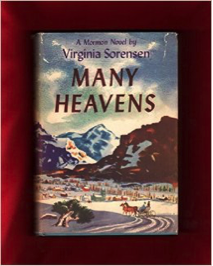 But could there be such an organism as a Mormon imagination, a Mormon sensibility? Sorensen may have wondered too: in Many Heavens Dr. Niels Nielsen reads a passage about Abbot Isaac of Stella (which puts Isaac in the wrong century) describing “imagination” as “intelligence clothed in sensation” (39–40). I don’t find that exact language in the first English translation (1977) of Isaac’s “Letter on the Soul,” where he locates imagination at “the high point of the body and the low point of the soul, through which body and soul can be easily joined in a personal union without confusion of nature” (164).15 Dr. Nielsen is reading from a secondary source, which must have quoted a 19th century or earlier English paraphrase. But Isaac’s description does sound compatible with Latter-day scripture: “the spirit and the body are the soul of man” (D&C 88.15). Could such an embodied imagination, such a soul, produce a “Mormon novel”? — if there is such a thing in any but a nominal sense, a book-length story about Mormon folks in a Mormon situation. Sorensen’s life and works offer chances to try out such notions, and to examine how such an imagination, in the works it shapes, is “faithful” or not, and to what or whom; how a possibly “Mormon” writer of any nominally “Mormon” novel shows up in that novel, or not.
No literary — certainly no novelist’s — imagination develops in isolation. I want to know more about Sorensen’s intellectual and literary affiliations and affinities both outside and inside Utah Mormon culture. Various names, sometimes with quotations, come up in (or are implied by) her letters, interviews, and talks. A 1932 letter mentions Byron, and in one of Virginia’s coed love epigrams, the triple rime of “lyrical/miracle” (6) recalls his use of that device in Don Juan. A 1933 letter, when she was falling for Fred Sorensen, says “he likes [Edna St. Vincent] Millay” (6), so I wonder did she read, say, Fatal Interview (1931)16 and learn something of love and of thinking and writing about love from that fifty-two-sonnet sequence? (She said much later, “I have never felt able to satisfy myself with any description of how it feels to be in love” [YW 30].) The letter referring to Byron also alludes to a specific episode in Tom Sawyer (6), so did she also read Adventures of Huckleberry Finn and notice the differences (instructive for any fiction writer)?17 In her Newbery speech, a capitalized reference to her girlhood “Bosom Friend” in Manti (NA 277; qtd on Carter, 3) suggests she knew Anne of Green Gables, so did L. M. Montgomery’s books help guide her artistic aims and techniques in her books about young girls?18 Willa Cather, Eudora Welty, and the anthropologists Ruth Benedict and Margaret Mead (among others) show up in her June 1953 lecture at the U of U Writers’ Conference. Also in that lecture, when she says “a good novel is one person’s honest report upon life” (IT 283), do I rightly hear an echo of Henry James in “The Art of Fiction” saying “A novel is in its broadest definition a personal, a direct impression of life” (AF 50)? Or when she speaks of “Human beings and their humanness” (IT 284), am I mistaken to recall E. M. Forster saying “Human beings have their great chance in the novel” (241)? The genre is, as James implied and Forster said, “deeply committed to the claims of human beings” (241; note the plurals), and that’s why Sorensen said that a novelist cannot “take sides” and smother the “people in books” in “attitudes” that diminish their humanity (IT 284). I’d bet that Sorensen read Forster’s Aspects of the Novel (1927) and likely his fiction; a few lines farther on in her lecture, her word “expand” may (more remotely) echo Forster saying “Expansion. That is the idea the novelist must cling to” (241–42). I’m tempted to suggest Woolf, too; and Dale Morgan did liken “her arresting turns of phrase, and the rhythm of her prose” in On This Star to something he had also found in “a young D. H. Lawrence” (Carter, 26).19
Carter (like others) tells us that when Fred Sorensen was finishing his doctorate at Stanford (1934–37), Virginia took “poetry workshops from Yvor Winters,” and “wrote a play in verse,” “The Hungry Moon,” based on the (ersatz) “legend of Mount Timpanogos” (8). Again the plot thickens, and in several directions. Millay also wrote half a dozen verse plays, Aria da Capo (1919) being the first and perhaps best-known (published with two others in 1926). But might Sorensen’s play also have been influenced by Maxwell Anderson, whose (partly) blank verse drama Winterset (1935; film, 1936) would later provide On This Star with its title and epigraph? Not only did Anderson get an advanced degree at Stanford (MA 1914), but he was born in Atlantic, PA, the family lived for a time in Edinboro, where the Sorensens settled in 1952, and in 1959 half of his ashes would be buried not many miles away — did Sorensen know any of this? Her pioneer venture into verse drama as a Utah Mormon writer preceded Clinton Larson’s verse plays by decades. It’s not clear how many or what other “courses” she may have taken at Stanford (8), but the jacket copy’s mention of her having “studied creative writing” there seems to have touched off Vardis Fisher’s scorching review of On This Star (25); it’s hardly as bad a novel as he claimed, so was some professional envy or obscure animus also at work? When Sorensen studied with Winters, he was launching his career as a teacher and literary critic, revising his 1934 dissertation as Primitivism and Decadence (1937), writing Maule’s Curse (1938), and articulating a theory of literature that, “for lack of a better term,” he called “moralistic,” in distinction from “didactic,” “hedonistic,” and “romantic” theories (3). Winters’s theory and his studies of Cooper, Hawthorne, Melville, and James could have something to do with Sorensen’s approach to writing novels. Did she also know Winters’s wife Janet Lewis and her first historical novel The Invasion (1932)? Did she read the Kentucky novels of Elizabeth Madox Roberts, who had been in the poetry club at the University of Chicago with Winters and Lewis and dedicated The Time of Man (1926) to them? Directly as a teacher or indirectly through his critical writings, Winters has influenced other, later Mormon literary thinking and writing, particularly that of Douglas Thayer, Eugene England, R. A. Christmas, and Edward Geary (and me too).
What about Sorensen’s contemporary literary and intellectual affinities? Likely she met other writers at Bread Loaf (besides Robert Frost in 1943, who “saw eye to eye” with Fred on “this God business” [17], and whose 1939 essay “The Figure a Poem Makes” gets a quiet shout-out in On This Star in the “sort of stay against confused loneliness”20 that Erik Eriksen feels when he plays hymns on “the old ward organ” each summer in Templeton [OTS 22]); and at the MacDowell Colony (besides Alec Waugh in 1954, and Carl Carmer, author of Stars Fell on Alabama, with whom she’d have felt a connection after living in Auburn). When and where and how did she first meet Mahonri Young, Sam Taylor, Dale Morgan, Wallace Stegner, Bernard DeVoto, Ray B. West, Jr., Juanita Brooks, Fawn Brodie, Richard Scowcroft (she reviewed his first novel, Children of the Covenant, in 1945), William Mulder, and others; and did such connections develop and persist through her career?
Carter lacks room to deal with such matters, though some (like encounters with other writers, artists, or musicians) could be noted in a timeline. He also lacks room to explore more specifically literary questions, but might have found room to pose some. How “slightly fictionalized” (99) are the “memories” in Where Nothing Is Long Ago; and though she justifiably insisted they are stories, did Eugene England still validly call Sorensen the “founding foremother” of Mormon personal essayists? Susan Howe’s Foreword to the Signature reprint of the collection helpfully lays out this case (ix–xii), but there is more to say about how those “memories” play in the boundary zone between first-person short story and autobiographical narrative essay; perhaps more to debate about the book as maybe a quasi-novel.
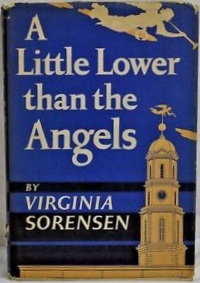 And what of the relations between Sorensen’s memories and her novels? I can’t be the only reader to notice that a “Darling Lady” (like and unlike “The Darling Lady” in the later book) played a brief but significant role in A Little Lower Than the Angels, where she becomes, communally, “a pretty legend and a service of love to fill lonely nights with” (346). Nor can I be the first to get curious when, in On This Star, Chel Bowen (in 1928) recalls “soliciting subscriptions” with her older sister “for a household magazine called Comfort” (175). Did Virginia Eggertsen do that as a kid? (She did write to a friend that the book “has so much of myself in it” [25].) That “household magazine” makes a fairly precise historical reference. Launched in 1888 (mainly to advertise its founder’s patent medicine), Comfort published fiction by numerous writers (including L M Montgomery), and by 1895 was “The first periodical to pass the million [subscriptions] mark” (Mott, 4.16).21 Rather neatly, the covers of issues from as far back as Virginia’s birth, February 1912, into the mid-1920s when a young Virginia could have hawked them, call the magazine “The Key to Happiness and Success in over a Million and a Quarter Homes” — snake oil in print?22 It folded in 1942 (also the year Montgomery died), so some readers in the 1940s should have caught its ironic pertinence to the discomforts of the materially successful but not entirely happy Eriksen family in the novel.
“I am a family chronicler,” Sorensen once said (NA 277; Bradford, vi),23 and all her books that I’ve read (including three children’s novels) are about families. In 1980 she told Mary Bradford, “I like to think of family life as Mormonism’s greatest value” (YW 21). I suspect she’d have said Amen to Eudora Welty’s remark to an interviewer in 1977: “I do think the family unit can hold just about all the stories of man, don’t you? It can embrace them” (EW 190). Sorensen’s work offers one place to explore our subculture-specific version of the British critic Tony Tanner’s question (so far unaddressed?), “What kind of imagination did the family stir and nourish?” (368). For Mormon/LDS studies, what sort of imagination did the Mormon family nourish? Or rather families, plural, since no two are quite alike, not even (pace Tolstoy) the happy, happier, or happiest; or (as Anne Tyler told me she wondered when writing Dinner at the Homesick Restaurant) could it be there are no happy families? If Sorensen’s books were more readily available, almost any of them might fit (maybe not quite comfortably) into a syllabus for the kind of “Family Proclamation-centered” courses that BYU started urging faculty to develop in the late 1990s. No two families in Sorensen’s books (including the kids’ books I’ve read) are quite alike in either their happiness or unhappiness; interestingly, at least four include one or more troubled World War veterans. Like actual families, each unfolds its singular and always shifting constellation in a specific place and time, enacts and suffers its own “inner” history current with the turbid ebb and flow of wider history “outside.” Has any Mormon novelist after Sorensen written about Mormon families as well as she does?24
Sorensen’s novelistic imagination had (in spades) the quality Henry James praised in women writers in his time: “Women are patient and delicate observers; they hold their noses close, as it were, to the texture of life. They feel and perceive the real with a kind of personal tact, and their observations are recorded in a thousand delightful volumes” (AT 1333).25 We have less than a score of volumes from Sorensen; we could have used and delighted in many more of her quality, her “kind of personal tact” — and still could. For Sorensen’s novelistic imagination was centrally familial, and centrally marital. The American critic Carolyn Heilbrun once wrote, “The truth is that marriage is difficult to imagine” (91), and Sorensen braved that difficulty over and over, with polygamous and monogamous marriages, from A Little Lower than the Angels through On This Star, The Neighbors, The Evening and the Morning, The Proper Gods, Many Heavens, and Kingdom Come, and into Part One of The Man with the Key (a mature marriage abbreviated by a death).26
Some attentive readers of Sorensen will incline to question Carter’s discussions of her books and of her relations to Mormonism and to her “lost generation” contemporaries and the preceding Home Literature movement, and they should, so as to carry the conversation closer to the writer and especially the books, to know better the small, dense, and intricately human worlds and situations and stories she offered us, the readers she felt most pleased to please. (To Mary Bradford in 1980 she said, “I get more pleasure out of being noticed by the Mormons than anyone else!” [YW 17].) No brief treatment of a novel can do it much justice (having tried, I know), and in his tight space Carter cannot and does not go very far toward elucidating Sorensen as a “Mormon Author” or her books as Mormon fiction, in more than the nominal senses that she was born, baptized, raised, and partly educated in Utah Mormondom in the early 20th century, and that her novels and stories for adults (all but two), plus one of her kids’ books, The House Next Door, are about Mormon families and their lives from the early 1840s to the mid-1940s.
As any writer might, Sorensen sometimes chafed at being “pigeonholed” and at “the misfortune to be labeled a particular kind of novelist” (IT 285, 290); yet she did consider herself “a Mormon novelist” (YW 17), and Mormon literati can ponder what that means without much harm. I’d still fall back on my pragmatic position in 1979: what are the “norms” by which the “implied author” of each novel invites us to judge the characters and their thoughts and deeds and speeches; and if those norms are consonant with Mormon norms or values, is their provenance most likely also Mormon (SMB 46–48)?27 But even on a nominal definition, Sorensen was indeed a “Pioneer Mormon Author” in more ways than one. A pioneer is a peon or pawn, a footsoldier who goes out ahead of the combat troops to dig trenches and latrines and establish camps, and Sorensen laid out a fine one on the ground of modern domestic realism, though the battalions seem slow to arrive. Since her time, we’ve seen substantial careers unfold with big publishers (Card, Perry, Udall, Hale, Sanderson) and with smaller alternative Mormon-related presses (Thayer, Peterson, Brown, Young, Bennion, Darin Cozzens), though not all encamped on quite the same ground Sorensen opened up. On that specific terrain, and in Hemingway’s pugilistic terms, she is who any later wannabe Mormon novelists have to get into the ring with and try to beat. It won’t be easy; her novelistic gifts were large and she used them generously. She also pioneered high-quality (implicitly) Mormon fiction for children, whether later writers in that category know it or not.
In 1974, with Sorensen, Fisher, Maurine Whipple, and David L. Wright in mind, I suggested that “Mormon literature may be said to have its lost or half-lost generation” (DF 58). Thinking along similar lines, Edward Geary in 1977 surveyed more than a score of books by a dozen or so writers: “Mormondom’s ‘Lost Generation’: The Novelists of the 1940s.” I meant mainly that most writers of that generation had not only expatriated themselves or stopped writing about Mormons (and Wright died too young), but had also been lost to us, their potential Mormon/LDS readers. Later, reading Apostle Widtsoe’s reviews of first novels by Whipple, Sorensen, and Richard Scowcroft, I’ve wondered if some took the hint and got lost — in different ways and to different degrees. Cruelly ostracized at home, Whipple never finished the trilogy she had planned. Scowcroft did not treat explicitly Mormon characters or setting again for a quarter-century. With no less an authority than Brigham Young having called novelists liars,28 maybe they were right to get the hell out of Zion? Bro. Brigham didn’t live to see the old Home Lit, much less the New Home Lit; he might have approved of both Nephi Anderson and Gerald Lund, but what might he think of “thriller,” “suspense,” “clean romance,” “Regency Romance,” “Proper Romance,” etc gushing almost weekly out of Deseret Book? Then there’s what I’ll call the Alt New Home Lit, published by independent small presses for a mainly Mormon/LDS audience; Bro. Brigham might have looked askance at that.
 Inevitably, Carter’s sketch of Home Literature, c. 1889–1940, looks too sketchy, and thus open to restatement. I’ve read only a little of and about it, and now too long ago: Nephi Anderson’s Added Upon (three editions), B. H. Roberts’s Corianton, a few short stories and poems and essays, and Gean Clark’s and Ross Esplin’s way longer-ago BYU master’s theses. But it’s hard for me to conceive how Home Lit writers could get away with “borrow[ing] the alluring aspects of ‘worldly’ fiction” and somehow thus “injecting Mormon lifestyles and beliefs with the dramatic flavor young Latter-day Saints were so eagerly lapping up” (68–69). Could it, did it work that way? — injecting Mormon beliefs with the blood and thunder of yellowbacks and dime novels? dashing heroes, vile villains, kidnapped maidens, highway robberies, shootouts, rags-to-riches successes? everything that Brigham Young and George Q. Cannon excoriated? Wouldn’t it more likely work the other way — injecting Mormon beliefs and values and folkways into popular literary forms?29
And Mormon lifestyles? At that time, some Saints in my home town huddled in dugouts or in sheds where snakes crawled in the wattle ceilings, and washed and cooked with (and I suppose often drank) water from what my grandmother said they called “Mormon wells,” clay-lined cisterns dug into the ground to catch and hold what little rain fell or snowmelt drained in.30 Late Victorian sentimentality might go down like Mary Poppins’s spoonful, yet I suspect some young Saints gagged on the medicine of “proper lessons” that a pseudonymous writer, “Homespun,” proposed would validate fiction in the Home Literature movement (50).31 If Virginia Eggertsen read any of the old Home Lit in its long nadir after the early “zenith” of Added Upon in 1898 (Carter, 69),32 it’s no surprise she tried for something better or at least different. All this calls for further study too.
Carter may be largely right that “it was the lost generation’s deviation from” a dominant LDS story “pattern,” epitomized if not standardized in Added Upon, “that bothered Mormon readers the most,” and that “none of Sorensen’s characters travels the sure path laid down by the traditional Mormon story structure” (70).33 The LDS metanarrative, which used to be called (in latter-day scriptural phrases) “The Plan of Happiness” or “Plan of Salvation,” has not turned out to be a feasible one-size-fits-all story for some members (like those who converted to Christian Science in the late 19th century). In On This Star (spoiler alert!), Chel Bowen tried it, transgressed it, drove herself back into it, and went slightly mad on her version of the “pattern.” Maybe its latest slogan (not quite a scriptural phrase), “The Covenant Path,” sounds less like a blueprint or flowchart, and admits wiggle-room for divagations along the way between scheduled stops. At any rate, all this again makes Sorensen look quite prescient, maybe even sort of postmodern. Maybe the novel itself was postmodern to start with — suspicious of metanarratives? Historically the term signaled “This is a new story, not one of your old stories, your myths, your Kinder- und Hausmärchen handed down by tradition.” Novelists don’t write stories to hand on myths or folktales (though they may use or parody them), nor to demonstrate or illustrate dogmatic truths, nor as blueprints or how-to handbooks to Heaven. If many novels tell “wandering” stories, that’s mostly because life itself wanders, and their writers are trying to “catch” what Henry James called “the strange irregular rhythm of life” (AF 58).
In his condensed discussion of our “lost generation” against its half-century Home Literature background, Carter’s phrase “was she trying” (71) puts the right question to Richard Cracroft’s “orthodox Mormon” claim (in a two-part 1981 Ensign article) that Sorensen (as one among “prominent writers in this group”) “attempted to persuade the readers that true happiness lies not in the sequestered valleys of the West but in the cultural capitals of the world” (qtd on 71; the footnote misdates Part 2 as June rather than July). He might have questioned harder; most of Cracroft’s claims about our “lost generation” should be questioned, and this one begs the question whether those (or any) novelists attempt to persuade their readers of anything beyond the human credibility of their characters’ experiences.34 Before making this claim, Cracroft named and briefly discussed Fisher, Whipple, and (at more length) Sorensen, but any reader of the books he mentioned — Children of God, The Giant Joshua, and Sorensen’s A Little Lower than the Angels, On This Star, The Evening and the Morning, and Where Nothing Is Long Ago — will find little or no support for it. I’m still reading Fisher’s novel, but so far I doubt anyone in it (or its narrator or implied author) will extol the virtues of cultural capitals. I can recall no one in Whipple’s novel having anything to do with or to say about them, and as far as I’ve heard, Whipple stayed in St. George at least partly by choice (she’d felt lonely and isolated at Yaddo while finishing the book). Of the people in Sorensen’s novels (those mentioned) who’ve lived in or visited a cultural capital, Erik Eriksen clearly has not felt entirely happy, whole, or at home in “Paris and Copenhagen and London” (OTS 8), Petrograd, Boston, or New York; when Kate Alexander revisits Manti in 1924, Los Angeles was booming and busting into a pop-culture capital, but though Kate has come to prefer Southern California to central Utah (more for a social worker to do there, at better pay?), she doesn’t try to persuade anybody to live there; her son-in-law Ike Cluff wants to move up near Salt Lake, the local cultural capital, with its colleges, better teachers, concerts, and a railroad station agency with working conditions that will allow him more time with his family, especially his wife and son (E&M 316–17). By the time Sorensen was writing her novels in the 1940s and early 50s, her own cultural capitals were Palo Alto, Terre Haute, East Lansing, Denver, the Yaqui village Potam in Sonora, Auburn, and Edinboro, Bread Loaf and the MacDowell Colony; Manti, I think it’s fair to say, remained her cultural home town to the end.35
The “lost generation” novels not only “heralded a major step forward for the image of Mormons in American literature” (67), they made that step, as at least some non-LDS reviewers testified. No one else, no non-Mormon writer, was likely to do that (though Elder Widtsoe read Elinor Pryor that way). That generation’s books, Carter notes, “have been viewed” as “meant primarily to please the world, not the Mormon community” (67); Elder Widtsoe did seem to think so, and manifestly the books sufficiently pleased some editors and publishers out there in “the world.” But I’ve seen no convincing evidence that Sorensen or Whipple or Scowcroft ever meant to scathe or offend the people they belonged to, rather than understand and write about them candidly, and even celebrate them. In a marginal note on Ed Geary’s essay, Sorensen did say that her “divided” protagonists “wish[ed] the community’s values were broader, more complex, more flexible — as in time they became” (qtd in Howe, v–vi). In any event, unlike others in that generation, she declined to get lost, and went on, after A Little Lower than the Angels, to publish five more Mormon novels, thus making herself our largest novelist of the mid-20th century and our best novelist of Mormon history so far, especially as that history has been entangled with polygamy and its impacts on marriages and families across several generations. (Someone might write about Sorensen and the imagination of polygamy.)
Due first and largely to Fred Sorensen’s academic roaming, Virginia was expatriated from the Mormon cultural region, but she never tried to cut loose from her roots there, and often revisited her home places. Neither silenced nor turned away from writing explicitly about her Mormon heritage, she persistently self-identified as Mormon,36 and a few of Carter’s quotations — e.g. “As if we had gone to The Temple and Renewed Our Covenants” (52) — suggest how deeply (though “As if” shadows those Capitals) Mormon/LDS discourse may have informed her sensibility; even with her insider/outsider stance, she didn’t resist its hold on her but used it, made what she could of it and with it. Though much less prolific than, say, Gerald Lund, she is by far a better prose writer and novelist. Wallace Stegner said in his review of her first book that she wrote “better than the majority of the novelists [then] practicing in this country” (qtd on 14), and having read (in the late 1950s) a bunch of big 1940s best-sellers,37 I’d say he was right. On the verge of publishing his own Big Rock Candy Mountain (1943), Stegner saluted Sorensen as a peer; along with him she joined the splendid minority company of James Agee, William Maxwell, Nancy Hale, Elizabeth Hardwick, Eudora Welty, Jean Stafford, Wright Morris, and Elizabeth Spencer. She and the rest of her generation have been too long and too far lost to their potential Mormon and Gentile audiences, and we’ve barely begun to recover them.
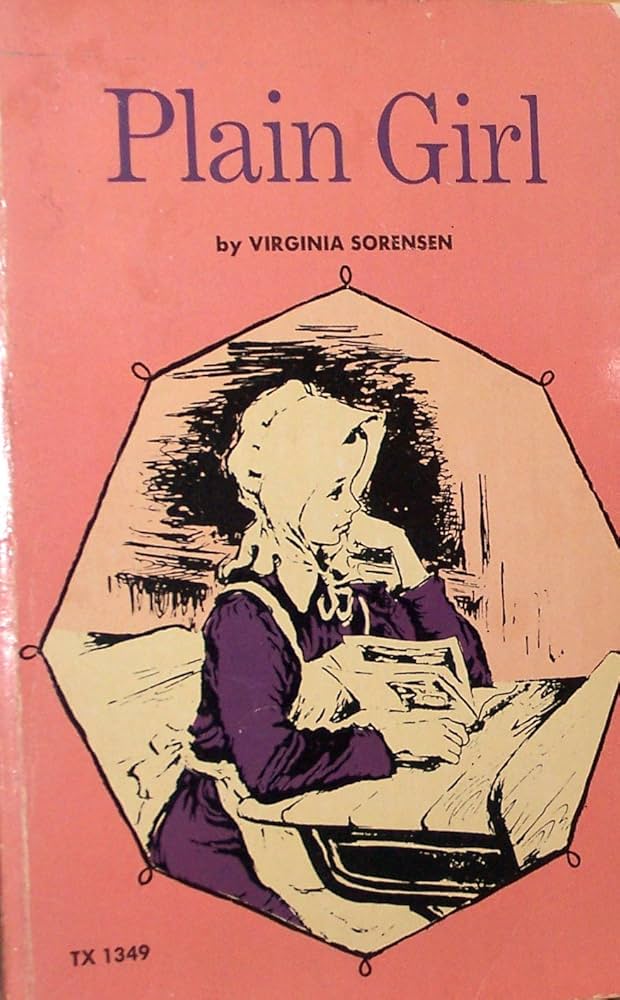 Whether or not Sorensen is the foremother of Mormon personal essayists, she does look to be the forerunner of those Mormon/LDS writers for young readers who are now so plentiful and prolific; maybe not an “influence,” since it’s not clear if any in these recent generations have read her. Carter rightly says her books for children “are indispensable to understanding her both as a writer and as a person” (x), which makes his dozen pages on “Her Children’s Novels” feel way too few. His suggestion that a child’s “lantern consciousness” — as distinct from an adult “spotlight consciousness” — shapes those seemingly loose or thinly-plotted stories is quite helpful (110). Yet I’d say that the three I’ve read, including the award-winning Miracles on Maple Hill and Plain Girl (which I think the better by at least a small margin), are plotted as one might expect a story about a real child to be (not a dystopian fantasy girl-warrior or prentice wizard, definitely not a kid with a superpower, but, as one kid reader thanked her for, “ordinary” and “doing
 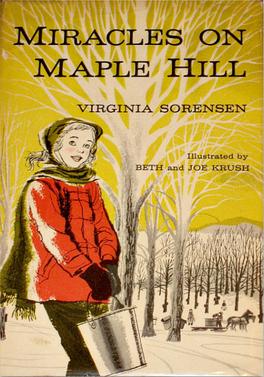 ordinary things” [110]). Plot, after all, is what Aristotle said it was, the mimesis of an action by means of an “arrangement of the incidents” (1450a) that comprise that action, whatever incidents, however arranged; and since a child’s situation narrows the scope of her agency, incidents and accidents driven by other agencies (adults, animals, germs, the seasons, weather, machines, etc.) will just happen to her as they hap.38 A Mormon/LDS (or other) specialist in children’s literature might do well to take a closer look into Sorensen’s children’s novels and their imagination of childhood experience, her sense of what it might feel like to be a kid in a family, from the 1890s to the 1970s.
I find Carter’s treatments of Sorensen’s adult books uneven in quality and result, best on the book that first won him over, A Little Lower than the Angels, on The Proper Gods, and in the last pages of his chapters on “Mormonism’s ‘New Pioneers’” and “Her Novels.” I trust and hope they’ll work mainly as teasers for readers new to Sorensen, and won’t pre-read or pre-judge her stories or novels in ways that warp those new readers’ readings; for any who’ve already read some or most39 or all of the books, they should provoke more thought, more conversation, some corrections, more accurate and precise restatements.
It’s inaccurate or at least imprecise to say that Erik in On this Star (1946) is “unbelieving” (70). To Ed Geary’s claim that Erik has “lost his faith,” Sorensen wrote a clear “No” and “A distortion” in the margin of her copy of his essay (Howe, v), so we all might do well to read and think more carefully to discern just what his faith condition is; Carter goes toward this in his more focused pages on the novel (78–82, esp 79–80). His remarks on The Evening and the Morning (1949) may misdescribe that novel in saying “Kate Alexander returns to her Mormon homeland to see if she can reconnect with an old lover and maybe her old religion” (70). It’s hard (for me) to be sure if Kate seriously thinks to “reconnect” with Peter Jansen (read, e.g., E&M 4–5, 61–63, and 222 very closely), though her insistent memories are passionate, and, in order to qualify for a belated government pension, she will seek his as one of three signed affidavits (E&M 11, 62–63) to attest her long-deceased husband Karl’s service in the Black Hawk War. I doubt there’s much “maybe” in her mind about “her old religion”; she seems to have all of it she wants or feels she can use. To call her story “strangely enough — a conversion story” (85) seems imprecise too. Still, ok, say that falling in (or standing into) love with Peter decades ago was akin to a “conversion”; but coming back to Manti in 1924,40 Kate lives a six-days-of-re-creation story that might better be called “repentance” in the original sense of the Greek metanoeō, to perceive afterwards, change one’s mind. Rather than try “to see if there is anything she can reclaim of her past” (73), Kate rethinks both her past and her present, and changes not only her own mind and heart but also her daughter’s marital and family life in doing so. But to sort out such interpretive differences as these (and more) we’d all have to re-read the novels patiently and closely (not an unwelcome prospect).
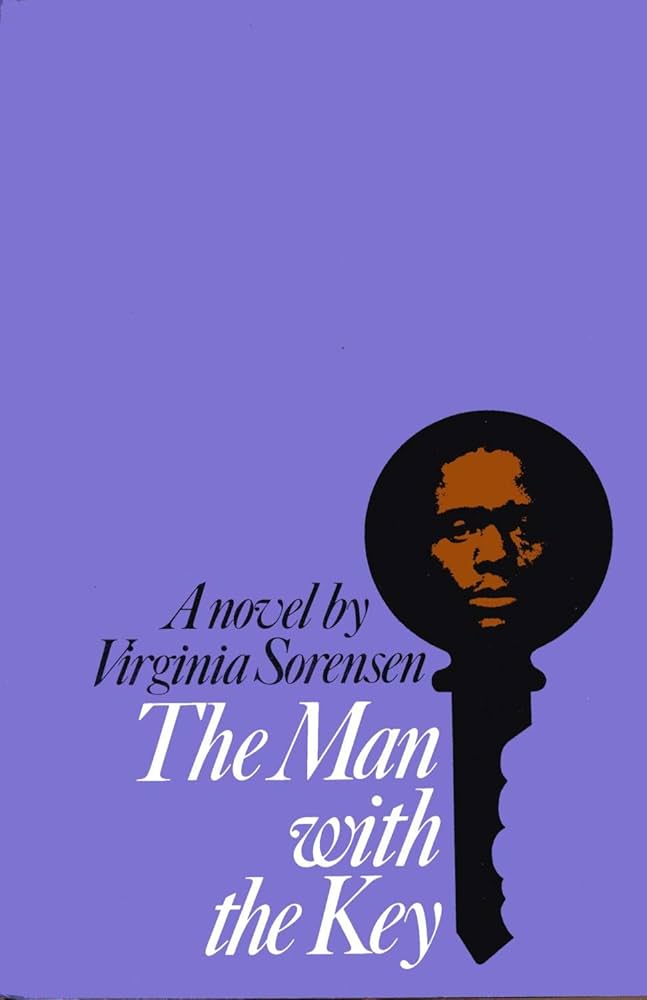 Regarding Many Heavens (1954) and The Man with the Key (1974), I’m a bit surprised that Carter takes little account of the “powers” of Sorensen’s first-person narrators in those novels, mature women who can both tell their own lives candidly and reflect intelligently and movingly on their experiences. To say that Many Heavens “rests on a simple premise: there is, indeed, a one-and-only for each of us” (92), risks oversimplifying or distorting that compound-complex story, which might be said rather to test that premise. True, the “joyful resonance” between any “two specific people” (92) will not sound identically between either of those two and any other partners; but I don’t think that quite leaves the notion of one-and-only “unscathed” at the end when, indeed, “love has been diversified” (95).41 Maybe few or none find their one-and-only other half, split asunder by worried Olympians in Aristophanes’ improv comic fable in Plato’s Symposium; maybe perfectly matched other halves would simply melt into one entity again (globular, four-armed, four-legged, two-faced), no longer two, and love (eros as desire and pursuit of the whole) in that consummation would vanish (189d–193d).42 Zina Johnson in Many Heavens does find a more than good-enough match in Niels Nielsen, thanks in no small part to his prior good-enough match with Mette. Vesta in The Man with the Key finds an unlikely and all too temporary second and less than good-enough match, clandestine, illicit, inappropriate, scandalous and damaging, after accidental death has put its full stop to her good-enough first match. In refutation of “one-and-only,” after her second husband died, and years after these novels, Sorensen would write, “I had two very good marriages, [with] good men twenty-five years apiece” (qtd in Carter, 65).
Carter’s five pages on The Proper Gods (1951) give that novel more attention than all but one other critic I can think of. It’s indeed “the most unusual” of her novels, likely “one of her least read” (I finally did, in the winter of 2023–24, and re-read some months later), and “quite an experience,” in which “Every page has been work; every paragraph, and sometimes every sentence, has presented a new piece of an alien matrix, one that seems to have almost no referent in a Western world view” (87, 91). The book does “baptize readers by immersion into this very un-Western culture at enough length and in enough detail that they could finally intuit two essential things: the Yaqui culture’s undeniable validity and the reader’s complete lack of authority to judge it” (91). “Complete lack of” may overstate, but Sorensen crossed the US-Mexico border decades before Cormac McCarthy with a bold and astonishing and exigent book,43 and Carter gives a creditable account of it. He might have gone farther to note that (although some now would charge it with “cultural appropriation”) it looks far ahead of its time in telling a rich, dense story of colonialization, genocide, stubborn resistance, native American assimilation of European ways to their ways (the weirdly thrilling melange of Catholic and Yaqui liturgical cycles and rituals), and within that, the story of one already deracinated American-Yaqui WWII veteran’s agonistic (and agonized) way back home. (N. Scott Momaday’s House Made of Dawn will arrive almost two decades later.)44 Sorensen said that she abandoned the “conception of the hero” as a “rebel who ends in the gutter”45 for “a much more subtle tragedy, to my mind” (qtd on 34). To my mind, her protagonist Adan’s integration into his ancestral village of Potam in Mexico didn’t feel exactly tragic. I might have to re-read this one too, and maybe rethink my notions of tragedy and comedy.
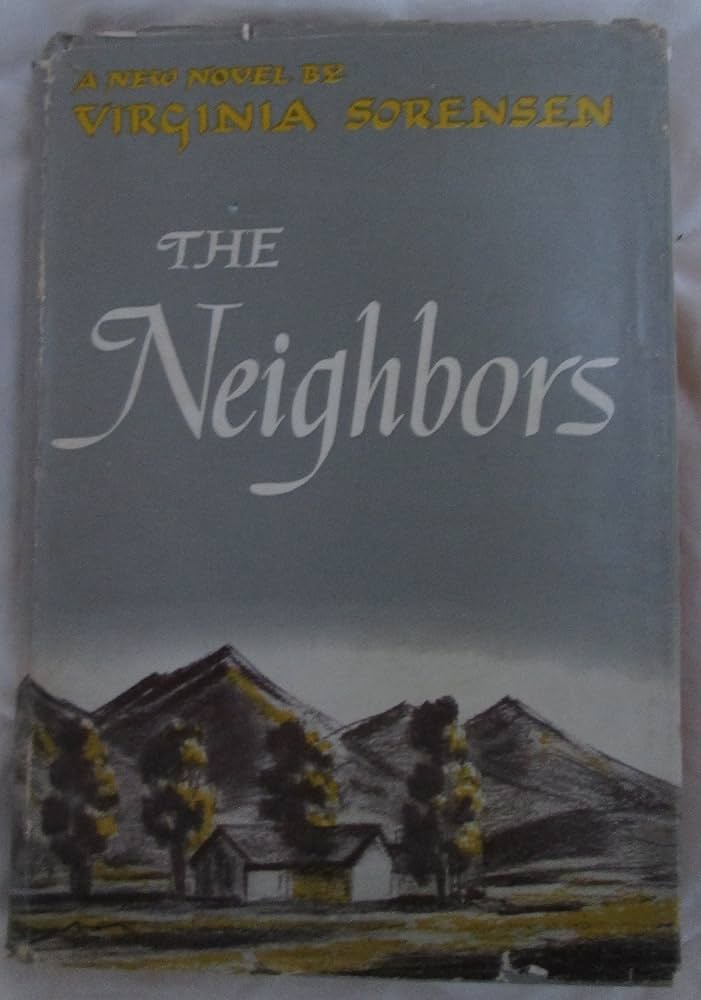 If it’s not a deep category mistake, an “allegorical reading” (84) of The Neighbors is a grave tactical error. Of course we’re at liberty to read any fiction almost any way we like, and scriptural allusion is wherever you find it; but I think allegory and novel (in any rigorous sense of either term) are incompatible literary modes; or if not that, then allegoresis is not the best way to read a novel, though as a way to read narrative it’s historically “classical” (e.g. allegorical readings of Homer in late antiquity), and quasi-allegorical “likening” is a dominant trope in LDS discourse (little factories, pickling cucumbers, rock-climbing, piloting airliners, an old-fashioned train ride, an Irish setter stalking a bushy-tailed squirrel, paddling a kayak in the open ocean, what-have-you). But: Bird Valley as “an Eden” (83)? No: you live there by shedding the sweat of your whole skin into the dirt and the hides of sheep. Phineas Roe as a God whose blundering attempt to control his world ends in the death of his firstborn son (82–84)? That reading elides far too much of the story, too many characters and too many scenes of familial and marital and inter-familial discord and concord, to be worth the loss in our understanding of a compound-complex human situation and action. Not to mention all the gritty greasy detail of mid-20th century Mountain West sheep ranching, which Sorensen knew about as thoroughly as Melville knew 19th century whaling.46 Granted, Father Roe (a widower) does seem to mimic a rather surly authoritarian and vindictive God, and his son Brad, “pet and darling” of his father, was to have had “the most magnificent range of all” (TN 93); now, the rest of Roe’s progeny own all but one ranch in the valley, and although an accident has left Brad “useless, a blind man feeling his way around the place” (TN 53), Father Roe will use him to try to push the Kelses out by having him divert part of their water turn in the dark of night.47
Having re-read the book twice as I write this essay, I see how it might feel like “a wandering novel” — sort of like a creek cutting a path through a valley? But its “sudden ending” (83)48 has been incrementally culminating (not foreshadowed but all too likely) from its first chapter, when Father Roe watches the car packed with the parents and all but the two eldest kids of the prolific Kels family pass his ranch on their way up to the Bird ranch they’ve bought farther up Bird Valley, which is also, naturally, nearer to the head of all the valley ranches’ water supply, Bird Creek.49 The Kelses are not “interestingly, an ex-Mormon” family (82) but, more interestingly, what some of us now call “borderlanders”; their taking up sheep ranching in a remote Colorado mountain valley (no other Mormons, no missionaries) marks that for us decades before anyone invented that term for a somewhat vague but significant Mormon demographic. Both John and Paulie Kels have Utah Mormon roots, and though he has lapsed into inactivity and a degree of skepticism, and mixes socialism with his Mormon communal heritage, she’s staunchly faithful (with one concession: she’ll hospitably make and serve coffee for those who drink it, and drink it herself if she needs to), and her family, on a brief visit, looks hyper-orthodox. John and Paulie’s two eldest, Ann and Call, do look like backsliders: she samples beer outside a schoolhouse dance, and falls in love with a leftist intellectual Jewish army buddy of Call’s; he drinks whiskey with the herder, falls in love with Roe’s daughter Cloie, and has helped his dad buy the sheep ranch at least partly to get as far as he can from the life he knew before the war, “to be alone, outside of things a while” (TN 12), perhaps mostly to put the North African and Italian campaigns behind him. The “wandering” third-person point of view does shift a lot among all these and other Kels characters and some of the Roes, sometimes between sentences, and that partly veils a careful (but hardly schematic) arrangement of incidents; to me this looks like Sorensen’s experimental response50 to the challenge of telling a story about two families, neighbors, in a conflict that one family (or rather just its Father) pursues but the other does not want — a kind of “war” or “power struggle” most of us likely know something about from our own familial or vicinal lives.
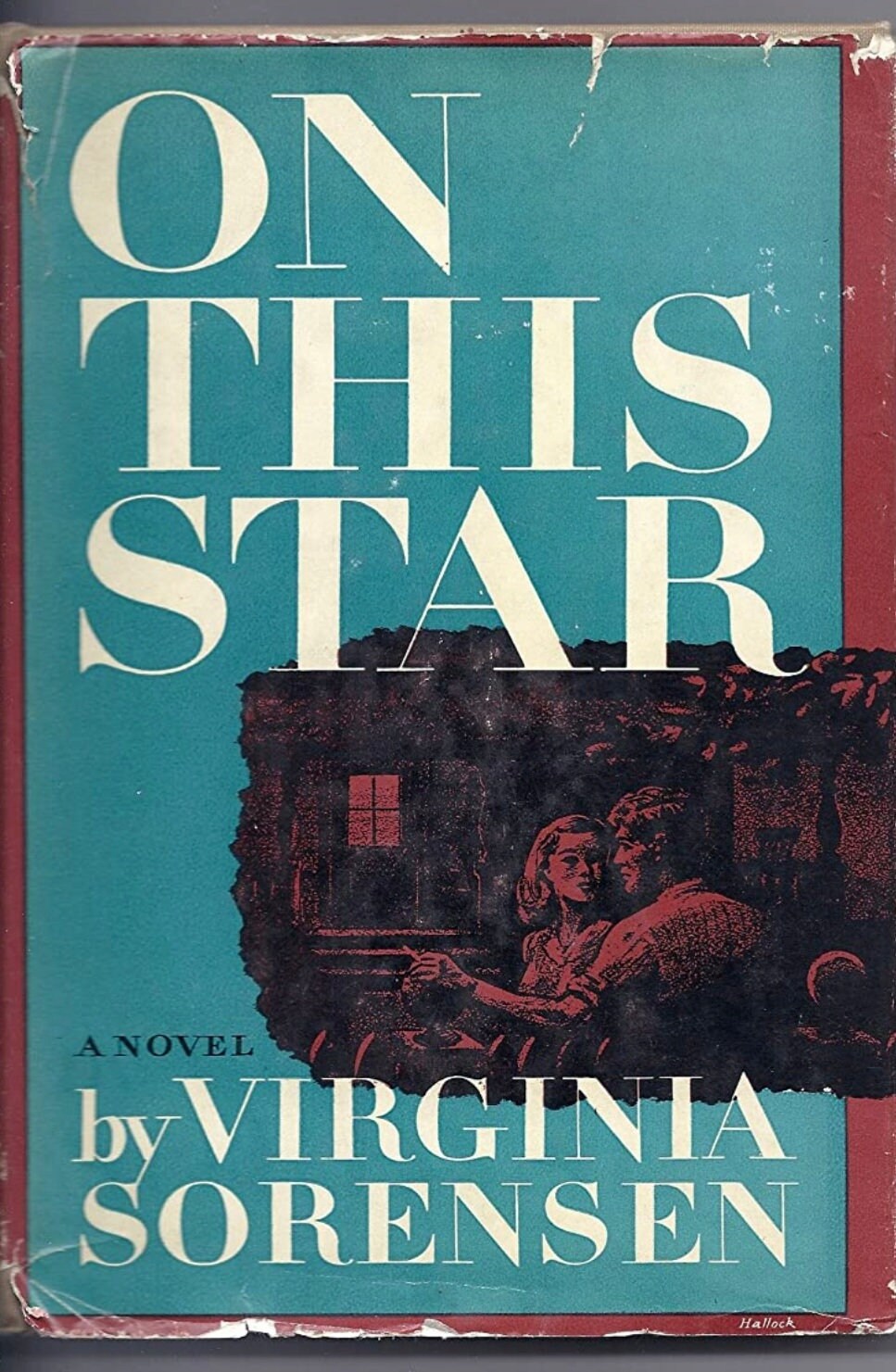 Carter tells us that some early reviewers of On This Star (Kirkus, Prescott) judged its ending “melodramatic” (25) and that even Dale Morgan “chafed at the novel’s ending” (26n15), as did Ed Geary in the late 1970s (MLG 97); me too. But now, having re-read both the novel and the first chapters of Robert B. Heilman’s Tragedy and Melodrama (1968), which allows a disparaged literary mode its own lesser dignity among “versions of experience” (1), I think we were mistaken. Sorensen’s story does end with shocking violence, but neither the story nor its ending nor its characters quite satisfy Heilman’s identity conditions, which largely fit our popular notion: sharply differentiated Good and Evil, “good guys” vs. “bad guys” in “dramas of disaster” or “dramas of triumph,” pure hero and pure villain, neither suffering a “divided mind,”51 blackhat vs. whitehat, etc (7, 9–14, 78–81). If we do call this novel a melodrama, is it a good one or not? But above all, how does it do whatever it does? Carter calls On This Star “the most tragic” of Sorensen’s novels (79), and, though Iris Murdoch has almost persuaded me that “There are no prose tragedies. [because?] Real life is not tragic” (93), I think he is onto something. Once again, the case calls for re-reading and re-thinking. A careful reader of Aristotle’s Poetics, or of Heilman, might justifiably call the novel “tragic,” if not “a tragedy” in the full sense.
Carter praises On This Star as “probably Sorensen’s most accessible novel,” “full of rewards,” and “In many ways [. . .] Virginia at her best” [82]. Could be — since I’ve begun to wonder where she’s not at her best. But I think he makes another sizeable interpretive misstep in saying “This story is about what happens when two patterns — embodied in Chel and Erik — converge” (80). It’s true enough that “When you live in Mormonism, you live in a pattern” (78) — like Animists, Taoists, atheists, Yaquis, et al — and the claim that two patterns “converge” in this novel — or do they intersect, overlap, mingle, merge? and does that happen between Chel and Erik, or within each of them? — is also true enough, though at too high a level of generality. Granted, it’s warranted by the novel itself, since the narrator, Chel, Erik, and Erik’s eldest half-brother Ivor all invoke “pattern” (the concept if not always the word), and a “pattern” that’s “embodied” in a character must mean something like habits of thought, judgment, feeling, choice, action. But “patterns” do not suffer tragedies (they can help set them up), and novels do not (nor do any stories except some allegories) tell “about what happens” among abstractions. Because “patterns” abstracts from embodied Chel and Erik and the other characters, it elides far too much of this novel’s action, its people, their thoughts and speeches, deeds and misdeeds and sufferings — in a word, too much of what Henry James called “felt life.”
Any reader of a Sorensen novel or short story will be welcomed into its felt life on its first page, in its first sentences, because there she always attempts what Eudora Welty said is “the primary feat” and “the absolute necessity” in writing fiction: “Imagining yourself inside the skin, body, mind, and heart of any other person” (LB 755). It’s a feat that Sorensen invites each reader to join, and if we get it, or it gets us, it’s what makes her novels and stories accessible and relatable. Try it and see — or rather hear and feel. Read any first page aloud, give it your living mortal breath and flesh (abs and pecs, diaphragm, lungs, larynx, tongue, teeth, lips, tympani, mirror neurons); slow down and live what you and those sentences do, what you make of them and they make in you. In connection with “the worth of a given subject” and “the right estimate” of its “values,” Henry James said (in his late preface to The Portrait of a Lady) that there was “no more nutritive or suggestive truth [. . .] than that of the perfect dependence of the ‘moral’ sense of a work of art on the amount of felt life concerned in producing it” (1074). For me (one reader) the amount of felt life in a Sorensen story can be huge, overwhelming,52 and that’s where I think we have to start and stay, if we want to make a right estimate of the work, or of the writer.
For me also as one Mormon reader, the abundantly felt life in Sorensen’s fiction might be its most “Mormon” aspect, and the most Mormon aspect of the writer’s imagination, surely learned first at home during her “formative years” in Manti, age five to thirteen.53 Attending Sunday School, where she felt “a perfect spirit prevailing among us” (qtd in Carter 4), or Seminary in American Fork, or religion classes at BYU,54 she’d have learned from LDS scripture that “the spirit and the body are the soul of man,” that “spirit and element, inseparably connected, receive a fulness of joy,” and “that all these things shall give thee experience, and shall be for thy good” (D&C 88.15; 93.33; 122.7).
But abundantly felt life is not a fenced-off pasture of Mormons or Mormonism; it’s the open range of that “worldly” genre we call “the novel.” Novels (since the rise of the genre in early Modern Europe and England),55 besides being Christian historically, are worldly because they are Christian: they come not to condemn the world (satire’s job) nor to unroll its blueprint and teach us how to fit ourselves to that (apologue’s job)56 but to reflect — to imagine — our life in it. They take our troubles in matter and space and time, in history, as seriously as Jesus did, comically and tragically. They shine and rain on the just and the unjust, and if our novelists do anything godlike or godly in their work, that’s it.
Especially they do it in what Elder Widtsoe deplored as “modern unlovely realism” in Sorensen’s first novel. Lamentably, some beggarly elements in Mormon culture anxiously corral and cramp and cage our sense of novelistic felt life, as if utterly ignorant of the novel’s roots in the gospels,57 as if forgetting that Jesus said he came so we “might have life, and that [we] might have it more abundantly” (Jn 10.10). But life more abundantly, life abounding, is life in waves overflowing any dike or levee or dam, overrunning boundaries, patterns; in another word, it “transgresses,” it steps across, wanders, strays. That tends to make the novel (as Tony Tanner suggested) a “transgressive mode” (3), and I suspect it’s what makes some Mormon readers and some Mormon critics58 nervous about novels and about fiction in general. It’s what, from a dogmatic point of view, makes the novelist in Sorensen look ill-suited to the Mormon in her. It could be what helps to incline some of us to write and read mythic fantasies and formulaic romances and melodramatic thrillers, because the felt life in a strong novel feels too close to home, cuts too close to the bone. More, I suspect it’s what tempts us as readers and critics to allegorize, to treat all stories as lessons, flannelboard illustrations of abstractions, or to declare (as my colleague Richard Cracroft did) that “the purpose of faithful fiction is to instruct” (RPL 78), and thus imply that only didactic fiction — if any at all — could be “faithful” and thereby support “kingdom building” (see CtM 122, 124, and esp 125–26; also NSM 4, 5, 8, 14–15).
Does the Kingdom get “built,” like a rigid structure? Jesus trained as a builder (Greek τέκτων, tektōn [Mk 6.3], as in archi-tect, master-builder), but did he ever put it that way? I recall him saying the kingdom of God is “within” or among us (Lk 17.21), or that it’s “at hand” (Mk 1.15), as if we might reach out and touch it. He told a big crowd to pray that it “come” (Mt 6.10), and to “seek [it] first,” before anything else (Mt 6.33).59 If we seek, may it come? Does only one kind of talk or writing seek it or invite it or let it come? — or, if you insist, “build” it? We might also ask what feelings and acts (not doctrines or messages) seek it, or may tend to let it come. Sympathy, feeling-with, for backsliders, borderlanders, dissenters, mavericks, recusants, renegades, black or lost sheep, critics, self-enlisted culture warriors left right or center, bitter apostates, sons of perdition? And then kindnesses to them? Why not? — supposing that we do mean to keep Jesus’s word to love our enemies? (Hint: sometimes they’re not our enemies, rather we’ve elected to be theirs.)
As to novels and fiction in general, and how they work, I’ve summoned some expert witnesses, besides James and Forster and Welty, more than once before, and will again now.
D. H. Lawrence:
The novel is the highest form of human expression so far attained. Why? Because it is so incapable of the absolute. (179)
And only in the novel are all things given full play; or at least, they may be given full play, when we realise that life itself, and not inert safety, is the reason for living. For out of the full play of all things emerges the only thing that is worth anything, the wholeness of a man, the wholeness of a woman, man alive, and live woman. (198)
Flannery O’Connor:
Fiction is the most impure and the most modest and the most human of the arts. It is closest to man in his sin and his suffering and his hope [. . . ]. It escapes any orthodoxy we might set up for it [. . .]. (192)
Milan Kundera:
Once it is part of a novel, reflection changes its essence: a dogmatic thought turns hypothetical. (79)
The novel is the imaginary paradise of individuals. It is the territory where no one possesses the truth, neither Anna nor Karenin, but where everyone has the right to be understood, both Anna and Karenin. (159)
Reynolds Price:
But east and west, the novel [. . .] has traditionally been an instrument of reason intended for discovery and comprehension and then, of necessity, forgiveness — in fact, the supremely Christian form, the new dispensation which rose to augment, if not supersede, older pagan forms (the psalm, epic, lyric, drama) which were hymns to mystery, human and divine. (30)
[. . .] the end of fiction is mercy [. . .] (Interview, 79)
Hear, O Israel! And please stop condemning novels long enough to think feelingly about how they work and what they do. Watch, feel what happens in and to you when you read or re-read one. Whatever one you choose, however ill-fittingly it wears the name of Novel, no matter that I might not call your “Proper Romance” or your alternate-history political thriller or your faux-medieval hero’s journey a novel in the strictest and strongest sense of the term; I’ll re-read, say, Marilynne Robinson’s Home, or Stewart O’Nan’s Last Night at the Lobster. Then, please, read the Conclusion, chapter 20, of Tolstoy’s What Is Art?60 and ponder whether and how the book-length story you chose might or might not be helping you “build the kingdom” or let it come within you. Then come back to one or another of Virginia Sorensen’s novels (one of her children’s novels, if you like) and think about the same question. When we’ve done that pleasurable homework, then we might fruitfully talk over how novelistic — not didactic, not fantastic, not costume-romantic — fiction does or does not serve what Tolstoy called “the task for art” and “the destiny of art in our time”: “to set up in place of the existing reign of force that kingdom of God, i.e., of love, which we all recognize to be the highest aim of human life” (190–91). In The Neighbors, Cloie remembers telling Call that “he now explained everything with love. And he had agreed; he did; how could one not do so truly” (305). In a note to Zina in Many Heavens, Niels Nielsen writes that love is “the only motion in the universe” (157) — echoing Lucretius, Dante, maybe Augustine, and who else?61
In Republic book III Plato has Socrates distinguish “simple narration” from “imitation” (393d): the poet (maker) telling the whole story in his own voice from the poet “imitating” the voices of characters, letting them be heard. Later, in book X, he argues that “imitative” poets (in our time, novelists) corrupt themselves and their audience by imitating “bad” or “mixed” characters, so we’d best send them away from our well-guarded ideal city, lest they infect and corrupt our guardians and us (see 602a–608b). Plato thus planted the seeds for 19th and 20th century LDS condemnations of novels and novel-reading; but in that fundamental narration/imitation distinction, also for the 20th century Russian thinker Mikhail Bakhtin to describe the novel (in his strong sense of the term) as “dialogized heteroglossia,” a genre (or anti- or hyper- or hypo-genre) in which no one62 of its many “other tongues” has a greater privilege or “authority” than any other, none has “the truth,” and all are heard, so that in their dialogue they “interanimate” one another (MB 139–45, 309–17). If that does not make novels “transgressive,” it does make them subversive, and particularly subversive of any “monological” discourse or authority.
Capital-A Authorities of every sort generally pronounce what Bakhtin called “authoritative” discourse (MB 218–23, 313–14); they usually mean to be “monological” rather than enter into dialogue (it might change them, and in any case they’d be yielding up their capital-A Authority).63 But human existence is dialogical (or so experience persuades some of us), and the other tongues, the alternate voices, will speak and might as well, might better or best, be heard and responded to. Novels like those of Virginia Sorensen and others of her generation, and of earlier and later ones, will be disparaged by authorities like George Q. Cannon, Brigham Young, and John A. Widtsoe64 as a threat to their community. But a “monological community” is a contradiction in terms, a chimera; humans, we might say, have been “authorized” (by the only Author [see Gen 2.19–20]) to speak for themselves, and so human community is and always will be dialogical. That is, until or unless some Last Man or Woman or non-binary Last Person gets the Last Word — Amen! or Hallelujah! or Merde! (Which, you recall, was one of Mormon’s last words (2.15) 65 before he decided to stand as an “idle witness” (3.16) to Lamanite slaughter of Nephites.) But (hint) if there is Eternity, there shall be no Last Word (Gott sei dank!).
So what I now say will be No Last Words (except the last of this essay), rather a provocation or an invocation of the next word next word next word next. To what Stephen Carter has said and what I’ve said so far, I will add first that I read Virginia Sorensen’s double career as adult novelist and children’s novelist as one career, guided first and always by the heart of a child turned toward her fathers and mothers, last and always by the heart of a mother turned toward children. We, her actual or possible Mormon/LDS readers, are the children, grandchildren, great-grandchildren of her generation, she and they our mothers and fathers.
Carter’s modest book is long overdue, useful, provocative, and could be better. I hope it does the work he meant it to do; obviously it’s doing some for me, prompting me to read and re-read Sorensen, thus evoking and enabling all I say here. It gives all of us something to work with. I’d put its overarching argument this way: it’s time to rediscover Sorensen because “you could say that,” having gone “through what we today call a faith crisis” when she researched Mormon history for her first novel, she is even “more relevant” to current Mormon/LDS readers, especially a younger generation confronting their own faith crises when they discover “the complexities of Mormon history” (vii, ix) and question church teachings, policies, or practices, than to readers in her own time. Maybe so. Back in the late seventies, I think some of us wanted to rediscover or restore her mainly because we thought she was a good writer who didn’t deserve to be lost to Mormon or other readers, and whose fiction set a high standard (see Geary, PoP, 24). It’s always time to rediscover, or to discover for your own first time, any good writer.
What we call (and study and enjoy as) “literature” is any text from no matter how near or far past that still speaks vitally, livingly, to us; as Ezra Pound said, it’s “news that STAYS news” (29), whatever the reason.66 Sorensen’s fiction stays news to me. But did she undergo a faith crisis when she researched the Nauvoo period? Or did her particular and peculiar Mormon origins, with “an apostate grandmother, a Christian Scientist mother, and a Jack-Mormon father,” give her “one thing that most of today’s Mormons don’t have” and thus spare her? Didn’t she (as Carter more cogently suggests) just start out as an “insider/outsider,” who thus could more readily become an “ethnographic novelist” (ix; cf 102) — or simply a novelist? That “middle” she grew up in and lived and wrote in left her, as she said, “incapable of severe orthodoxies” and thus more capable of the “honest looking” and “disinterested analysis,” the “understanding,” by which “art becomes possible”; more able to look at her own community with “sympathy” that was “not all tenderness”; more capable of letting go “forever any fear or distrust” of “strangers” (IT 284–86). In addition to any faith crisis she may have experienced, such qualities and habits of mind and heart go a long way toward constituting Sorensen’s novelistic — and as I judge, still also very Mormon — imagination, and thus toward validating her pertinence and usefulness to our latest generations.
So I’d add those to Carter’s suggestions about her present and pressing relevance to “the peculiar thoughts, emotions, and struggles of Mormons and post-Mormons in the internet age” (vii). In a church whose leaders, for about three decades now, have urged us to become better neighbors, especially with persons and families not of our faith, to go to the rescue of the snowbound and hypothermic, to call “come back” to the wandering, to set aside every prejudice against any others with different skin or hair, different beliefs or unbeliefs, different politics, different identities, different life choices or styles, different ways to love — in a few words, quit hating, quit being enemies67 — I suggest that cultivating and using novelistic imagination could help. No guarantees. But we do need all the help we can get, wherever it may come from. Made free in its discoveries of lowercase truths, a novelistic imagination like Virginia Sorensen’s is patient, generous, hospitable; it welcomes wanderers, exiles, lost sons and daughters; it will not forget to entertain strangers.
Dead or alive our writers give much of their lives to their work for us alive and living well or ill; they “minister” (= attend, serve) as best they can,68 and they and their stories — their life stories and the stories they lived to write — stand always ready to work in us and for us; they belong to us and to our whole immense compound-complex ever-lengthening ever-widening ever-deepening story. Which no one mortal will ever live to tell.
Can we without them be made perfect?
Sources
Alpers, Paul. What Is Pastoral? Chicago: University of Chicago Press, 1996.
Anderson, Nephi. “A Plea for Fiction” and “Purpose in Fiction.” Improvement Era 1.1–2 (January and February 1898): 186–88, 270–71. I regard this as a two-part article, at least partly intended to pave the way for Anderson’s romance Added Upon, published the same year.
Aristotle. Poetics. Translated by Leon Golden; commentary by O. B. Hardison, Jr. Englewood Cliffs, NJ: Prentice-Hall, 1968. Cited by the standard numbering of the Greek text, normally included in translations.
Auerbach, Erich. Mimesis: The Representation of Reality in Western Literature. Translated by Willard Trask. Princeton: Princeton University Press, 1953.
Bakhtin, M. M. “Epic and Novel.” The Dialogic Imagination. Edited by Michael Holquist. Translated by Caryl Emerson and Michael Holquist. Austin: University of Texas Press, 1981. 3–40.
Bradford, Mary. Foreword. A Little Lower than the Angels, by Virginia Sorensen. Salt Lake City: Signature, 1997. v–xvii. Pagination of this reprint does not match that of the original Knopf edition.
Cannon, George Quayle. “Works of Fiction.—Their Effects.” Writings from the “Western Standard.” Liverpool, 1864. 503–06. First published in Cannon’s weekly Western Standard (San Francisco) and dated “September 1st, 1858” in the Writings; reprinted in Millennial Star (Liverpool), 18 February 1860, with the subheading “From the ‘Deseret News,’” which had reprinted the editorial on 1 September 1858, p. 3. The original Western Standard date must have been 18 September 1857, since the preceding and following items in the collection are both dated “September 18th, 1857,” the last referring to “the new Governor and the myrmidons who accompany him on his way to Utah” (506). Cannon started the paper 23 February 1856 and published it for nineteen months (viii–ix), so the 18 September 1857 issue appears to be the last. He left San Francisco on 3 December 1857 (ix), arrived in Salt Lake City in mid-January 1858, and soon relocated to Fillmore, Utah, with the Deseret News printing press for the duration of the Utah War.
Carter, Stephen. Virginia Sorensen: Pioneering Mormon Author. Salt Lake City: Signature, 2023. Cited parenthetically by page number, footnotes by page number followed by n and note number, e.g. “2n6,” or by nn and multiple numbers; citations of the 2-column Index will add a or b to the number. Wherever it might not be clear if I’m citing a primary source or Carter, I add “qtd on” or “qtd in Carter” followed by a page number, to indicate Carter quoting a primary source.
Cracroft, Richard H. “‘Cows to Milk Instead of Novels to Read’: Brigham Young, Novel Reading, and Kingdom Building.” BYU Studies 40.2 (2001): 102–31. Cited as CtM.
—. “The Didactic Heresy as Orthodox Tool: B. H. Roberts as Writer of Home Literature.” In Tending the Garden: Essays on Mormon Literature, edited by Lavina Fielding Anderson and Eugene England. Salt Lake City: Signature, 1996. 117–33.
—. “Nephi, Seer of Modern Times: The Home Literature Novels of Nephi Anderson.” BYU Studies 25.2 (1985): 2–15. Cited as NSM.
—. Review of Pillar of Light: A Historical Novel by Gerald N. Lund. BYU Studies 31.3 (1991): 77–81. Cited as RPL.
—. “Seeking ‘the Good, the Pure, the Elevating’: A Short History of Mormon Fiction.” Ensign 11.6–7 (June and July 1981): 56–62, 56–61.
Dardis, Tom. Some Time in the Sun: The Hollywood Years of F. Scott Fitzgerald, William Faulkner, Nathanael West, Aldous Huxley and James Agee. New York: Scribner, 1976.
Forster, E. M. Aspects of the Novel. New York: Harcourt, 1927.
Geary, Edward A. “Mormondom’s ‘Lost Generation’: The Novelists of the 1940s.” BYU Studies 18.1 (1978): 89–98. Cited as MLG.
—. “The Poetics of Provincialism: Mormon Regional Fiction.” Dialogue 11.2 (Summer 1978): 15–24. Cited as PoP.
—. The Proper Edge of the Sky: The High Plateau Country of Utah. Salt Lake City: University of Utah Press, 1992. Geary adapted his title from a phrase in Sorensen’s Where Nothing Is Long Ago (120). Cited as PES.
Heilbrun, Carolyn G. Writing a Woman’s Life. New York: Norton, 1988; rpt. Ballantine, 1991.
Heilman, Robert Bechtold. Tragedy and Melodrama: Versions of Experience. Seattle: University of Washington Press, 1968.
Hemingway, Ernest. Death in the Afternoon. New York: Scribner, 1932.
Homespun [pseud.]. “Whatsoever a Man Soweth.” Young Woman’s Journal 1.1–2 (October and November 1889): 1–9, 45–50.
Howe, Susan. Foreword. Where Nothing Is Long Ago: Memories of a Mormon Childhood, by Virginia Sorensen. Salt Lake City: Signature, 1998. v–xiv. This reprint reproduces the pagination of the 1963 Harcourt text. My thanks to Sheree Bench for enabling page citations of the Foreword by sending me a pdf, and to Susan for a photocopy I can tuck into my first edition.
Isaac of Stella. “Letter on the Soul.” Three Treatises on Man. Cistercian Fathers Series 24. Edited by Bernard McGinn. Kalamazoo, MI: Cistercian Publications, 1977. 155–77.
James, Henry. “Anthony Trollope.” Literary Criticism: Essays on Literature, American Writers, English Writers. New York: Library of America, 1984. 1330–54. Cited as AT.
—. “The Art of Fiction.” Literary Criticism: Essays on Literature, American Writers, English Writers. New York: Library of America, 1984. 44–65. Cited as AF.
—. Preface to The Portrait of a Lady. Literary Criticism: French Writers, Other European Writers, The Prefaces to the New York Edition. New York: Library of America, 1984. 1070–85.
Jorgensen, Bruce W. “Digging the Foundation: Making and Reading Mormon Literature.” Dialogue 9.4 (Winter 1974): 50–61. Cited as DF.
—. “Heritage of Hostility: The Mormon Attack on Fiction in the 19th Century.” Wasatch Review 4 (1996): 74–94. Cited as HH. The earliest version was presented at the first AML Symposium in Salt Lake City, 4 October 1976.
—. “‘Herself Moving Beside Herself, Out There Alone’: The Shape of Mormon Belief in Virginia Sorensen’s The Evening and the Morning.” Dialogue 13.3 (Fall 1980): 43–61. Cited as SMB. Presented at the AML Symposium in October 1979 at BYU.
Kane, Elizabeth Wood. Twelve Mormon Homes Visited in Succession on a Journey through Utah to Arizona. Philadelphia, 1874. Published anonymously by her father.
Kundera, Milan. The Art of the Novel. Translated by Linda Asher. New York: Grove Press, 1986.
Lawrence, D. H. Study of Thomas Hardy and Other Essays. Edited by Bruce Steele. Cambridge: Cambridge University Press, 1985.
Lee, L. L., and Sylvia B. Lee. Virginia Sorensen. Western Writers Series 31. Boise, ID: Boise State University Press, 1978.
Lindsay, John S. The Mormons and the Theatre. Salt Lake City, 1905.
Morson, Gary Saul, and Caryl Emerson. Mikhail Bakhtin: Creation of a Prosaics. Stanford, CA: Stanford University Press, 1990. Cited as MB.
Mott, Frank Luther. A History of American Magazines. 5 vols. Cambridge, MA: Harvard University Press, 1938–1968. Cited decimally by volume and page numbers.
Murdoch, Iris. Metaphysics as a Guide to Morals. London: Chatto and Windus, 1992; Penguin, 1993.
O’Connor, Flannery. Mystery and Manners. New York: Farrar, Straus and Giroux, 1969.
Plato. Great Dialogues of Plato. Translated by W. H. D. Rouse. New York: Mentor, 1956. 118–422. Cited by the standard numbering of the Greek text, normally included in translations.
Porter, Katherine Anne. “Three Statements about Writing.” The Collected Essays and Occasional Writings of Katherine Anne Porter. New York: Dell, 1973. 451–59.
Pound, Ezra. ABC of Reading. Norfolk, CT: New Directions, 1951.
Price, Reynolds. “Pylon: the Posture of Worship.” A Common Room: Essays 1954–1987. New York: Atheneum, 1987. 20–31.
—. Interview by Susan Ketchin. The Christ-Haunted Landscape: Faith and Doubt in Southern Fiction. Ed. Susan Ketchin. Jackson: University Press of Mississippi, 1994. 69–99.
Sacks, Sheldon. Fiction and the Shape of Belief. Berkeley: University of California Press, 1964.
Salinger, J. D. The Catcher in the Rye. Boston: Little, Brown, 1951; rpt. New York: Signet, 1962. If you know not Holden Caulfield, you can get acquainted here.
Sillitoe, Linda. Foreword. The Evening and the Morning by Virginia Sorensen. Salt Lake City: Signature, 1999. v–ix. This reprint reproduces the pagination of the 1949 Harcourt text.
Smith, Joseph. Joseph Smith’s “New Translation” of the Bible. Independence, MO: Herald, 1970. Cited as JST.
Sorensen, Virginia. The Evening and the Morning. New York: Harcourt, 1949. Cited as E&M.
—. “‘If You’re a Writer, You Write!’ An Interview with Virginia Sorensen” [by Mary L. Bradford]. Dialogue 13.4 (Fall 1980): 17–36. The interview was taped in the spring of 1980. Cited as YW.
—. “Is It True? The Novelist and His Materials.” Western Humanities Review 7.4 (Autumn 1953): 283–92. Cited as IT.
—. Kingdom Come. New York: Harcourt, 1960.
—. A Little Lower than the Angels. New York: Knopf, 1942.
—. The Man with the Key. New York: Harcourt, 1974.
—. Many Heavens. New York: Harcourt, 1954.
—. The Neighbors. New York: Reynal & Hitchcock, 1947. Cited as TN where contextually needed.
—. “Newbery Award Acceptance.” Horn Book Magazine 33.4 (August 1957): 275–85. Cited as NA where contextually needed.
—. On This Star. New York: Reynal & Hitchcock, 1946. Cited as OTS where contextually needed.
—. The Proper Gods. New York: Harcourt, 1951.
—. Where Nothing Is Long Ago: Memories of a Mormon Childhood. New York: Harcourt, 1963.
Stang, Richard. The Theory of the Novel in England 1850–1870. New York: Columbia University Press, 1959; London: Routledge & Kegan Paul, 1959.
Tanner, Tony. Adultery in the Novel: Contract and Transgression. Baltimore, MD: Johns Hopkins University Press, 1979.
Tolstoy, Leo. What Is Art? 1898. Translated by Aylmer Maude. Indianapolis: Hackett, 1996.
Walker, Ronald W. “The Willard Richards and Brigham Young 5 September 1840 Letter from England to Nauvoo.” BYU Studies 18.3 (1978): 466–75.
Welty, Eudora. “An Interview with Eudora Welty.” By Jean Todd Freeman. Conversations with Eudora Welty. Edited by Peggy Whitman Prenshaw, Jackson, MS: University Press of Mississippi, 1984. 172–99. Cited as EW.
—. “Looking Back at the First Story.” Georgia Review 33.4 (Winter 1979): 751–55. Cited as LB.
Winters, Yvor. In Defense of Reason. Denver: Alan Swallow, 1947; rpt. London: Routledge, 1960.
Widtsoe, John A. Review of Virginia Sorensen, A Little Lower than the Angels. Improvement Era 45.6 (June 1942): 380. Signed “J.A.W.” Apostle Widtsoe was associate editor. The review in its heading and its text misspells Sorensen as “Sorenson.” Not cited parenthetically in-text, since it appears on a single page.
Wolfe, Thomas. A Western Journal: A Daily Log of the Great Parks Trip, June 20 – July 2, 1938. Pittsburgh: University of Pittsburgh Press, 1967. Page numbers cited from this text are those of the recto pages in Wolfe’s journal.
Footnotes
1It took an embarrassingly long while for me to pay attention. It was Clinton Larson, in a modern lit class at BYU c 1965, who first spoke Williams’s name in my hearing; he recommended Butcher’s Crossing and Stoner, just then out. In grad school I bought Stoner in paperback (1972) but apparently read only two chapters till after New York Review Books reissued it in a handsomer paperback (2006) — not ready it seems, or just too busy, to become its reader till then. Clint Larson had studied with Williams at Denver in the 1950s, as decades later Susan Howe also did. After Williams transferred to Denver, his last baccalaureate years, 1947–49, overlapped the Sorensens’ time there, 1945–48, and Williams might have studied English Renaissance poets with Fred Sorensen.
2An informal intrafamilial but not utterly unscientific single-question small-sample survey (so far, n = 9), not requiring institutional review board clearance for the use of human subjects, finds that two sons (mea culpa!), one daughter-in-law, and two granddaughters know not Holden, and one daughter and one granddaughter (among the biggest readers in a family of readers) sort of know but haven’t read the book; two daughters know from reading.
3I’d already stocked a small shelf with paperbacks of Shakespeare’s tragedies, comedies, and histories (3 books, 4 plays in each), The Catcher in the Rye and Nine Stories, The Story of Philosophy, Lady Chatterley’s Lover, An Essay on Morals, The Undiscovered Self, Bertrand Russell’s Best, The Song of the Red Ruby, Rabbit, Run, On the Road, The ABC of Relativity, Great Dialogues of Plato, The King Must Die, etc etc.
4As here, initials will cite work by an author of two or more items in my “Sources” list, which explains the initials.
5As its dedication, Where Nothing Is Long Ago posts a letter to “Dear Carol,” Sorensen’s childhood “Bosom Friend” in Manti, later her BYU flatmate (YW 25). Guess how the letter closes.
6The place and date of the “Dear Carol” dedicatory letter support this: “Springville, Utah / Jan. 30, 1963.”
7Think of William Faulkner co-writing Gunga Din and Land of the Pharaohs, which, among some other and better and worse things, he did.
8Two A-list writers who have both published and been rejected there have independently told me “It’s a crapshoot” — from a writer’s point of view, of course; from an editor’s, it’s a judgment call and a business decision.
9The KJV committee may not have “translated correctly” here. I’m a homemade proto-novice at NT Greek, but it looks to me like the phrase panta anthrōpon might best be rendered as “everyone,” since anthrōpos generally denotes “mankind” or “human.” Some recent translations also connect the last phrase to “the true light,” so “the true light, which lights everyone, was coming into the world.” That seems to make this light “outer” to each of us, rather than (as in Quaker teachings) “inner.” The Greek syntax must be ambiguous enough to let doctrinal preference decide. Our most recent LDS translator, Thomas Wayment, uses “all humanity” but stays close to the KJV syntax. Could we have it both ways?
10A writer’s juvenilia can be revealing, so I wish Carter could’ve included something of that poem, “Leaving It All.” The same with Virginia’s American Fork high school valedictory speech, which was published in a local newspaper. What “All,” besides Manti and her friends, did thirteen-year-old Virginia feel she was “Leaving”?
11Yes, I read it, in my fiction-gorging teens. Wikipedia says it was banned in 14 states and Australia.
12Are we still, this late in the latter days, hunkered down in the penumbra of the long shadow of the Reformation of 1856–57?
13So identified in a 4 December 2007 Los Angeles Times obituary misread by Wikipedia. Katharine S. White was senior fiction editor at the New Yorker in 1954; her heir-apparent William Maxwell would take that role when she retired in 1961. Even in 1954, Alpert was best known as a film critic, but must have been scouting fiction at the MacDowell Colony for the New Yorker.
14 Had she read Zola’s 1880 novella?
15In these last 9 words, I hear echoes of earlier patristic Christological language that attempts to work out how Jesus of Nazareth can be both God and man.
16Among four in its open stacks, the BYU library has two first printing copies in original bindings, faded and worn but still handsome; Sorensen could have read the same copy I recently read. The complete sequence can also be read in the current Library of America Selected Poems of Millay, edited by J. D. McClatchy, which corrects at least one obvious typo in the 1931 text.
17I read both at about age 13 and didn’t notice the differences for several decades. Let’s not forget that the world Mark Twain wrote about in those books was not far downriver from Nauvoo, and at about the same time as the Mormons made their city flourish. I’ve driven from Hannibal to Nauvoo in not much over an hour. One might read, say, Bernard DeVoto, Mark Twain’s America (1932), and ponder how it might help us understand the world Sorensen researched and tried to imagine in her first book.
18Montgomery does not capitalize the commonplace phrase, so I take Sorensen’s capitals as an emphatic signal to readers of Horn Book, which published the speech.
19I assume Morgan meant something like the rather striking narration and description of English Midlands rural life in Lawrence’s first novel The White Peacock (1911), or perhaps in Sons and Lovers (1913), though only two years pass before we read a more mature or maturing Lawrence in his fourth novel The Rainbow (1915). But was he ever not young? He died, aged 44, in 1930.
20L. L. and Sylvia B. Lee in their 1978 pamphlet on Sorensen, apparently familiar only with Frost’s use of this essay as the preface to his Complete Poems (1949), say that Sorensen “pre-dates” Frost (23).
21Coincidentally, Comfort begins in the same year as the “Home Literature” movement in would-be isolationist Utah Mormondom. In 1889, a year after Orson Whitney proclaimed the movement, Susa Young Gates would inaugurate The Young Woman’s Journal, one of Mormonism’s responses to the deluge of periodicals and junk fiction that had started flushing into Deseret almost as soon as her Papa declared “This is the Right Place.” If largely assimilated Mormonism now faces an “internet crisis,” it had begun to suffer a prolonged and feverish “print crisis” much earlier, and Home Literature was a belated and not very efficacious vaccine for that pox.
22In October 1896, that self-promoting cover blurb, apparently aimed at advertisers rather than subscribers, read “The Key to a Million and a Quarter Homes.” I’ve not gone deep enough into the (sometimes incomplete) volumes at digital.library.villanova.edu to discover where “Happiness and Success” got wedged in.
23Bradford’s version of the sentence goes on: “not a historian.” But all novels (in a strong sense of the term) are historical insofar as they attempt, as Henry James said, “really to represent life” (AF 45) in specific places and times; convinced of that, James could “insist on the fact that as the picture is reality, so the novel is history” (AF 46; watch that “as” and “so”!). If intended as contemporaneous with their writing (as, say, Updike intended present-tense Rabbit, Run), they start to become historical by the time readers read them: yesterday’s news. This of course does not make them histories in a historian’s sense, even though histories, like biographies, memoirs, etc, are also radically fictional, all being made of sentences about irretrievably past events, after the facts. Novels and short stories normally, one way or another, wear their fictionality on their faces, their sleeves, wherever. Histories, biographies, and autobiographies don’t.
24Marilyn Brown, Linda Sillitoe, Margaret Young, and John Bennion quickly come to mind, and Dean Hughes might also be a runner-up, with his double series about the Thomas family in Sugar House through WWII and the Sixties.
25James made this remark in a paragraph praising Anthony Trollope (a few months after his death) for his “great, his inestimable merit”: “a complete appreciation of the usual.” Clearly James did not think this quality was necessarily “gendered.”
26In her Newbery speech Sorensen said that “if one tells [a story] true, and to the very end, there is always death in it” (277; qtd in Howe, xii–xiii). She almost quotes what “Hemingstein” in Death in the Afternoon said to his “Old lady” interlocutor: “Madame, all stories, if continued far enough, end in death, and he is no true-story teller who would keep that from you”; “Especially,” he went on, “do all stories of monogamy end in death [. . .]. If two people love each other there can be no happy end to it” (122). In this last-published novel Sorensen will tell what happens (in the wake of the American 1960s) after such an “end in death” — and still, in a way, will further explore marriage. Now, as many of us live longer, before death gets to us we may have to confront and endure a drawn-out “end” in dementia, a long afternoon and evening till good dark comes.
27In 1979 I used “values” rather than Wayne Booth’s term “norms”; see esp. The Company We Keep (Berkeley: University of California Press, 1988), 142–49. I also used Booth’s earlier “implied author” concept (48), from The Rhetoric of Fiction (Chicago: University of Chicago Press, 1961), where “the core of norms” largely defines “the implied author” (74). My 1979 essay relied mostly on the equally important and useful work of Sheldon Sacks, Fiction and the Shape of Belief (Berkeley: University of California Press, 1964).
28See Richard Cracroft’s compendious 2001 article, “Cows to Milk Instead of Novels to Read” (esp. 106, 109, 110, 119). Cracroft cites some of my own earlier work (HH), spinning it slantwise toward a vector I would not take. Sometimes, as when he likens Brigham Young’s censure of fiction to Plato’s (106), as I had done with his and some BYU students’ Mormon/LDS criticisms a decade earlier, he cites less scrupulously than he ought; he distorts one bit from The Republic (382c-d: the medicinal lies “we” tell because we don’t know the truth “about ancient times” are not the noxious lies “they,” the poets, tell about heroes and gods), and he mislocates another in “book II” (128n9) rather than well into book III (388d); the page numbers citing Jowett’s translation in the Britannica “Great Books” edition are accurate, but the little pastiche of two widely separated passages makes them sound more closely linked, logically, than they are. So: are the “lies” novelists tell about olden or recent times noxious or medicinal? (Which leaves unasked and unaddressed the question whether any “medicine” is always and everywhere beneficial.)
29I’d say this is what Orson F. Whitney tried to do in his poetry. Nephi Anderson said that “If one has a message to deliver, he puts it in a novel” (188; cf 269–71); was he doing that in his never-quite novels? Was B. H. Roberts doing it in Corianton: A Nephite Story (1902)? Lew Wallace’s Ben-Hur: A Tale of the Christ had appeared in 1880, soon outsold Uncle Tom’s Cabin, fetched up a wave of scripture-based fiction, and remained the all-time top U.S. bestseller until Gone With the Wind (1936); Roberts’s Nephite story springs from Ben-Hur’s lineage.
30No wonder that in 1875 Clarence Dutton described “the little Mormon village Salina” as “a wretched hamlet” (qtd in Geary, PES 75). But it’s a bit surprising that Thomas Wolfe, coming up US 89 from Zion and Bryce on his last road trip in late June 1938, would write of “fields ripe with thick green” and “the miracle of water, always, in the West. [. . .] and then the dusty little Mormon villages — blazing and blistered in that hot dry heat — and the forlorn little houses — sometimes just little cramped and warped wooden boxes, all unpainted, hidden under the merciful screenings of the dense and sudden trees” (155–59), and so on. Re: “Mormon lifestyles” in the late 19th century, one might also consult Elizabeth Wood Kane’s Twelve Mormon Homes (1874).
31Some elements in Homespun’s 1889 homiletic tale, “Whatsoever a Man Soweth,” led me to suspect that its writer was Susa Young Gates, who published it in her newly-launched Young Woman’s Journal. It turns out that scholars of LDS women’s history long ago blew Homespun’s cover (thanks, Kylie Turley), and the whole wikipedian world knows. The tale may reflect novel-reading (and soon novel-writing) Susa’s dissent from her Papa’s “Puritan prejudice” (qtd in Cracroft, CtM 117), a safe dozen years after he died. Had Susa by 1889 read Henry James’s 1884 remarks (included in his 1888 Partial Portraits) on “The old superstition about fiction being ‘wicked’” and “The old evangelical hostility to the novel” (AF 45)? A specifically “evangelical” campaign against fiction-reading had been waged in Britain, c 1780–1830, but had mostly subsided by the 1850s (see Stang, 5–6, 25, 48), roughly when the Mormon campaign started its almost forty-year run. Richard Stang’s account of The Theory of the Novel in England, 1850–1870, especially his discussions of “Didacticism” and “Leslie Stephen: The Morality of Art” (67–72, 75–79), will help contextualize Nephi Anderson’s 1898 “Purpose in Fiction.”
32Anderson’s debut romance is the biggest Home Lit bestseller I know anything about, and (I suppose mostly thanks to his family putting out new “editions” after his death in 1923 to extend its copyright, reportedly to 2005) the longest-lasting. I can’t recall that it injects into its very “Mormon” story any of the “alluring aspects” of junk fiction that Young and Cannon blasted, but it does have “the proper lessons,” steeped in sentimentality (cf Geary, PoP 15). From what I’ve lately read of a disintegrating copy of Anderson’s Piney Ridge Cottage (1912), I’d call that a better book (cf Cracroft, NSM 8, 10–11), and somewhat more like a novel, but still far from the qualities of, say, Forster or Lawrence, or even Arnold Bennett, at the same time,
33I’d say “major characters” — but what about Jens and Ivor Eriksen in On This Star? Or Paulie Kels in The Neighbors? Or Simon Baker in A Little Lower than the Angels? Others might come to mind.
34As I judge, Cracroft also overstates the merits of Home Literature writers here and elsewhere, as in his later articles on Nephi Anderson and on B. H. Roberts’s Corianton, and in his review of Gerald Lund’s Pillar of Light. Between this Church magazine piece and his 2001 “Cows to Milk” article, he compiled a good deal of Brigham Young’s anti-novel rhetoric, which mainly served to consolidate his own views. I think he scants the evidence that both Young and George Q. Cannon didn’t just parallel but replicated the broader 18th–19th century Anglo-American censure of fiction, and specifically targeted junk fiction, not “the typical plots that characterize the whole of noveldom” (CtM 119; my italics). I also think he overstates the implications of a single 1877 letter Young wrote to his then-collegiate son Feramorz, urging him to sell his “Dickens’ works” (possibly the 1868–70 “Charles Dickens Edition”) and buy travel and religious history books (CtM 110). (Another small historical irony: the name Feramorz gained Anglophone popularity as that of the leading man, a young king disguised as a poet, in Thomas Moore’s 1817 Lalla Rookh: An Oriental Romance.) The letter does counter two of the usual weak defenses of fiction-reading in general, but the only evidence Cracroft presents for Young’s specific awareness of Dickens is his swift suppression (in 1869) of a stage adaptation of Oliver Twist (CtM 112). Likely this play was Charles Zachary Barnett’s three-act burletta that had opened in London in 1838, the year Dickens’s novel appeared in three-decker hardbound form, and if so, it was serio-comic; yet I’ve suspected its presentation of Oliver’s workhouse ordeal and later adventures in London might have disquietingly reminded Bro, Brigham of the squalors he had witnessed in 1840–41 as a missionary in Britain (see his and Willard Richards’ letter of 5 September 1840 [Walker, esp 469–72]), and thus failed to “amuse” or “happify” him as he thought theater should (CtM 112). But it turns out that the specific trigger was Bill Sikes’s murder of Nancy, offstage but with horrific sound effects and screams, followed by Nancy crawling out to center-stage to die with her face covered in gore (Lindsay, 82–83; Cracroft inaccurately cites only 82 [129n22], having attributed the anecdote to Susa [112], whom Lindsay does not mention; she’d have been 13 at the time, and likely did attend the play). (In 1898, in “Purpose in Fiction,” Nephi Anderson will commend Dickens along with Eliot, Hugo, Hawthorne, et al — writers whose plots don’t often employ the typically sensationalized elements that Young and Cannon volleyed and thundered at.) I also suspect that after the Reformation of 1856–57, Mountain Meadows, and the Utah War, the Church still needed enemies (a them for us to be versus), and the railroad (which Brigham Young helped facilitate) soon enough hauled in more junk fiction as one eminent target, above all a target Mormons could share with anti-novel Americans. There is still too much more to say about the compound-complex story of 19th and 20th century Mormon authorities and fiction, starting with who put that Anglo-American killer bee into Bro. Brigham’s Deseret bonnet. My prime suspect? George Q. Cannon, who, just before he shut down his Western Standard and headed back from San Francisco to Salt Lake to fight the Utah War, published an editorial titled “Works of Fiction.—Their Effects.” It’s time to ask where his ideas came from (hint: the already long-running American censure of fiction; but also, as a boy in England before emigrating in 1842, he might have absorbed some anti-novel rhetoric from the Evangelical campaign against fiction there); and it’s time to ask how and when Brigham Young imbibed those ideas. Cracroft had Cannon’s editorial in hand (CtM 129n28), as well as its 18 February 1860 Millennial Star reprint (CtM 129n29), but did not note its first and second publication dates, nor its pertinence to his own implicit question: how, between 1853 and 1862, had Brigham Young “changed his mind — dramatically and irrevocably — about the effect of fiction” (CtM 106)? There may indeed be “no tidy chain of causation” (CtM 117), but there is probable transmission, and Cannon’s editorial should not have been tidied out of the untidy chain Cracroft offered (CtM 117–21). The Millennial Star reprint is subheaded “From the ‘Deseret News’”: Cannon’s September 1857 West Coast shot that appears to open the Mormon war against novels was first re-published in the Deseret News on 1 September 1858, so it was heard in Fillmore and Salt Lake City even before he fired it off a third time in Liverpool, where the smoke from the British war against novels had mostly dissipated already.
35In 1954–55, Copenhagen did enchant her, and she was “glad” she saw that cultural capital “first, for after Paris I think all cities must be somehow pale” (Carter, 45–46, 48). But read Where Nothing Is Long Ago (also Howe for a sketch of Sorensen’s last “pilgrimage” to Manti [viii–ix]); and guess where those Danes in Kingdom Come, the first volume of an unfinished trilogy, will emigrate to (hint: read Carter, 46).
36Even after she became an Anglican at Alec Waugh’s request. Can there be an Anglican-Mormon or Mormon-Anglican? It may sound oxymoronic, though some LDS leaders have comfortably quoted Anglicans like Austin Farrer and C. S. Lewis. I’ve known of a family who faithfully continued to practice Orthodox Judaism as faithful members of the LDS Church.
37I don’t recall that, at the time, I thought of them as “big 1940s best-sellers”; they were books made into movies, or you heard people talk about them, and our town and school librarians and the state library bookmobile would let me check them out in bundles (the state politely declined my request for Ulysses). But Publishers Weekly’s lists of its top ten for each year of the decade can now be read on Wikipedia. Except for a few, like Hemingway and Steinbeck, the best writers of the decade, the ones who’ve lasted, like Maxwell and Welty, don’t show up on those lists. There’s some sort of literary history lesson here.
38I think this is only somewhat less true of stories about adults, though we may think — too often melodramatically — that we are protagonists exercising agency more broadly and effectually than we actually do.
39That would be me: I’ve just finished Kingdom Come, not yet started her other children’s novels.
40My 1979 essay mistakenly dated the novel’s action in 1922; rather, the occasion is 75 years after the pioneers first came to settle Sanpete Valley and establish Manti, in 1849.
41Further explanation seems in order here. Each of us, each “I” and each “you,” is a “one-and-only,” so it makes sense that any “joyful resonance” between one “I” and one “you” would also be the one-and-only instance of that specific resonance. But each of us resonates differently with different people. So I suspect that a lot of men and women could testify of more than one “joyful resonance” they have known with more than one other. They might rank these as good, better, and best, but that can’t foreclose the possibility of a resonance still better than the best they’ve known. I have a nearly lifelong prejudice that the one-and-onliness of monogamy is, for most of us, our best chance at long-term erotic happiness. But that depends less on finding than on becoming a one-and-only for one person who becomes a one-and-only for you. No easy task. In Many Heavens, polygamy (post-Manifesto, illegal, and scandalous) works for Zina and Niels and Mette, but that depends heavily on the good character of all three, on how, and how well, each of them loves the other two. As Mette says, polygamous marriages “didn’t all turn out so well” as her father’s did (347; qtd in Carter, 94); her own does not sit well with some in her community.
42It’s hard (for me anyhow) to judge how seriously to take this comic poet’s speech, which does offer a version of one-and-only as “the way to make our race happy”: “to make love perfect, and each to get his very own beloved and to go back to our original nature” as those round, eight-limbed creatures. Is he satirizing the very notion of one-and-only? Did 5th century Athenians have that notion? “If this is the best thing possible,” he goes on, then “the best thing to our hand must of course be to come as near it as possible, and that is to get a beloved who suits our mind” (193c-d). To me our Judaeo-Christian texts about “an help meet” (Gen 2.18, 20) suggest not one-and-only but one “suited” or good-enough; and that “one flesh” (2.24) does not mean “one soul.” But as St Paul says in another context, “This is a great mystery” (Eph 5.32), something hidden and hard to speak of. We might say that Added Upon offers a “Mormon” analogue of Aristophanes’ one-and-only.
43Sorensen’s novel of course is not without precedents — e.g. Helen Hunt Jackson’s Ramona (1884), or Oliver LaFarge’s Laughing Boy (1929; Pulitzer Prize 1930; film released in 1934), etc etc. Sorensen could have read these and more, well before she observed Yaqui culture in Sonora.
44Incidentally, Momaday also studied with Yvor Winters at Stanford (PhD 1963). He might also have studied with Richard Scowcroft.
45Think of Ira Hayes, the Pima (or Akimel O’odham) who helped raise that photogenic flag on Mt. Suribachi; then listen to Johnny Cash’s 1964 cover of the ballad.
46My dad ran sheep on ranges not far from Sanpete till his heart wouldn’t let him, so I heard, saw, smelled, touched, and tasted something of sheep camps, sheepdogs, sheepdip, sheepherder cuisine, lambing, docking, branding, earmarking, and shearing, and helped him slaughter a couple of old ewes for mutton; plus I butted heads with a bum lamb we raised till he got too big and muscle-bound and maybe mean. But obviously Sorensen learned more about all this than I did. In a significant sense, The Neighbors is a “pastoral” novel, with Bird Valley as Arcadia; to think along that line, start with Paul Alpers’ magisterial book, What Is Pastoral?
47As homework for thinking more carefully about allegory and allegoresis, and whether any putative “novel” might more properly be called an allegory, I’d start with Angus Fletcher, Allegory: The Theory of a Symbolic Mode (I’ve still not read all of this one); Edwin Honig, Dark Conceit: The Making of Allegory; and A.D. Nuttall, Two Concepts of Allegory.
48I’m not sure if by “ending” Carter means the entire final episode (chapter 20), including Father Roe’s scheme to have Brad divert the water, Brad’s accidental death, and the convening of the two families, or just the quiet climax of its last slow scene, when “Paulie Kels [. . .] steps in” (83), and what follows from that. Her gesture is indeed “sudden” and surprising; yet, if you reflect on the story from its first pages, on all you may know (if you noticed) of Paulie and Father Roe, this too has been preparing (not foreshadowed) all along. If you read the novel, try its last pages (307–11) aloud and feel what those sentences and paragraphs, and those quick “wandering” shifts in focalization, are working in you.
49Like Israel crossing into Canaan? But the Kelses aren’t coming to conquer a promised land, only to make a living and a life in the same valley with the Roes: to become “neighbors.” For them, it’s an unlucky coincidence that Bird, the son of the first rancher in the valley, was ready to sell when John and Call were looking to buy a ranch, and didn’t want to sell (even for cash) to Phineas Roe, who wants to put his name on the whole valley.
50It’s here that I think of Virginia Woolf’s “roving” point of view in novels like Mrs Dalloway, To the Lighthouse, and The Years. But Woolf is hardly the only or the first novelist to use such a technique.
51I’d say that Ivor Eriksen has the least-divided mind of any major character in the story, but although he’s vengeful, he’s far from the kind of hyper-villain who (with Satan in Milton’s Paradise Lost 4.110) says “Evil be thou my Good.”
52I find the felt life thinner in her children’s books that I’ve read, and there could be several reasons why; or maybe I’m just no longer a reader who can feel that life as a child reader could.
53Lee and Lee, 8. Carter says the family moved to Manti “when Virginia was eight” (2); but Sorensen in 1980 told Mary Bradford that she lived her “first five years in Provo,” then “spent first grade and on until high school in Manti” (YW 17).
54From Virginia’s diary entry dated 13 September 1925 (Carter 4 n20), it’s hard to tell if the Sunday School experience took place in Manti or in American Fork. The American Fork Seminary had opened in 1917, so it’s likely she attended during her high school years. BYU in the early 1930s required 6 quarter hours of religion per year.
55Limiting geography and history this way, I’m bracketing out the stunning instance of Murasaki Shikibu and her Genji Monogatari in 11th-century Japan; this compassionate Buddhist beat the Christian West to the genre (or something amazingly like it) by about six centuries, and the West would not know it for several more.
56See Sacks, ch 1, “A Grammar of the Types of Fiction,” for his useful distinctions between these two and “represented action,” his term for “novel” in a strong sense.
57Of course not its only roots, some of which extend to the Hebrew Bible, as well as to ancient epics, histories, prose romances, etc (see Mikhail Bakhtin, “Epic and Novel”). But read Erich Auerbach’s Mimesis, ch 2, “Fortunata”; then re-read the story of the Lost Son in Luke 15 (aloud, please) and ponder how Jesus told that wandering story and how it does what it does with you.
58That would be me too, if you’ve not noticed. It’s why I’m still trying to learn to read fiction well.
59Joseph Smith in his “new translation” did expand this to read “seek ye first to build up the kingdom of God” (JST Mt 6.38), but that part of his work on the Bible has not become part of the LDS canon.
60I think this must have been the chapter that Chauncey Riddle, in my first philosophy class at BYU, c 1963 (and my only one ever, unless elementary logic counts, or decades later sitting in on colleagues’ classes), obliged us to write a final exam essay on; he did not identify the author, except as “a 19th century nobleman,” though one classmate guessed right. Obviously I’ve never got over it, though I let half a lifetime pass before I read the whole, sometimes exasperating thing. I’ve found no way so far to gainsay its fundamental premises, nor this conclusion. I wonder now if Susa Young Gates, who corresponded with the aging Count, read this book too.
61In those passages, by the way, and in some others, like Erik Eriksen in chapter 4 of On This Star telling Chel Bowen about “the Art of Touch” he learned from “a serious little professor at the Royal College in London” [62], and some of the narrator-protagonist Vesta’s reflections on art and music in The Man with the Key, I find scraps of, or clues toward, Sorensen’s aesthetics of fiction. Might someone look into this?
62Including the author, who also takes a non-authoritative part in the dialogue. At least that’s how I understand Bakhtin mostly secondhand from Gary Saul Morson and Caryl Emerson’s persuasively lucid exposition of his thinking. The implications are large: think of Mormon, the compiler-editor-redactor of most of what we call the Book of Mormon, as engaged in dialogue with the voices of Mosiah, Alma, Helaman, et al, not to mention the voices they engaged in dialogue with, e.g. Korihor. Is the Book of Mormon monological or dialogical? Is the Bible? You can guess how, given the documentary multiplicity of both books, I’m likely to vote on these questions.
Some British critics and novelists, debating the theory of the novel from the 1850s on, leaned ever more strongly toward “imitation” in Plato’s and Socrates’ sense of the term; see Stang’s discussion of “The Disappearing Author” (91–107).
63So do too many lowercase-a authorities, special authorities like us literary critics. It’s a hard disposition to dispose of, a hard-baked habit to shake or break. I know; I’ve been at it a long time, trying to speak and write as a scribe (preferably non-Pharisaic, if I could manage that) and not as one having authority, while still making as good arguments as I can.
64With whose Rational Theology I’ve engaged in some private dialogue I ought to resume.
65Hardly his very last word, though in it he sounds like any defeated or victorious general tallying up losses. The (authorized) French translation renders the more polite original English “dung” as politely as it can: “fumier” — which still sounds like it means something stinky.
66Gilgamesh stays news to me; read aloud Gilgamesh’s lament for Enkidu and feel what it does with you.
67Just to be clear: enemy < Latin inimīcus, < in– negative prefix + amīcus friendly, friend. And in the OED s.v. enemy, n.1 and adj., sense A.i.1 reads: “One that cherishes hatred, that wishes or seeks to do ill to another; also in weaker sense, an adversary, antagonist, opponent.” I don’t visit social media (too much vitriol in the water mains), but I hear tell that Facebook “friends” sometimes would “unfriend” one another. (Did Virginia Sorensen ever unfriend any friend?) The ancients saw our day (or their language still does see it) and knew what we’d be talking and texting about in the internet age, and we do keep demonstrating that, as scripture saith, “the natural man is an enemy” (Mos 3.19). The Book of Mormon tells a long sad tale of enmities (count how often enemy/ies occurs in that text; then count how often brethren, the Lamanites occurs); and as I read him, when Nephi in his famous psalm urges his own soul to “give place no more for the enemy of my soul” (2 Ne 4.28), that enemy is sin, and the one sin he names, which most disturbs the peace of his soul, is “anger [. . .] because of mine enemies” (4.29; cf 4.27). He was onto something big about himself and us, and it’s long past time for Latter-day Saints to heed him and stop picking out enemies to hate. End of sermonette for the day.
68Indeed we might say that some, maybe many or most of them — and surely Virginia Sorensen — have followed an admonition of Paul: “by love serve one another” (Gal 5.13). Look it up and ponder, especially that littlest word “by” in all its senses, which accurately enough translates Greek διὰ, dia, which has its own wide and revelatory range of senses and uses.
Bruce W. Jorgensen earned a BA cum laude in English at BYU and an MA and PhD in English and American Literature at Cornell. He taught literature and writing at BYU from 1975 to 2014. He was AML President in 1990-91.
Let me say up front, that I probably shouldn’t even bother to comment here. I’m definitely in dangerous and deep waters way over my head. I haven’t read Carter’s book. I haven’t even read Sorensen. I even had to look up how to spell her name. And as someone with a proclivity toward–or at least who takes an occasional indulgence in–taking a critic out behind the woodshed myself (as evidenced by my own AML post which immediately precedes this one), you should probably simply dismiss my suggestion here as an act of blatant hypocrisy. But I have recently committed myself to being more engaged in AML (and other) discussions of Mormon literature, so here I am (out of my league and punching above my weight) trepidatiously sallying forth where angels fear to tread to humbly and respectively suggest–in Carter’s defense–that even though I respect this review’s Holden Caulfield reference, I must admit that personally the review itself–despite its magnanimous and thorough account of the minutiae of Carter’s sundry errata and lacunae, etc. and such and so forth–mostly just reminds me of Emerson’s warning about hobgoblins and Roosevelt’s defense of the man in the arena more than it engages me to read Sorenson. Keep writing Stephen! You can direct an commments about my syntax, grammmar, and speling and oxford comas and so forth an such, et cetera, et cetera to my email.
Hello Robert Bennett —
If I had your email address, I’d reply that way, but I don’t (this site tells me it won’t publish mine, though it does require it); and, truly, I’d prefer to conduct any dialogue on Mormon literature and criticism in an open forum, in case someone pays attention and inclines to join in.
I’ve read least one of your earlier posts (transplanted from Substack) and thought, well, here’s a mind that might do some useful work on Mormon Lit; so I’m gratified that you paid some attention to this egregiously long (and autobiographically, polemically, hortatorially overindulgent) review-essay (about which I might a tale unfold, but not now). By all means, please read Stephen’s book; it deserves and will reward your attention (and then you might gauge how “magnanimous and thorough” I tried to be; thanks for both words, which I take as kindly meant). But before you do, read at lest one or two of Sorensen’s — given your interest in short stories, I suggest Where Nothing Is Long Ago, then perhaps a novel, say The Neighbors. Alas, your readings of both Sorensen and Carter will have been contaminated by my essay. No help for that.
I do regret that the essay failed to engage you more to read Sorensen than to recall Emerson and Roosevelt. Both Stephen Carter and I hope Sorensen will be read more widely, wisely, and well (on that point, I think I may speak for him as well as for myself). I studied Emerson rather closely in grad school, and I’m still doing that, too slowly reading Michael Colacurcio’s 2-volume Emerson and Other Minds, which, so far, seems to show a strong consistency in RWE’s thinking from start to[ward] finish. I’ve fondly hoped, and supposed, that my consistencies, especially in Mormon literary scholarship and criticism, have not been foolish; but I think I’m ready to be shown where and how they might be, and to try to amend my follies and errors. I do wonder: consistency as/in/with what? I’ve tried to stay consistent with a few specific scriptural teachings, to enact a hermeneutic of charity more than of suspicion; to get historical, biographical, and especially textual facts straight; to interpret with careful attention to context, not ignoring or sweeping aside contrary (or subcontrary) evidence; and to edit and proofread carefully (a writer is likely the least reliable proofreader, and I’ve overlooked an embarrassing number of my own errors, including few I corrected at the last minute in this essay).
I don’t think Carter — or rather his useful book — needs any “defense” from my review (which I sent to him some time before it could or would appear here); yet both he and I might — or would — value any specific responses to what we’ve said, especially where we diverge (see my second epigraph). I mistrust combat metaphors and try to avoid them (wary that the metaphors we live by might prove to be the ones we die by). But I think Carter and I are in the same “arena,” on the same side, and gladiatorily facing the same beast — our culture’s widespreading failure to understand and justly appreciate its writers. By the way, the critic I take to the woodshed here — or so I thought — is Richard Cracroft (see notes 28, 34); even there, I tried to stick with textual facts and not go ad hominem.
You may be glad to know, or may already know, that Stephen Carter has kept writing, and should soon publish a short biography on May Swenson. We may hope Signature gave him more space, time, and editorial care.
I’ve meant to comment on your “Shock of the New” post, but other tasks (on the keyboard, in the house, in the yard . . .) press hard, and that might have to wait a week or several.
bwj