
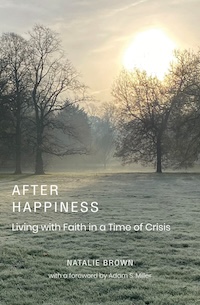
 Review
———-
Title: After Happiness: Living with Faith in a Time of Crisis
Author: Natalie Brown
Publisher: Greg Kofford Books
Year Published: 2026
Pages: 152
Genre: Religious non-fiction
Binding: Paper
ISBN: 978-1-58958-846-2
Price: 19.95
Reviewed by Jennifer Quist
Too far north to care much for Utah newspapers, I had no preview of the cultural commentary on US-American Mormonism that Natalie Brown had been writing for the Salt Lake Tribune over the past three years. When I requested that my Canadian university add Brown’s After Happiness to its library, it was mostly because of the title, which intrigued and, admittedly, slightly alarmed me. Like Brown, I’m a practicing Mormon woman, an academic with a complicated dead dad, and my ongoing project in Mormon Studies also has the word “happiness” in its working title. Had I just been scooped? No, of course not. There is plenty of research and literature on happiness yet to be written in Mormon Studies, and despite my work in this area, there was a lot for me to learn from Brown’s book.
A responsible researcher, Brown takes one for the team in doing the vital, foundational work of historicizing Mormon discourse on happiness with sources from official channels on Church history, sermons by Church general authorities, articles posted on the Church’s website, and scripture itself. Blended into this history is the twenty-first century commentary of podcasters, whatever bloggers are called now, and more journalism from US outlets. Academic literary and social science studies are included as well, most of them directly related to Mormon Studies. From outside Mormon Studies, Sara Ahmed’s germinal work on happiness lends the book more general theoretical support and relevance. Through this kind of eclectic literature review, Brown assembles a valuable corpus for arguing her own ideas and as a resource for future writers and researchers.
Still on history and theory, Brown conceptualizes values that emerged in the US alongside the Church during the nineteenth and twentieth centuries, challenging “common sense” with critiques of the capitalism and individualism that take up so much space in happiness discourse. Brown distinguishes these ideologies from historical Church doctrine. She calls out concepts of self-reliance that focus “primarily (or even exclusively) with individual economic independence” (8). Brigham Young, Brown notes, emphasized self-reliance on the level of community. “The Church’s turn toward happiness rhetoric paralleled the weakening of Latter-day Saint community,” writes Brown, “and placed more temporal and spiritual responsibility on the individual Saint and their family” (9). Brown includes herself as an object of critique and is forthcoming about the benefits she enjoys under these systems, a trace of self-aware regret in her own nostalgia for the nation’s waning prosperity.
But then she takes it too far, lamenting that “many of the cultural norms that we experience as being synonymous with living the gospel were never possible outside the United States” (5). This statement seems to be offered as an acknowledgment of privilege, and I don’t believe Brown means to efface or ghettoize those of us living lives of privilege and prosperity outside the US. As good as her intentions may be in making this statement, it is still US exceptionalism and it is still a problem in fact and in effect. Such statements are not limited to historical comments and intrude into Brown’s speculation on the future as well. Brown writes of her generation of Church members as people who “may be the last scholars to receive a liberal arts education” (127). This may be arguable in the US, but there are certainly societies throughout the globe where liberal arts education continues to be viable and accessible. Surely it is too late in history to still be conflating the experiences of general Church membership with US-American life. Especially when US imperialism is mounting in the western hemisphere, and while US complicity emboldens the imperialism of other superpowers elsewhere, this conflation has perhaps never been more inappropriate. This lack of perspective, however, is a rare departure in an overall reading experience that left me feeling incredibly well seen.
Chapter two is framed within Brown’s account of being a young Mormon wife aspiring to a career in academia. Somehow, I hadn’t realized how poorly experiences like ours had been documented or validated until I read it. A married Mormon woman’s academic career can exist in a state of misty dissonance. We may be reluctant to talk to fellow Church members about it. In Brown’s case, this may be in order to not be deemed defiant of Proclamation gender scripts. For me it may be because talking about intellectual work is sometimes seen as bragging in need of being cut back down to size with jokes about my “piece of paper.” I have never forgotten the grin of the fellow Relief Society sister who asked me what I was studying, and when I told her, she answered, “Gobble-dee-gook.” Brown wasn’t standing next to me to see that moment, but in telling her own story, she saw it even more clearly than I did.
At the same time, she sees how women like us may be reluctant to talk to colleagues about our identification with a Church whose most public moments are its shameful ones. “I have never told my professors that I am Mormon,” Brown writes of herself as a young student. “I sense that it would not be well received by everyone, or would dramatically alter how people look at me” (51). In unpacking this doublebind, Brown has real insight into what holds back the happiness we might find in work that can feel like an old-fashioned vocation – an occupation that is also a spiritual calling. Brown interrogates what it is that leaves us glazed over with apologies for ourselves, what degrades the life of an academic Mormon wife into a secret life. The cause is what it always is: patriarchy. “Gender,” Brown writes, “is not a problem merely in the Church but in every facet of American [enough already] life. Religion and academia are ancient, codeveloped systems built by powerful men who assumed women, less powerful men, and minorities would accommodate, conform with, and labour for their needs” (52). Gender remains one of the book’s through-lines, adding this book to the rich TBR list in this area.
In another review of After Happiness, Conor Hilton has called it “pastoral.” Especially in the third and fourth chapters, this is a fitting description and the point where my academic reading habits become disconcerted. Words like “should” and “must” occur more than I care for, but there is wisdom and practical help in the subheadings of good advice in chapter three, the section titled “The Courage to Be Unhappy.”
The final chapter is mostly a close reading of sections of the books of Nephi. It is the shortest chapter and the one heaviest with quotations of scriptures – block quotes over ten lines long – and references to exegeses by other scholars. The reading and the research are fine, but through these passages, Brown’s voice recedes, and the chapter is worse for it. Brown’s voice is that of good personal longform journalism. It is engaging while adept in conveying complex situations and ideas with clarity. It expresses something too often dismissed as impossible: the holding of faith, curiosity, and intellectual honesty all at once. But through the Nephi chapter, the voice becomes too generic, and I’m left casting about, trying hard to keep seeing Brown like she has seen me.
This chapter leaves the impression that the voice that has been driving the argument is flagging, wrapping up too hastily. This is to be expected in the writing process of any book and is to be countered with editing. That is not to say that this book isn’t otherwise well edited. I’ve seen plenty of disappointing editing in Mormon publishing and, up until the final chapter, I had been impressed with the superior quality of the editing in Brown’s book. But as a one-time editor of Mormon literature myself, I say we can do better, especially for debut authors new to the rigours of book-length manuscripts. Something besides Brown needed to come through chapter four to refresh and reinvigorate the narrative, invite the voice to speak up, slow the pace down, space it out, let it move. Someone should have suggested to Brown that she doesn’t need the last sentence of the book – that the already strong ending would have been stronger without it. If you pick up this book to read it yourself (and I hope you do), do a little editing of your own and stop reading at the beautiful line “there is no goodbye to be said.”