
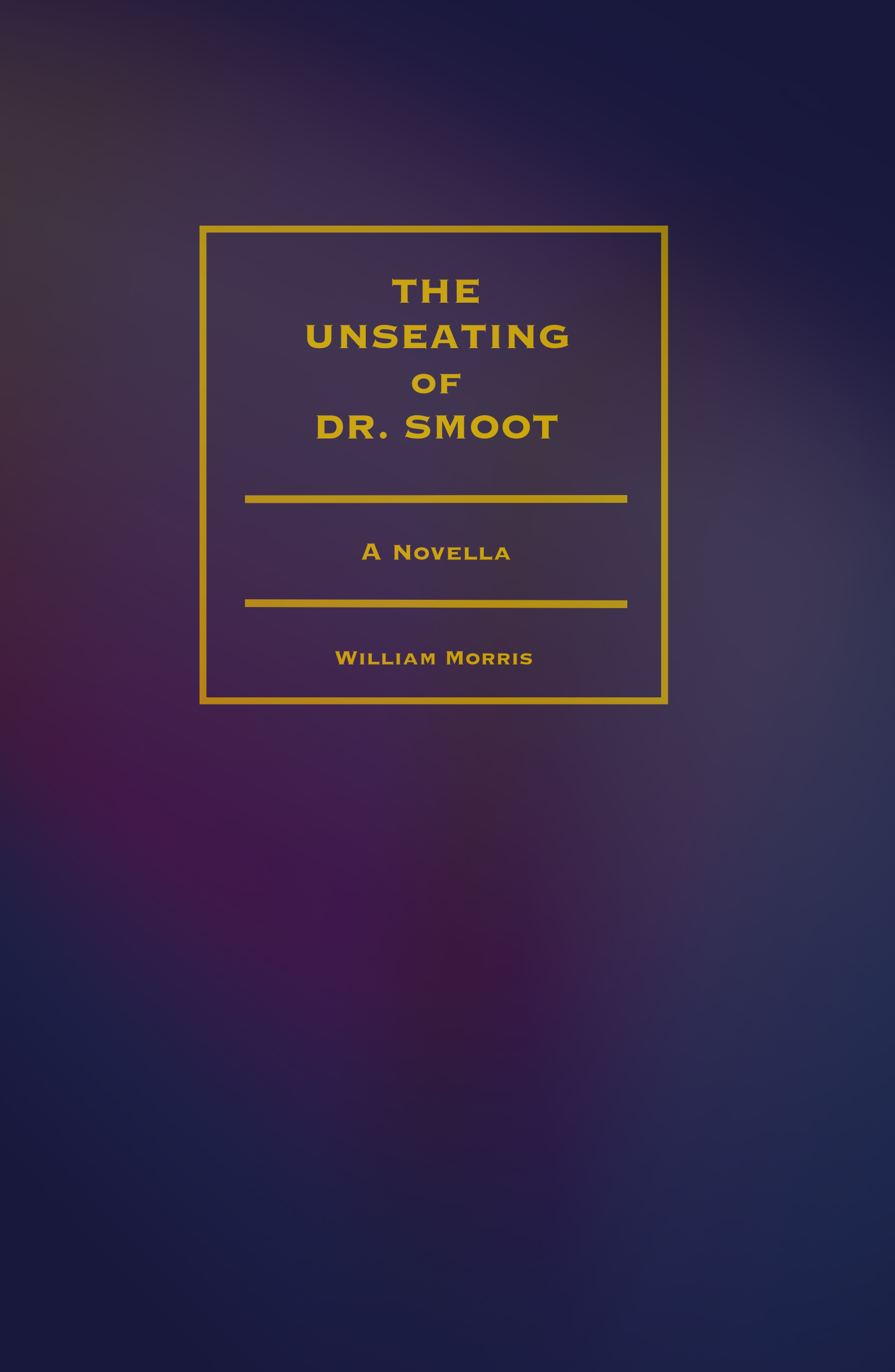
 By Michael Andrew Ellis, republished from his website.
I first read The Unseating of Dr. Smoot by William Morris soon after its publication in 2023. The title intrigued me, and I was eager to see whether Morris’s choice of the surname “Smoot” for his main character referred in any way to the Utah Senator Reed Smoot hearings of 1904-1907 in which over half of the US Senate sought to unseat Senator Smoot for his connection to the past LDS practice of polygamy. A lover of form, I appreciated the structuring of the story into chapters named after the common events of an LDS sacrament meeting. Morris’s long sentences, diction, and observations on Utah Mormon culture filtered through Dr. Rebecca Smoot’s “container of consciousness” engaged me. But when I finished the last chapter, I was surprised to discover that I had reached the end. Seeking closure, I was perplexed that Rebecca remains in the same situation and experiences the same ambivalence at the end as at the beginning of the novella. However, upon reading it again three years later, I have discovered that I was unprepared at the time to read the novella as Rebecca herself hints that it ought to be read, as a work that resists closure both at a structural and a character level when it matters most, reflecting Rebecca’s own epistemology of keeping an open mind to truth and knowledge from whatever source they may come, satisfying her “urge to fill information gaps that had plagued her most of her life,” and to the varieties of mortal experience.
Questions of Epistemology
Rebecca hints at her core fundamental belief in the significance of our mortal experiences in the “Sacrament Hymn” and the “Administration of the Sacrament” chapters, but her curiosity about truth and knowledge and the “assemblage” she builds with them atop that fundamental belief becomes clear in the first “Adult Talk” chapter. Her best friend Jenny’s husband Scott is undergoing a “faith crisis,” and she is surprised because she “hadn’t thought him self-aware enough to engage in questions of epistemology.” Enviously, Jenny describes Scott’s crumbling faith, saying, “he, like, just starts picking at one little thing, and it all unravels for him.” As Rebecca processes this revelation, we become privy to how she sees herself balancing the often irreconcilable demands on Latter-day Saint belief and faith:
She was having one of those moments where she became very aware of the fact she wasn’t sure how she knew the things she did even though she had a certain staunch, perhaps arrogant, confidence she knew them and held firm to the belief that no one else knew any better than she did.
She couldn’t remember a time when she hadn’t been pulling knowledge and experience into her orbit regardless of source and through any method—study, sensory experience, the whisperings of the Spirit, creative imagination—available to her. Always seeking more for the creaky, multifarious edifice she’d been building since childhood. One that had proven fairly useful in teaching others but was so idiosyncratic and bulky that it’d be impossible to construct for anyone else. One she was fairly certain wasn’t in danger of toppling because so far she’d been open enough to integrate, no matter how awkwardly, everything she’d ever encountered, but strong enough to not let one worldview or critical lens or compelling narrative overpower her fundamental belief that this world was meant for the children of embodied Heavenly Parents to learn, grow, experience things more vividly than they could as spirits. (Emphasis mine)
Setting aside her healthy theological outlook for getting through mortal life, observe how she “knows,” but at the same time undercuts that “knowledge” by admitting that “no one else [knows] any better than she [does].” This underscores her resistance to letting “one worldview or critical lens or compelling narrative” rule. This instance of an irreconcilable pairing serves as a method for reading, understanding, and even enjoying the novella. Irreconcilable truths, dual propositions that are both true and in tension with each other, but neither canceling the other, abound, and that fact endears Rebecca to me more as a “kindred spirit.”
Like Rebecca, in my own life, I find myself exploring, gathering knowledge, evaluating experiences, being indecisive, having faith, having doubts, trying on personas, shedding them as fast, and making an “assemblage” of my belief. I look with envy and pity upon those who have settled opinions, who have life “all figured out.” How do they “know”? I cannot resist evaluating my positions and opinions again and again. I pity them for “not being self-aware enough to engage in questions of epistemology.” I am more complete as a person for having gone through a “crucible of doubt.”
Container of Consciousness
I mentioned above that when we read The Unseating of Dr. Smoot, we’re inside Rebecca’s “container of consciousness.” That term comes from one of the essays of the late writer and essayist, William H. Gass, and inspired by the fiction and commentary of Henry James. The text is all that is. Morris’s novella contains Rebecca’s consciousness. There is no authorial interpolation. The observations, the judgments are all Rebecca. There is no indication that we’re dealing with an unreliable narrator here. She is trustworthy. That said, any irreconcilable “readings” of the text as Rebecca are hers and this contributes to her being “real.” As a fictional character constructed from the text Morris gives us, Rebecca is antithetical to the common fictional character who wants something so badly she boldly faces the obstacles she must overcome to get it. Rebecca equivocates about what she wants. This adds to the lack of complete closure at the end of the novella, but it resonates with me as more “true to life” than the driven character of much fiction.
The Sacrament
The seventh chapter of fifteen, the “Administration of the Sacrament” chapter relates Rebecca’s lecture at Brigham Young University on the Gilead novels of Marilynne Robinson. This rich chapter introduces several irreconcilable ideas in tension that echo throughout the rest of the novella, both forward and backward from that point. A third of the way into her lecture, Rebecca acknowledges to herself the Latter-day Saint desire for knowledge and truth placed over against doctrine and religion when she says, ironically, “Look at us being smart and educated and religious. Here in this place, this right place, gathering intelligence, armfuls of glory.” Rebecca understands that the more you discover and pull in truth from various sources, the more you are called upon to evaluate what you know.
Next, in a beautiful and poignant passage, she sets the LDS worldview of seeing themselves as “exceptional” against the genuine communion with deity the sacrament ritual demands, that includes creating “connections that flash with pure knowledge, the satisfaction of some strange integration between the Mormon stuff and some of the other stuff.” Then, in speaking of how “we as members of the Church should be very sympathetic readers of [Robinson’s] work,” because Latter-day Saints “know what it means to be misunderstood,” she encourages us to sympathize and try to understand marginalized people. It’s the setting ourselves apart as “exceptional” versus the digging into the experiences of what goes on in life.
This dichotomy is delineated even more by Rebecca’s thoughts wandering to the images of Robinson she had to choose from for her presentation’s backdrop. The one she decided against evokes Dale Parson’s portrait of Christ displayed in many LDS homes: a White Christ with red robe. Instead, she picked a photo of Robinson in front of a tapestry that, in Rebecca’s mind, inspires thoughts of the “great and spacious building” from Lehi’s dream in the Book of Mormon, an allusion to the idea of living “in the world but not of the world.” Ah, those irreconcilable prepositions, how does one live “in” the world, but not “of” it? Admittedly, a play on the word “world,” but, once again, the proposition is to set ourselves as Latter-day Saints apart from what we perceive to be the less desirable elements of life instead of engaging with them in a productive way.
In the next section of the Robinson lecture, Rebecca mentions the words “former and future Zion,” and she senses the audience (and herself) experiencing that “welling” up of emotion about something they hold dear. Rebecca questions whether it’s the “workings of the Holy Spirit or sentimentalism, some autonomic reaction. Or was it the way the one manifested the other? Or something else entirely?” Belief in Mormonism prioritizes the feelings you have as you read The Book of Mormon, listen to General Conference talks, or go through the conversion process. That Rebecca acknowledges she can’t always discern between the “workings of the Holy Spirit” and mere emotive rhetoric that achieves a similar effect further earns my respect. If it is the “way the one manifest[s] the other,” then I have a testimony of It’s a Wonderful Life, the importance of sacrificing time and means to help others, and that Fitzwilliam Darcy and Elizabeth Bennett belong together forever as much as I do about the religious experiences I’ve had as a Latter-day Saint. Yet, that manifestation cannot be denied as significant for the hundreds of thousands each year who experience this “welling” sufficient to motivate them to change their lives and join the Church, or any other church. But it’s not all feelings, as Rebecca alludes to at the beginning of the chapter: Mormons value intelligence and “study[ing] it out in your mind” to arrive at conclusions about the big questions in life. Feeling isn’t supposed to discount using your God-given reason.
Mormon Lit Manifesto
The final part of the lecture rang odd at first, coming as it does from a character who studies literature but isn’t a writer of fiction herself. In the “testimony” portion of her final thoughts on Robinson, Rebecca points out that Marilynne Robinson, Flannery O’Connor, Chaim Potok, and (I could add) a host of other non-Mormon authors write moving, spiritual, and transformative literature, and these are held up as models for writers of Mormon literature. She states that she’s sick of these comparisons, but softens her comment by stating if Mormon writers want to emulate them, that’s fine, but urges them to write about who they are and where they come from, and the “specific circumstances of how [they] are members of the Church.”
Rebecca hints that a failure of Mormon fiction is its predominant focus on the Mormon Corridor and its avoidance of the experiences of mortality that make each of our own stories different, even though we share a connection to the Church: “individual daughters and sons of heavenly parents brought up in our own unique, peculiar mortal ecosystems.” She calls upon Mormon writers to be “haunted” by where they are from. She says, “And rather than attempt to run from or hide from those feelings, turn towards them. Embrace them. Embrace the ghosts. Get to know them. Maybe even reckon with them. Let them be present for you ….”
I take Rebecca’s injunction not to “ignore the diverse experiences of mortality” to include the uncomfortable things that literature allows you to experience and be transformed by. We cannot handle vice and evil with kid’s gloves and expect to impact and transform an audience desensitized to what we Mormons set ourselves apart from. Adversity and missing the mark come in more “divers ways” than getting cancer and losing one’s temper. We must be honest about our mortal experiences rather than insist upon “[portraying] not the unclean thing.” Be present and be real. Write in the world as if you are of the world, because you are. Then again, remember “moderation in all things.”
Opening Hymn
I began with the “Administration of the Sacrament” chapter because moments in the chapters before it build up to it, and then in the chapters that follow it, one tends to evaluate Rebecca by the “glow of satisfaction that would soon fade yet wouldn’t tarnish the possibilities, the new ones and the old ones, [Rebecca]’d discovered during the course of the lecture,” by the standard she’d set up for herself. But through it all, she holds two irreconcilable truths or propositions in tension, striving to keep her “edifice” upright and stable.
In the “Opening Hymn” chapter, Rebecca is in her hotel room and her first thoughts at the start of the chapter present the dilemma of all the things you “should” be doing versus being present, or seeing all those things as options you could choose to do rather than have to do. In college, I took a psychology class in which I learned that “should” is a swear word. “Don’t ‘should’ on yourself,” said the professor. Yet, the Protestant Work Ethic and the belief in prosperity equating with righteousness persist in Zion.
Rebecca chooses to “be,” to veg in front of the TV for a few minutes. She watches a cooking show. I love the way her thoughts about the cooking show competition map onto her place in academia and her place in the LDS community. She mentions that the cooking show judges said every dish needs at least three different textures. Then:
One of them also mentioned how a bit more acid would have added brightness. Rebecca had never had trouble with the latter, but sometimes fretted about the former.
She interprets this thought in terms of her academic career, but it can be read in the reverse as her position in the LDS community, in Utah Mormon culture. In academia, she’s bright, agreeable, and doesn’t take on difficult subjects that would set her apart, when more “acid” might be what she needs to progress. If she’s more bold, it’s a greater risk, but it offers her greater opportunities. Alternatively, in Utah Mormon culture, she can’t help but be set apart as different. It’s not a bad thing. She’s unmarried, intelligent, introspective, and has the perspective to influence lay members to think about things in a different way than usual, to become “aware enough.” But, unfortunately, the more bold she is at church, the more likely she may be assigned to the margins and unappreciated.
She likes how the cooking competition shows “moved in stages, had predictable steps, has familiar, repetitive phrases, like a good hymn—or the temple.” She continues:
It gave them a certain formal momentum, a gentle raising of the stakes, she preferred over the you can aspire to cook this at home shows with their ‘you could do this or this and look how easy this came together and oh it’s yummy, isn’t it?’
She’s thinking in terms of how having an outline of steps to deal with the politics and administration side of academia would help her, but this too maps onto a Latter-day Saint’s tension between having a “covenant path” that’s supposed to be the same or similar or predictable for everyone, with incremental commitments and risks associated with those covenants and obligations, and the reality of each person having their own agentic journey in mortality and even feeling confined by the ever increasing expectations and structure of the former.
Presiding Authority Remarks
The novella, filtered through Rebecca’s consciousness, comments on Mormon men in positions of authority. In the “Prelude” chapter, Rebecca’s thoughts about the stake-president type she experienced on the plane ride to Utah set us up to expect more male characters like him:
The next few days would be filled with men like him. Sure, most of them would be able to swaddle their status and personality in academic discourse or the padded layers of academic administration speak, but their enthusiasm and attentiveness would contain a hidden pith of wariness and seed of neediness. She would need to temper both her expectations and her habit of matching their energy.
But both men who gate whether she has future academic opportunities in Utah—Kirk at Utah Valley University and Jared at Brigham Young University—are prevaricating, apologizing, uncertain, indecisive, and wimpy compared to what we expect. It is embarrassing, yet rings true to life, how much Kirk apologizes. This set up is keenly dramatized in the “Presiding Authority Remarks” chapter. Both men call to inform her that while she was impressive, they can’t promise her anything right now. They are weak, but if she wants a position at either university, she must wait on them and the influence they hold within their respective positions. The image of Jared “leaving behind an exploded halo of yellow-white crumbs on the table” at the end of the “Announcements” chapter foreshadows what Rebecca ends up getting from them.
Does this weakness, this Beta-maleness, while being a part of the Mormon “patriarchy,” extend to the other two males presented in the novella? It does. Jenny’s husband, Scott, in the “Adult Talk” chapter mentioned above, echoes the stake-president type Rebecca met on the plane, yet despite the impenetrable shell he appeared to have, “lacquered up over a lifetime of knowing exactly what [he was] made for, that future reinforced at every moment of [his life], and hardened and polished during [his] mission,” his faith unravels when he starts “picking at one little thing.” Not “self-aware enough to engage in questions of epistemology,” the faith of these men is fortified in ignorance, but fragile when a bullet of scientifically accepted knowledge shatters their clay pigeon.
Rebecca’s dad presents as pragmatic, casual, and unassuming. He doesn’t attempt to exert any control over Rebecca. He lets her come to him. He enjoys the freedom he has to let things go in his widowhood. In the second “Adult Talk” chapter, which pairs with the faith crisis presented in the first, Rebecca’s dad admits he doesn’t recall her mom ever saying why she liked the painting of a woman in a purple polka-dot bikini diving off a cliff that hangs in their kitchen. That he doesn’t know why sounds odd considering he co-ran an art gallery with his wife and would likely have had discussions with her about the paintings they bought. But could it be that he feigned ignorance to draw out Rebecca’s interpretation and have a moment where he could appreciate her intelligence and art analysis? He sets aside his supposed “authorial position” to allow her to shine.
A few years ago, while lunching with a friend of mine who taught at BYU in the early 1990s, he mentioned the uproar over the feminism erupting at the time in the Humanities, and then he said with a smile, “But all that’s changed. We’re all feminists now.” This may be true to a large degree in the Church now, but even if Priesthood power and authority has been re-understood during President Russell M. Nelson’s tenure to be exercised by women in their callings, it remains true that “covenant-path” Priesthood ordinances are administered by males. The Church is changing from the more strict gender role interpretations of the past, but this tension exists. It is a nice touch that Morris sets up Rebecca’s lecture so that in a way, from a position of authority, she’s administering a sacrament to her audience.
The Unseating
To be “unseated” is to be removed from a position of authority or political office. The specter over Rebecca’s consciousness for nearly the entire novella is that her “tenure clock” at the University of Wisconsin—Madison has been extended for two years. After that time, she either gets tenure or she’s not allowed to take a seat in academia and is out hunting for work. But that can’t be the “unseating” because it hasn’t happened yet. True, she’s exploring employment opportunities in Utah during her visit, but she has a position at UW. An exploratory interview happens at UVU and then she has the lecture at BYU. Yet, at the end of the novella, the certainty of securing a position at either university is no firmer than at the beginning. If anything, this mirrors what happened to Senator Smoot. The threat of being unseated hung over him for three years before the vote took place that seated him more securely in Congress. Revisiting the possibilities of employment in two or three years is all Kirk and Jared can offer Rebecca.
There is the idea of “unseating” in relation to the sacrament. If religious leaders determine a person is unworthy to partake of the sacrament because he has confessed to a sin that requires it as part of his repentance, he will be excluded from partaking for a period. But he must attend sacrament meeting and bear the shame of those beside him noticing that he has abstained from partaking. Members of their own accord can judge themselves unworthy and refuse to partake too. This is less of a physical “unseating” than a spiritual one.
I don’t believe that this aspect of unseating applies to Rebecca, but it is clear from the text that when she’s among friends and family in Utah she doesn’t feel accepted for who she is and the choices she’s made in life. She barely interacts with her sister Maggie. And Hal, whom I take to be a brother, gets one line in the entire novella. There is an underlying resentment toward her way of life that her group of college friends exudes, rather bitingly from the minor character Melanie.
Yet, because we’re in her consciousness, she doesn’t give us much to go on to determine her level of church activity. (I do feel guilty, incidentally, for being led into forming a judgment about her from the clues she leaves, but alas, I’m human.) It’s implied that she wears garments from the length of her skirt. Kirk and Jared both value her for the “type of Mormon” she is. Her niece wonders how she manages to navigate the line between what their religion demands and what her heart tells her is right. Jenny confides in her regarding her husband’s faith crisis, but doesn’t accept Rebecca’s offer of talking to Scott yet. Rebecca doesn’t share what her calling is at church, how her ward at home in Wisconsin might be different from a Utah ward, and what Sunday School might be like in a roomful of academics who are open to “questions of epistemology.” As a reader, I assume she’s an active member, but within the text, this resists closure. It’s a trap, because I’m drawn into making assumptions and judgments about her that make me complicit in the way the Utah family and friends make her feel, as the “Other,” thereby unseating her.
I once heard that experiencing something is gaining a knowledge about that thing by living through it. Throughout the novella, Rebecca’s epistemology holds onto her core belief about mortal experience. As high and unwieldy her edifice built atop this belief is, she emphasizes it several times in the novella, even teaches it, as mentioned above, but in the “Sacrament Hymn” chapter, she calls into question her memory of a seminal experience from her childhood and her interpretation of it. Had she misjudged her grandmother’s fastidiousness over her getting her pink dress dirty? Had she read into it more than what it was? If the memories of our experiences can be called into question, how certain is our knowledge about them? Perhaps one “unseating” is her recognition that she is not in a position to speak authoritatively about her own experiences?
I began this essay saying that I wanted closure. Upon reading the novella again, I appreciate the subtle shift in Rebecca’s paradigm as she leaves Utah in the “Postlude” chapter. Accepting that nothing is settled, she has possibilities. She recalls a quote from the Reverend Ames in Gilead about the openness of the prairie and the impertinence of the mountains. She takes home a lesson from her BYU lecture to focus on the Midwest where she’s planted right now. Feeling like there is no place for her in Utah, she’s unseated. But one could ask, Has she reckoned with her ghosts? Has she resolved what troubled her about growing up in Utah? These questions remain open, and one could argue that she may be running away from her ghosts, for now.
One thing that does offer closure and resonates with the lessons Rebecca both teaches about and learns in the “Administration of the Sacrament” is a beautiful image in the “Closing Prayer” chapter. In the Springville Museum of Art, Rebecca notices an “assemblage,” a collection of artifacts put together in a way to provide message and meaning. That it’s an assemblage maps onto her epistemology. The engraving of the word “indite” on the brass plaque affixed to the “polished black walnut handle” of the mini revolver in the assemblage complements Rebecca’s call for Mormon Lit writers to write about our experiences here in mortality, her “Mormon Lit manifesto.” That “indite” is engraved on the handle of a mini revolver indicates that there is an aspect of “life-and-death” choice and struggle to writing literature. You never know where your exploration of an idea or theme will take you, what dark corners of your soul it will illuminate. Rebecca thinks for a moment that the text in the assemblage, the first page of Chapter 18 of Jane Eyre, had “nothing to do with it,” that “it was just meant to be a container.” But she suspects otherwise, and she’s right. The text is all that is.
If you haven’t read The Unseating of Dr. Smoot by William Morris, go read it. There are more layers to it than I have explored in this long essay. If you approach it as Rebecca does mortality, with an open mind, it’s you, the reader, who will be unseated.
Great essay. Got me to buy the book immediately–which is always the best compliment you can give any review. A novel structured by the cycle of a sacrament meeting, allusions to Robinson’s Gilead novels, a Mormon Lit Manifesto, and the tenure clock. You’ve sold me. Bonus: It combines the only two worlds I am sufficiently embedded in that I am qualified to write fiction about: Mormonism and academia. Well those and maybe the high school hijinx of 1980s John Hughes films and Naploeon Dynamite-esque teenagers wilding–in a good Mormon way, of course–in Boise, ID circa 1985. If you are a card-carrying member of that last club and want to write some fiction about it, hit me up and maybe we can workshop a few short stories together. And while you are at it pre-order William’s latest novella–11 Bookmarks–which “drops” on Tuesday in the parlance of the kids these days. Eager to read both.