
 Review
———
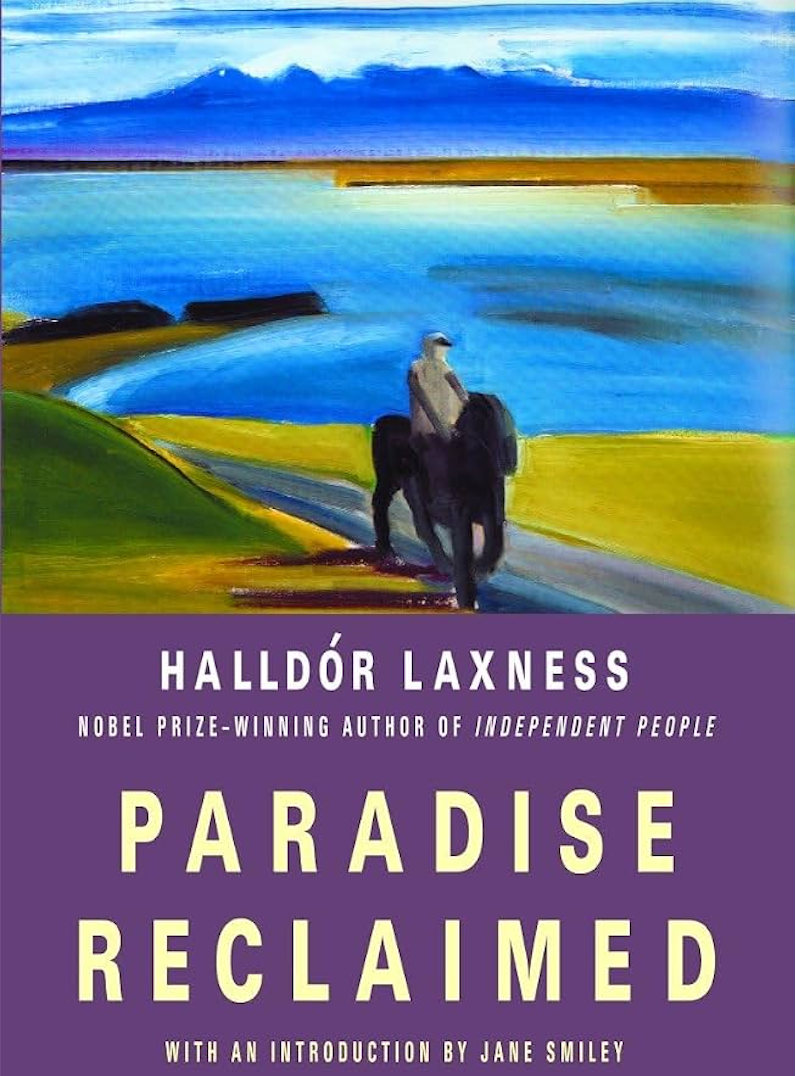
Title: Paradise Reclaimed
Author: Halldór Laxness
Publisher: Knopf Doubleday
Genre: Historical fiction
Year Published: 1960
Number of Pages: 320
ISBN:9780375727580
Reviewed by Randy Astle
[Editor’s note: Halldór Laxness (1902–1998) won the Novel Prize in Literature in 1955.]
This is my first foray into Icelandic literature, and what a queer little interesting book this is! I read it specifically because of my research into Mormonism and cinema, and the 1980s West German miniseries adaptation of it; since that hasn’t proven easily available, reading the book is the next best thing. So here are a few general thoughts followed some on the novel’s take on Mormonism and the pioneer experience.
I haven’t read all of Paradise Lost (or Paradise Regained) yet but I am familiar, so I think the first place you have to start with this is with the title. I don’t see a lot here about Satan’s journey or an epic battle with God; instead, we start on a humble farm with a husband and wife who, like Adam and Eve, are completely innocent. In fact the language throughout, as rendered in English by Magnus Magnusson here, is simple and terse, reminding me at first of perhaps Hemingway, but quickly proving to be something much more childlike: this renders the entire story in a way that seems simplistic and straight-forward, giving it the veneer of a myth—or, perhaps, a saga—making you feel like these characters could be archetypes, or at least that they live outside of the realism or naturalism that you would expect in most contemporary fiction—like Hemingway. But it also simultaneously allows for Laxness to sneak in irony and satire, of religion, of the justice system, of politics, of love and sex, even of Icelandic customs of hospitality.
So the language is simple, and so are the characters. It’s almost tempting to assert that our protagonist Steinar of Hlidar has no growth or learning. That of course is wrong, but what does stay the same is his eternal mental simplicity: when he gets to Utah he forgets his own name. Whenever he is hit by an impulse he follows that impulse regardless of others’ opinions or the difficulty of performing the action. Thus he gives away his family’s two prized possessions—their foal and their chamber box—just because he thought it would be nice, and he sets off to America just because he hears it is beautiful and has good drinking water—and, ironically for someone with so little introspection, because they have “correct thinking” there. Once he makes up his mind he journeys from Copenhagen to Salt Lake City in the course of about six words; Laxness just skips his entire journey, eliding it from the narrative and jumping us ahead to Steinar’s adjustment to his new surroundings.
So if we are to parallel Milton, there isn’t much of a lost Eden in Steinar’s case. I mean, the deserts of Spanish Fork sound much less attractive than Steinar realizes, as he’s content spending all day and night working and sleeping in his brickyard. It’s back home in Hlidar that his wife and children lose everything and become separated and destitute. The book begins with a virgin birth, that of their pure white pony, which seems magical and a metaphor for freedom and divine providence, until Steinar foolishly gives it to the Danish king who condemns it to pulling the children’s cart. But then there follows another virgin birth, when Steina the daughter gives birth (to a boy) without any awareness that she had been pregnant or even had sex. But if Jesus was born to save us from our sins, this birth is the beginning of the end (besides Steinar’s desertion) for the family, as Steina is just too innocent and naive to work her way through the courts that are seeking to establish the child’s father, even when the sheriff coaches her on what to say. She adheres strictly to the truth as she understands it, which, just like when Eve falls with Adam (with all its sexual connections about the loss of innocence), ultimately results in the loss and destruction of the farm.
This of course would make the young boy’s father, the affluent horse dealer Bjorn of Leirur, a friend of Steinar’s, the serpent of Milton’s story. But Laxness complicates things, particularly in the second half, by striking Bjorn blind and a pauper—perhaps akin to cursing the serpent to eat the dust of the earth—and, unlike the serpent, turning him into a sympathetic character. Law, society, Bjorn’s industry and capitalistic endeavors with the sheriff, all are satirized in a subtle but rather Dickensian way. At the book’s end he tells Steinar, now a Mormon missionary, that he is just as much a Mormon himself, without any need for baptism, because Steinar’s daughter “converted” him when he had to acknowledge their son.
So what of the Mormonism? Well, from that comment Bjorn seems to be boiling the faith down to polygamy—early in the book he envies the Mormons because they get to have many wives openly while he has to conduct his sexual exploits secretively—and polygamy does loom large in these pages. The Bishop who “converts” Steinar is the main pundit on Mormonism’s behalf, and you can tell Laxness did a fair amount of research, allowing him to get many small details about the culture and geography correct. I even liked that the Utah Mormons drank coffee, something that’s taboo today but was ubiquitous in 19th-century Utah.
But, like with the simplified language throughout, the language used to describe Mormonism feels like it comes from a slightly different dimension, as they sing the praises “correct thinking” and the “Gold Book,” which is not how Mormons then or now spoke. While he gets some things spot on the nose, others are completely erroneous, like the lack of temple ceremonies (or even Endowment House ceremonies) to seal children to parents or couples together. Early temple worship was lightyears away from how it is done today, with prayer circles occurring in people’s homes, etc. But the bishop “baptizing” a toddler—something which has never been done under pain of damnation (that’s from Moroni 8 in the Book of Mormon, plus some D&C revelations)—while simultaneously sealing the boy to himself has no resemblance to Church doctrine or practice at the time. The two marriage sealings that take place are also done serendipitously and outside any temple grounds, so modern Mormons will reject this inaccuracy. Perhaps, however, Laxness didn’t realize how unorthodox this was as he researched the history of Erikur Olafsson, his model for Steinar. In this historical case Olafsson evidently performed his own marriage ceremony, something so unusual it was submitted to the King of Denmark to validate, which he did. But Olafsson seems to have been an eccentric with his own thoughts about ordinances, and he soon apostatized entirely. Since there’s not much doctrinally that seems to draw Steinar to the faith—he’s just searching for paradise—maybe this isn’t such a great flaw after all. His sealing a mother and adult daughter to himself in Utah then immediately abandoning them to return to his farm in Iceland, just like he earlier left his Icelandic family to journey to Utah, has not just poetic symmetry but the sense of a cyclic story repeating for all time and eternity.
I should note that polygamy is given an incredibly sympathetic treatment here. From the novels of the 1870s to the stage plays of the 1890s to the films of the 1910s, most treatments of polygamy from outsiders were critical at the least, and exploited it to portray the Mormons as lascivious monsters more often. Mormons themselves, by and large, avoided the subject, as they knew how strange that practice made them appear to outsiders, even decades after its cessation in the 1890s. In fact, rather than portraying the Mormons as lecherous old men, he essentially uses the real-life Mormons’ own explanation of the practice, that the practice was meant to care for single women who needed some (patriarchal) protection and financial care. The Bishop has married an old destitute woman and a woman who has lost her honor, an act he repeats when Steina is unwittingly seduced by a trio of men on the Atlantic passage; Steinar himself sees no fault in this and soon follows suit, as mentioned above.
This is a sympathetic perspective on the practice, but Laxness does fall into the trap of making polygamy essentially the only unique trait that defines the Church. For all the talk of Joseph Smith, correct thinking, and the Gold Book, nothing else about Mormon belief distinguishes them from the Icelandic Lutherans; this is generally how Mormonism and polygamy were treated by the midcentury, as with the films Brigham Young (1940), Bad Bascomb (1946), Wagon Master (1950), and the play Paint Your Wagon (1951). The fact that Mormons, even with their polygamy, aren’t so abhorrent after all is made clear when Steinar returns home as a missionary and, instead of being beaten and driven out, he is invited to preach in Lutheran churches. This isn’t ecumenical acceptance or the growth of the Church, though, as some Mormon readers may take it. It’s pure satire of organized religion, whatever its form—there’s no difference between Mormons and Lutherans when it’s all just a bunch of baloney.
[This paragraph contains spoiler information.] But just a few pages later the book’s final paragraphs return to an actual paradise. Steiner has received the deed to his own farm, now destroyed, as a gift from the sheriff. When he sets foot on it he immediately begins restacking the stones that have fallen off the mountain, the very way he began the book. When a passer-by asks what he’s doing he says, “I am the man who reclaimed Paradise after it had been lost, and gave it to his children.” It’s not a doctrine, but a place that he is looking for. “I have found the truth, and the land in which it lives,” he continues, “And that is assuredly very important. But now the most important thing is to build up this wall again.” And he gets to work. There are a dozen different ways this could be interpreted, but the first to spring to my mind was that all of the political, social, and religious mores that the book investigates are hollow, misguided, and actual distractions from “the most important things.” The simple act of building the wall to push back the mountains and regrow the fields—in other words, reclaiming paradise through effort, rather than just regaining it with no work or toil—is where paradise can be found.
Adam and Eve were cast out of paradise and cursed to toil over the earth all the days of their life. But it precisely through that toil—shaping bricks in Utah, lifting stones in Iceland—that Steinar of Hlidar finds it.
.
Sounds like a fascinating novel. I wonder I can get over the irritations it would inflict….