
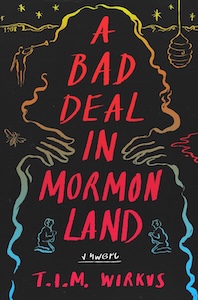
 A guest post by T.I.M Wirkus, introducing A Bad Deal in Mormon Land, a novel which is being published this week by Type Eighteen Books.
My first two novels frustrated some readers even more than I expected them to.
In City of Brick and Shadow, two Mormon missionaries turn private investigators when a recent convert disappears under mysterious circumstances. Despite their best efforts, the missionaries (and readers) never find out what really happened to the man; it’s an unsolvable mystery.
The Infinite Future centers on the long-lost manuscript of a profoundly obscure Brazilian science fiction writer. In the first half of the novel, characters (including a frustrated young novelist, an excommunicated Mormon historian, and a zealous librarian) search for the lost manuscript, building up the legend of the lost novel and its author as they do so. In the second half of The Infinite Future, the reader is presented with the lost manuscript itself which falls far short of the epoch-defining work the characters anticipated.
While some readers seemed to enjoy the particular ethos of those first two novels, others responded with what I can only describe as betrayal. Why would you write a book like that? they asked, sometimes explicitly.
My initial answer, then and now, is that the frustration and disappointment saturating my first two novels mirrored the books I most loved to read at the time, encyclopedic novels like Moby-Dick and 2666 in which epic quests (to comprehend whales, to solve mass murders in Juarez) ultimately fall short, leaving the novels’ seekers (and readers) to grapple with those failures and disappointments. That dynamic reflected the world as I experienced it then and I appreciated the way novels of frustration reminded me I wasn’t alone in my experience.
While I may not have recognized it at the time, one much-read-by-me book that fits this mold is The Book of Mormon. Take the large narrative arcs of the volume: At the beginning of the book, 6th century BCE Jerusalem residents Lehi and Sariah are led with their family first into the wilderness and then across the sea to a supposed Promised Land. So far, so good, except that in the Promised Land, rather than happily flourishing, Lehi’s sons develop such deep antipathy for each other that they and their children spend the rest of their days trying to destroy each other, initiating a cycle of infighting and warfare that will continue, on and off, for nearly a thousand years.
A significant respite to the conflicts comes when, over six hundred years after the arrival of Lehi and his family, a resurrected Jesus Christ visits the people of the promised land, teaching and healing them. A veritable utopia grows out of this visit, where the people have “all things common among them” and live in such a way that “there could not be a happier people among all the people who had been created by the hand of God.” This would be a sunny place for the narrative to end, leaving the reader awash in the hard-won peace and prosperity that comes after so many centuries of conflict.
The Book of Mormon doesn’t end there, though, instead tracing the decline of that utopia and its eventual descent, hundreds of years later, into a Cormac McCarthy-esque hellscape, replete with bloody massacres and cannibalism. It’s within this grim milieu that the reader is introduced to Mormon, and then his son, Moroni.
As its name suggests, the Book of Mormon presents itself as a collection of ancient writings compiled and edited primarily by Mormon, a prophet/historian living in a rapidly deteriorating civilization. When Mormon is killed in one of many gruesome battles, his son Moroni takes over the project.
Not surprisingly, given the general state of the world he occupies (not just his father, but all of his people are eventually killed in the epic wars of the Book of Mormon’s final sections), Moroni is especially attuned to the mechanics of disappointment. When the reader first encounters Moroni, he’s awash in despair at the prospect of finishing the Book of Mormon—as his father has commanded him to—in part because he’s alone and his life is in peril: “my father hath been slain in battle, and all my kinsfolk, and I have not friends nor whither to go; and how long the Lord will suffer that I may live, I know not.” External circumstances, in other words, are dire.
Moroni is also gripped, however, by a nearly overwhelming fear of disappointing his imagined readers, an audience whose ghostly presence he feels acutely, and with whom he’s desperate to establish some type of connection. At one point in the text, it’s as if Moroni suddenly realizes the pathos of his gambit: “Behold, I speak unto you as if you were present, and yet ye are not.” Even this imagined audience, though, is one worth hanging onto for Moroni, and he frets about how they will receive the words that he’s written. Not only does he worry—again and again—about the inadequacy of his writing skills, but also, more pressingly, about deeper flaws in both the text and its compilers.
The book is self-consciously compiled as a work of scripture meant to convince its audience “that JESUS is the CHRIST, the ETERNAL GOD, manifesting himself unto all nations” (capitalization here is the text’s). However, given both his vocation as an unwilling historian, and his situation in a war-ravaged society, Moroni seems more acutely aware than the book’s other narrators of the persistence of human frailty. He knows that mortal flaws that must be present in the volume, flaws that might impede the text from achieving its purpose.
Some devotional readers of the Book of Mormon may take Moroni’s protestations as a kind of aw-shucks modesty, but human ugliness is not hard to find in some of the assumptions and editorial decisions of the book’s narrators/compilers. There is, for instance, the consistent equating throughout the volume of lighter skin with divine favor. There is also the near total omission of narratives of or sermons by women. Such features don’t just disappoint, but devastate some readers of the book, an eventuality Moroni fears, but can’t prevent. His response to this conundrum comes in the form of a plea for understanding:
Condemn me not because of mine imperfection, neither my father, because of his imperfection, neither them who have written before him; but rather give thanks unto God that he hath made manifest unto you our imperfections, that ye may learn to be more wise than we have been.
Learn from our mistakes, in other words, and while Moroni’s plea for exculpation may be insufficient redress for some, the plea does forward a sneakily radical definition of scripture. Though it may be touched with moments of divinity, says Moroni, the book is no less fallible than its composers. By forcibly denying the inerrancy of the book’s authors, this model grants significant power to readers, positioning them as active participants in the search for and creation of transcendent meaning in the book.
Disappointment can lead in many directions, in other words, some of them positive, and when it comes to my own fiction, I’m increasingly interested in disappointment as a starting point for my characters, rather than a wall they run into at the end of the narrative.
My current novel, A Bad Deal in Mormon Land, takes place in Salt Lake City in 1908, and follows a cast of characters whose lives have not ended up how they’ve hoped: a fraudulent spirit medium whose career has been in steep decline for years; a former LDS apostle, excommunicated for sticking with the practice of polygamy even after the Church renounced it; a beautiful private investigator betrayed by a trusted friend; a plural wife of the ex-apostle who regrets having embraced polygamy as a young woman.
When the ex-apostle hires the spirit medium to summon the ghost of Joseph Smith to give his blessing to the ex-apostle’s breakaway sect, violence, double crosses, and the revelation of long-buried secrets ensue.
I like to think of A Bad Deal in Mormon Land as a kind of thematic sequel two my first two novels. Part of that is a function of age. City of Brick and Shadow and The Infinite Future both focus on young adults experiencing their first truly worldview-shaking disappointment. The older I get, though, the more I realize how common that experience actually is for most people, and how it can repeat again and again throughout adulthood. That doesn’t mean that everyone learns to handle disappointment well. Far from it, in fact. I’d say nobody handles disappointment well all the time, but the messiness (and occasional transcendence) that ensues makes rich soil for fiction.
T.I.M. Wirkus (they/them) is the author of the novels The Infinite Future (Penguin Press, 2018) and City of Brick and Shadow (Tyrus Books, 2014), which was a finalist for the Shamus Award and the winner of the Association for Mormon Letters Novel Award. Their novella, “Sandy Downs”, won the 2013 Quarterly West novella contest. Their short fiction has appeared in The Best American Non-Required Reading, Subtropics, Emerald City Review, and elsewhere. They hold a PhD in creative writing and literature from the University of Southern California. You can read AML interviews with T.I.M. from 2015 here and from 2018 here.