
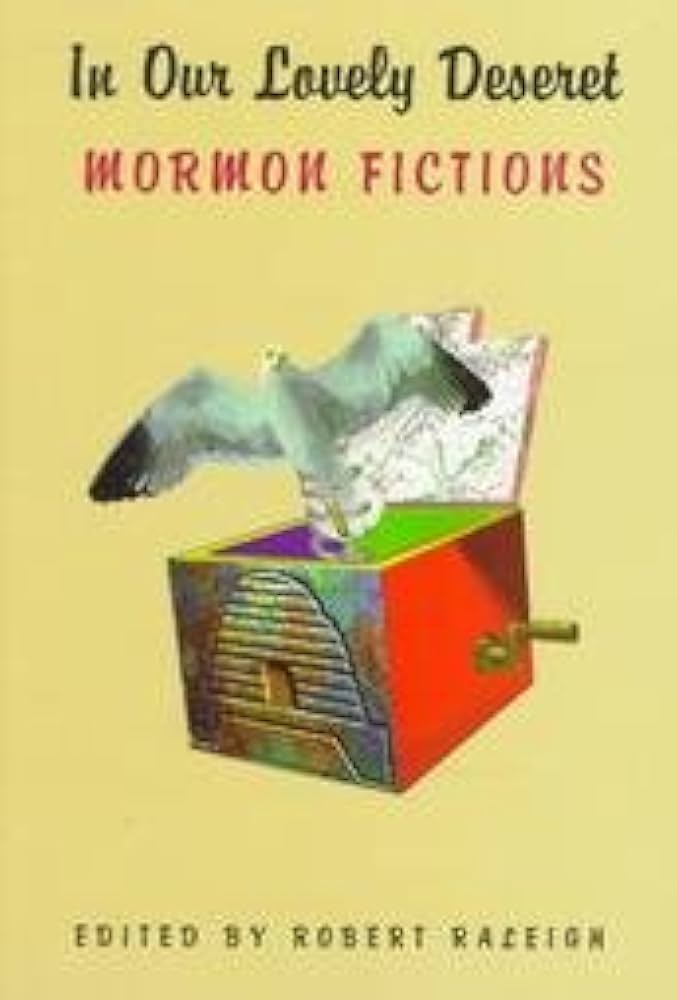
 B. W. Jorgensen gives a full reply to Robert Bennett’s review essay, “The Shock of the New: Robert Perry Raleigh’s In Our Lovely Deseret“, following up on his preliminary comments to Bennett’s post.
02–03Oct26 Notes in Reply to “The Shock of the New.”
I didn’t think it would take so many weeks to get back with this. First, an apology for misspelling Petersen with -son in my brief comment on 19 May: Todd (if you should see this), you’d think I might do better, since my grandmother used to remind all and sundry, “S-E-N! Ve ain’t Svedes!” I’ll try to proofread more carefully henceforth, especially since it looks like my A key might be hexed; either that, or my touch is too light.
Although I agree with some of its claims, after several re-readings “Shock of the New” (hereafter, SotN) still strikes me all the more as rather short on “analyz[ing]” Raleigh’s In Our Lovely Deseret (LD), giving only 3 stories more than bare mention, 2 of those in rebuttals of Eugene England; way too long on attacking England in his 1999 “Danger” essay (DRL; not so much the essay itself as its implied author, and perhaps the real author); way too long on generalities, metaphors, rhetorical questions, epithets, accusations, insinuations (“pearl-clutching,” “hypocrisy,” “churlishness,” “bitching and moaning,” “whining,” “fits,” etc) based on suppositious “real issue[s]” or motives imputed without much (to me) persuasive evidence; way too long on aspersion, invective, vituperation, grave-stomping, general badmouthing; altogether too long on a hermeneutic of suspicion. It even has a few solecisms, malapropisms — or maybe deliberate puns? — like “tongue and cheek”? “au currant”? I won’t guess at motives. But I will say that SotN reads like it soaked too long in the social media snark tank, and thus (by my lights) it just won’t do — and, regrettably, doesn’t do much — as responsible Mormon literary criticism (“responsible” first to texts). We ought to do, we can do, better. Specifically, I’d be a whole lot happier, immeasurably happier, to read patiently attentive analyses of any 3 stories from Bright Angels and Familiars (BAF) and any 5 from LD. Those sound worth doing and worth reading. Maybe also a couple from Turning Hearts (TH)? And before all those anthologies there was Levi Peterson’s Greening Wheat (GW) — anything there look worth analyzing?
Does the paragraph that begins with “There are no stories about” “analyze” LD, as we thought we could expect? It does give more attention to the anthology as a whole than any other paragraph, but gives it rather summarily short shrift; it deserved, and still deserves, more patient attention. LD’s first and last stories do get more space, but not much more attention, later on, which might count toward analysis. Add the 4 paragraphs that rebut England’s treatment of Townsend’s “Almond Milk,” and that about sums up the precipitated and precipitous residue of what seems to have been a rather abbreviated attention span — or perhaps attention distracted from its announced object.
The notes that follow (accumulated 20 May – 11 July) will not be entirely aleatory, though they may not closely track the sequence of SotN; and though editing and augmenting as I go, I won’t try much to knit them together into a well-formed essay; most will respond to terms or phrases or clauses from SotN, and the result will be patchwork, though I hope not crazy-quilt. I’ll sometimes use — as implicit disclosures — first or familiar names of people (friends, colleagues, students, writers) with whom I’ve been even briefly on a first-name basis; I can’t pretend to be entirely disinterested, though I mean mainly to defend not a person but a misread essay (which I’ll also criticise) and some ideas about Mormon fiction and criticism.
Getting into SotN, after some preliminaries and some metaphorical and maybe rhetorical questions, we come to “a serious point,” posed as a general (perhaps still metaphorical) question: “Just how faithful does literature need to be in order to be classified as Mormon?” We might wonder if artworks can be “faithful” in any literal sense, and if so, how; or is that a state of mind, habit of heart, and mode of conduct possible only for persons, e.g. writers and readers? There follow a few particular questions about what characters in Mormon fiction “can” do, which I’d answer with “all of the above” (though some readers and critics might holler Nay! in thunder). Then come more general questions again: “When does the edgy, the provocative, the I’m having a bit of a faith crisis, the non-temple worthy, the I might be gay, or even simply just the ‘it’s complicated’ cross over the line into an excommunicable offense, let alone an unforgivable transgression. When is a transgressive story no longer literature? Or Mormon? Or both?”
A lot to deal with. Did the two I’s there refer to writers, or to their stories and characters? I’ll suppose characters and, by implication, stories. “Just how faithful [. . .] to be classified as Mormon”? — as if we might gauge “how” (= how much? to what degree?) on some scale or other? On the immensely latitudinarian AML definition (“by, for, and about”), not necessarily “faithful” at all. We’ll agree to consign the “excommunicable” to church authorities and the “unforgivable” to the Lord, not to Mormon literary critics, though some censorious readers might make those their business. As to whether this or that literary work is or is not “Mormon,” that either-or binary is too simple. I too-dimly recall some lively AML discussion (a panel, or something less formal?) as to whether Walter Kirn’s “Whole Other Bodies” (the final story in BAF) was “Mormon” or not, which at the time seemed fruitless (I don’t know if there’s any record of this). As I’ve viewed it, fiction (or we could limit ourselves just to short stories) by the disaffected, peripheral, disaffiliated, apostate, non-member, “enemy,” et al, if it’s in any way “about” or “for” Mormons, can be examined as “Mormon fiction” — of course always on the assumption that we care, in any way, to look into that. The first questions, for me, will normally be: What does it do and how does it do it? Then: To what norms or values, or to whom, is it “faithful” or not, and how? — not “how much?” but “in what ways?” and “just where?” I ask the same questions about any putative “Mormon criticism,” including my own, and sometimes answer “not overtly” or “not noticeably.”
“When is a transgressive story no longer literature?” If it’s written and published, it is literature (in a rather trivial baseline sense); but only time will tell if it lasts “longer” enough to retain that status in any more honorific, capital-L sense (see, e.g., John M. Ellis, The Theory of Literary Criticism, ch. 2). Readers will read and judge, may re-read, and may pass the word along. Critics and academics and publishers (esp of textbooks) may help a work last a generation or several, but readers in the longer run will determine its status (D. H. Lawrence’s The Rainbow, banned and burned in 1915, still survives, but who knows for how long? Does anyone still re-read, for pleasure or analysis, Erich Segal’s wildly “successful” Love Story?). Anthologists will read and select. Anthologies will go out of print and be forgot, or not. The writers of the stories in the anthologies may or may not go on to publish more. Notice how many in BAF and TH and LD, as well as GW and all the annual Best American and O. Henry Prize Stories volumes, have not gone on to publish much more, if anything at all (that would be me too). And so on.
But I passed over one other important word: What’s “a transgressive story”? It can’t be (for me) just a story about a transgression (aren’t most stories?); so what would a story transgress, and how? Well, say the taste of somebody or other, or, if they are editors, their sense of what their readers or advertisers will tolerate or should be exposed to (think of Harold Ross or William Shawn at The New Yorker); or somebody’s sense of communal or cultural norms of social or literary decorum (Huckleberry Finn was banned at first for bad grammar and for Huck itching and scratching, among other offenses); maybe someone’s sense of “proper” literary form or technique or even typography (Kent Haruf got a letter from a reader who refused to read his novel Plainsong because he hadn’t marked dialogue with “ and ”); or someone else’s view of what kinds of human beings should or shouldn’t be “represented,” by whom, and how. This could go on and on . . . and each of us will meet stories that, for one or another (often obscure) reason, we don’t want to read (cliches, a clumsy sentence, a too self-regarding narrator, the first-person present tense, a minimalist or maximalist style, one more rinse-and-repeat monomythic spin-cycle, sheer tedium), or don’t want to re-read (once through Fanny Hill was enough; same with Babbitt). Generally I finish what I start, but I couldn’t go on with Twilight or The Host, couldn’t get past the second page of The Hunger Games. (I think of those as win-wins: the writers and their books clearly don’t need me and I don’t need them; everybody’s happy.)
Have there been any “writers who deny the Holy Ghost”? So far I’ve not noticed, and I wonder if any actually would or, finally, could, given how ultimately mysterious — and just possibly attributable to something we might as well call Spirit — the making of fiction is, of putting sentences into a sequence that somehow (variably and indeterminately) moves a reader to feel what some imagined characters (and maybe their author) feel. There might be really too much to say about this.
But also (in partial agreement with SotN): who’s more “Mormon” than an ex-Mormon or a Mormon heretic, a bad Mormon or a jack Mormon? Too-easy answer: an “orthodox” “active” “faithful” Mormon. And yet: what can we hope to know about any other agent’s “orthodoxy” or “faith,” or, though we can tally it up, what that agent’s “activity” may signify? We are all so various . . . . I tend to agree with Johnny Townsend (Sunstone, Nov 2011): “We are all non-mainstream, and all of us have stories worth telling — and, just as important, worth hearing.”
And let’s not forget that although Jesus did say that only badmouthing the Holy Ghost was unforgivable (Mt 12.31-32, Mk 3.28-29, Lk 12.10), one of Joseph Smith’s revelations rather clearly specified “murder, wherein ye shed innocent blood” (see D&C 132.27) as (minimally one instance of?) that blasphemy. In context (Mt 12.21-30, Mk 3.22-27), it seems to me that Jesus warned against denying that someone else has spoken or acted by the Spirit. Obviously any writer might imagine a character who denies the Holy Ghost, or can’t feel sure she “feels the Spirit,” or like Justin in Kirn’s “Mormon Eden,” knows he “chose for it [a certain “low tingling”] to be the Holy Ghost” (not utterly unlike Augustine in that garden in Milan hearing a voice say “tolle lege,” choosing to take that as a divine voice addressing him, and picking up the text of Romans he’d been reading). (To me, by the way, that’s the most interesting and “challenging” moment in Kirn’s story, intrinsic, as I read it, to the inclusive “action” the story presents.) Just as obviously, any Mormon or Christian reader might judge a character as denying or not feeling sure or choosing, but might also, in charity or justice, do well to suppose the writer judged likewise.
Regarding “Kirn’s infamous reading” of “Planetarium”: I was there and enjoyed it. So far as I know, Gene England had not pre-authorized Kirn’s choice; Terryl Givens allows he requested “Whole Other Bodies,” which is consistent with Gene’s selection for BAF. (Had he already secured Kirn’s and Knopf’s permission? It seems likely, but I don’t know.) As I recall, Walter told me, or us, afterwards that he’d decided on the spot to read “Planetarium.” Had he asked about reading that story, either of us might have cautioned him that it would risk offending (we might now say triggering) some in the audience. (When I brought Richard Ford to read at BYU c. 1987, he asked if he should be careful about anything; I said obscenity or explicit sex could offend some; he elided one word when he read “Great Falls.”) After the reading (I think in Q&A, but perhaps more privately to me), Walter said he’d read “Planetarium” to a sophisticated audience (East or West Coast, I don’t recall) and was pleasantly surprised that the BYU audience took it with more laughter (a lot, and not all nervous) and with less squirming and dead silence. Obviously someone in that classroom did more than squirm, but kept silent, went out for blood, and got some (we know whose). After BAF was published, Walter wrote Gene a letter that praised the collection as “splendid — not just well turned-out but well-ordered and full of surprises” but also “a somber feeling” and “even an exiled quality,” and reflected on Mormon culture and his “peculiar relation” to it as his “most valuable (and troublesome) literary asset” (from a photocopy of the 2-page holograph, dated “25 Nov” [1992]).
As to the bishop in “Planetarium” and his way of dealing with adolescent boys’ masturbation, I recall that after the reading Walter told me (or us?) that an editor, thinking “president” or “elder” would baffle readers, obliged him to use “bishop.” (At least I think it was in this story; one could still ask Walter, who writes in his memoir Lost in the Meritocracy that “The ward house was located in a St. Paul suburb,” though I’ve thought I heard him mention some experience in a branch where some officers were “elders.”) I’d never heard of that “planetarium” tactic (not exactly policing?), but it struck me as a wonderfully creative — and comic — object lesson, which might show each boy he was not alone in “the solitary vice,” and leave him (anonymously) free to deal with it as best he could — stop cold turkey or strew the night sky with galaxies numberless as the seed of Abraham. So, yes, while Kirn might not think “bishops” do that, he imagined that one bishop, obliged to “police” teenage boys’ sexual indulgences, might or (with enough imagination) could do it; and (in Coleridge’s famous notion of “poetic faith”) I believe or imagine that with him. We should all have been so lucky. Actually I don’t recall any bishop in my own youth warning us boys against “self-abuse”; later generations would suffer that. Over several years I collected a thick file of materials toward an essay I thought I’d call “The Big M,” a phrase Dick Cracroft used in a mission president anecdote he once told me; I did some historical homework in Peter Gay’s “Learned Ignorance” chapter in The Education of the Senses and in Thomas W. Laqueur’s Solitary Sex, plus a bit of Mark Twain, some records of the Utah State Hospital (that one-time “white house on the hill” here in Provo), a mysterious (Samizdat?) copy of quasi-official “suggestions” for Church leaders who are counseling someone with a masturbation problem (no “planetarium” hints therein, alas), and of course Elder (later President) Spencer W. Kimball’s chapter in The Miracle of Forgiveness, etc etc. I may yet live long enough to write that one out. It will have to take account of “Planetarium” and a couple other short stories.
About “Brian Evenson’s fateful public reading” of whatever story, I’m pretty sure I missed that one, if it took place. But I did witness the consequences of one anonymous student’s reading of about 1/3 of his first book, and tried to help deflect them with an essay titled “Swallowing Altmann’s Tongue” (presented in a Literature & Belief Colloquium 30 March 1995 but still unpublished, though I’ve been revising and considering). From the evidence I read in 1995, the woman grad student (we knew only that much) who objected to Brian’s reading and discussion (not widely “public” but rather in an advanced creative writing class) did so on the grounds that (not “it,” the fiction, but) he, the writer and person, “glorifies” and “revels in” “darkness and degradation” and the “graphic” depiction of “disgusting, pointless violence”; in short and therefore, that he “preaches” violence — obviously arguing from a serious misconception of how fiction works (or at least how many writers, readers, and critics think it works or should work). I don’t recall that she attested that Brian’s fiction made her want to “practice” violence — except whatever damage she could do to Brian, which turned out to be plenty (and which might thus argue some validity in her notion of how his fiction worked). On 11 July 1995 the Daily Universe attributed the following to then-Pres. Rex Lee: “If his future work follows the same pattern of extreme sadism, brutality and gross degradation of women characteristic of ‘Altmann’s Tongue’ [presumably the book, not just the story by that title], such a publication would, in our view, not further his cause as a candidate for continuing faculty status.” The predicate of that “If” clause seemed so ill-acquainted with the book (and maybe so bedeviled about fiction) that I scarcely knew how to unsnarl it. (Lee resigned as BYU Pres. 31 December 1995 and died of cancer, far too young, less than 3 months later.) The rest is, I suppose, history.
If the “canonical status” of “Planetarium” and “Killing Cats” (or whatever story Brian fatefully read) “has long since been vindicated by history,” somehow I missed that memo. Still, the richer and wider the canon, the better (I agree with SotN on that); but I think we’ll none of us live long enough to see what history vindicates amid the recent, present, and likely future welter of putative “Mormon literature” defined as the AML so broadly and porously defines it.
Was Raleigh’s In Our Lovely Deseret “a scandal”? If so, I missed that too. Do we know how many copies it sold, how many readers it had, how many were scandalized, maybe how many wrote in protest to Signature or to Church HQ about it? Likewise I never heard of anyone calling Rob VanWagoner’s novel excerpt in LD (or his first novel, Dancing Naked) “scandalous,” or “bad or unethical literature.” Nor can I imagine anyone inclined to do that. If it somehow inflicted a “shock of the new” on some readers, that must be for its subject matter: a story — a father’s discovery of the peculiar manner of his teenage son’s death — that I’d not seen told before, from the father’s shocked point of view. Otherwise, it seems rather straightforwardly conventional fiction. (The analogy between its newness and that of modernist art is weak.) Within the domain of “Mormon fictions,” subject matter might be about all the “new” we’ll see, or can expect. And I’m ok with that, though also ok with old subject matter treated anew so that I see and feel more in it than before; this need not require formal or technical innovation, just good writing, or what Henry James would call “execution”: how well is it done?
Also, would anyone outside of a Mormon Lit context perceive this fiction as “Mormon”? — even knowing VanWagoner was (or had been, I’m not sure) a Mormon? Maybe. Mormon writers’ fiction about non-Mormons (Scott Card? Darrell Spencer? Shannon Hale?) does interest me, more or less as Chaucer’s writing about pagans does, or Flannery O’Connor’s about Southern Protestants. This story takes place in SLC, but I missed any clue that its main characters might be Mormons. Which of course, on the AML definition, does not exclude it from the category of “Mormon fiction,” since Signature would soon publish Dancing Naked “for” a mainly Mormon audience, which makes it interesting within that category. If we read it as Mormon readers or critics, one component of our interest, I suppose, will be in how this writer’s “Mormonness” affects the fiction, if it does.
About “the new” I’m equivocal, or maybe just puzzled. As they used to say: What’s new? Decades ago, Dante was “new” to me, and still is. James’s The Ambassadors on a 4th or 5th reading, Tolstoy’s War and Peace midway in a 3rd, Joyce’s Portrait of the Artist as a Young Man on a 5th or 6th and Ulysses on starting a 3rd — all still deliver what feels like a shock of the new. The next Chekhov story I read, if I’ve not read it before, will be new to me, but so will “The Lady with a Pet Dog” on a 10th re-reading (maybe a 20th — I’ve lost count). On this I’m with that Idaho-born arch-Modernist Ezra Pound, who not only said “Make It New” (in 1928, then used it as a book title in 1934, but he’d borrowed it from an old Chinese guy c 1760 BCE; google it, and see esp imagejournal.org/article/making-it-new/) but also said “Literature is news that STAYS news.” I admit I’m equivocating a bit on “new” and “the new” as Dunlop seems to have meant the term (no, I’ve not read his book, nor Robert Hughes’s book with the same title, nor seen his BBC series). But “the new” in the Modernist sense is over a century old now, and though I’ve almost ecstatically enjoyed looking at, say, some of Mondrian’s black-ruled primary-colored rectangles, no two identical, enticing attention into endless irregular rhythms, I’d just as soon be struck into alert stillness by Rembrandt’s steady loving gaze at a boy who might have been his son Titus, or by one of George Ault’s Russell’s Corners nocturnes, or Wyeth’s Distant Thunder, or Harald Sohlberg’s Fisherman’s Cottage, or Philip Glass’s Metamorphosis. We all have our private galleries and concert halls and libraries. I’ll never lack “new.” And, sure, I’ll keep an eye and ear out for the yet-uncreated “new.”
Did Todd Petersen and Gene England publish “dueling reviews” of LD? Todd (who was then studying with Brian Evenson at OSU) cannot have thought he was crossing swords with anybody (unless Robert Raleigh?). Nor can I detect any conclusive evidence that Gene read Todd’s review, much less responded to it (I do see language that echoes my 1979 use of Sheldon Sacks’s Fiction and the Shape of Belief, and my 1991 use of Leviticus 19.34); still, of course we’re quite free to put the two into a “debate” or “dialogue.” I have more than “a cursory acquaintance” with Gene, though not really with Todd (one could ask him about this; I confess I’ve not kept up with his fiction as I should); I do have a rather in-depth (charter subscriber) acquaintance with both Dialogue and Sunstone (eyed with equal suspicion from the tower in SLC, as history has shown); yet I’d not presume, on that basis, to guess who’d be “pro” or “con.” As it turns out (on any candid reading of the two), neither is simply one or the other, neither only “praises” or “pans”; both find what Petersen called “virtues and failings” in LD. As “reviews” — and England’s DRL is better described as an essay that (maybe too cursorily, fragmentarily) “reviews” two anthologies as components in a larger argument — they don’t “duel”; rather, they interestingly diverge and now and then converge (both taking specific note of Lee Ann Mortensen’s story) or even intersect (on Kirn’s “Mormon Eden,” which I think both misread in much the same way, one claiming he “has not” done his “homework” on Mormon culture, the other that he “gets many of the details of Mormon life wrong” — the one possible clue that Gene read Todd’s review).
Oddly, neither Todd nor Gene (nor SotN) mentions Phyllis Barber’s “Spirit Babies,” which on re-reading I regard as one of the best (and perhaps most startlingly “orthodox”) stories in LD; and I can’t fathom how I passed over it in 2001 when I surveyed some “contemporary Mormon short stories” (including others by Phyllis) in “Toward a ‘Marriage Group’” and listed and (mostly too briefly) discussed stories from both TH and LD. We all do suffer from “blind spots.” Imagine: a short story about a Mormon marriage that is both prolific and (apparently) happy. And so far nobody seems to have “analyzed” it. (AML and its members, especially its practicing critics, have a lot of unfinished business.)
At its time, BAF was, I think, a (not the) “latest word” on Mormon short fiction from the 1950s through the 1980s; but of course it slid from “latest word” status as soon as it was published if not before, and I can’t think what other story from that period, “substituting” for what “single story” in the selection, might have made it more “new” — maybe “Planetarium”? I think Gene England knew it could not be a “latest word” for long, and had little stake, and much less hope, in “maintaining [its] preeminence [. . .] as the gold standard of contemporary Mormon short fiction.” (N.B.: “contemporary” can’t mean the same thing c. 1998 as it did c. 1991; like “the new,” it’s a sliding term.) The list of “stories and collections” at the back of BAF (which I helped compile, so yes, I have more than one stake in the anthology) might suggest how much it left out, enough to fill a few more, and entirely different, volumes, each a different “latest word”; similarly, LD left out a lot of “Mormon fictions” published c. 1991–97. Gene England titled his introduction to BAF “The New Mormon Fiction,” but was not setting up as “the au currant arbiter of the new,” rather as the retrospective curator/exhibitor of what Mormon short fiction c. 1950–90 looked like to him. The stories he selected, most of them published from the mid-1970s to the earliest 1990s, were mainly “new” with respect to the old “Home Literature” and our “Lost Generation,” with stories by Sorensen and Whipple linking that generation to the later ones. The next “new” was still somewhere over the horizon. The instances of non-didactic fiction that Gene found in that period did, he believed and hoped, point toward more such fiction to come. With “not for or against, but about,” Raleigh’s preface to LD seemed to announce that more had come since 1991 — as indeed it had, in many of the stories he selected, and Gene acknowledged too few of those.
What Gene did not have a stake in was to “police [. . .] the boundaries” of either literature or Mormonism, nor to “have the last word and slam the gate behind him to lock out any rival parvenus.” Very likely “He had no intention of opening up a Pandora’s box which might unleash anarchy into the world of Mormon letters”; yet I don’t think that in LD he saw mere anarchy loosed upon the world. In criticising both TH and LD he manifestly did have a stake in keeping open, or re-opening, a gate toward a “middle way” — or better, a “third way,” admittedly difficult — between, or rather apart from, Mormon culture’s inherited polarity of “for” vs. “against”: fiction written or regarded as either “faithful” (a term Richard Cracroft lifted from Richard Bushman’s “Faithful History”) or “apostate,” “all in” or utterly “out”; the old Home Literature vs. the Mormon Lost Generation (as viewed by some in the 1940s, like John A. Widtsoe). As I read DRL, Gene tried to leave a gate open toward that third way when he admitted, “perhaps I’m being unfair in suggesting that [some stories in LD] are merely cynical, or even nihilistic,” then quoted Flannery O’Connor (“People without hope [. . .] don’t write novels,” etc), just before going on to “end on a more positive note” with examples of what he meant by “ethical fiction.” Maybe that was too little too late.
Closely tied to “for” vs. “against,” the other large and also historically inherited problem in “Mormon fictions” that Gene (and I too) tried to address was “didacticism,” or what I once called “package-message aesthetics” (see Nephi Anderson’s 1898 “Purpose in Fiction” for a quasi-canonical old Home Lit statement): the view Dick Cracroft strongly implied (if he didn’t flat-out declare) that only didactic fiction, which preaches “the restored gospel” and thereby “builds the kingdom,” could be “for” or “faithful”; fiction that didn’t unambiguously (overtly?) “instruct” us on those terms could only be “against” or “apostate,” and therefore a book like Sorensen’s The Evening and the Morning could only be read (as Dick urged in his response to my 1979 essay on that novel) as an anti-“apologue,” not as a “novel” (as Sheldon Sacks defined those types). Under the binary of fiction defined as either didactically “for” or didactically “against” the Church, a non-didactic “novel” (as understood by Lawrence, Bakhtin, Sacks, Booth, Kundera, et al) either can’t exist or can’t be read as one.
Did BAF set, or meet, any worthwhile and usable “standard” that avoided what both Gene and I regarded as a false dilemma (or “fallacy of the excluded middle,” as Gene used that term)? I’d say that it tried to remind Mormon/LDS readers of a standard of non-didactic fiction long available in literary tradition, which some Mormon writers in the 20th century had tapped into. In his “Editor’s Preface” to LD, as Gene noted, Raleigh implied that its selection of stories belonged to “a growing body of work” that was “not for or against, but about,” that “doesn’t exactly instruct, though it often provokes feeling and thought.” I’ve long believed that’s what the best fiction does (the fiction I personally and usually prefer), so I read Raleigh’s language as aligning with England’s third way; “about” is his rubric for what England called “the radical middle” (if you wish, a “Goldilocks” zone or “Golden Mean”). For Gene, “too many” stories in both TH and LD veered off from that third way, and in his 1999 essay (DRL), he clearly did want to show how, as he saw it, those two anthologies split “right” and “left” and landed too often in didacticism and “sentimental manipulation.” I think some of the evidence in the two collections (more, I’d say, in TH, but I can’t locate my copy to check) does show that he was at least partly right, and that SotN, in its overweighted attention to one side of his essay’s argument, its lack of “patience — to recount [it] in full,” seriously misrepresents that argument. If I decline to “recount” an opponent’s “arguments in full,” then do I have any business trying to rebut them? Can anyone — can I myself — trust that I’ve understood them? My main complaint about some recent instances of Mormon literary criticism is that they lack the patience to read what they criticise. (See my rejoinder to a Dialogue review of Levi Peterson’s latest story collection for a rather blatant case of impatient reading, and a rather scrupulous, thus egregiously lengthy, effort to recount that review’s claims in order to rebut them, with evidence, rather than “largely dismiss them.”)
One sign of SotN’s critical impatience shows up in its treatment of the word “danger.” The “Danger” that alarmed Gene was, as he judged then, to the ongoing development of Mormon fiction, not some indefinite “danger” (to whom or whatever) in “mere words on a page.” I think DRL was clear enough on that, and rightly lamented the left-right split and the didacticism Gene saw in both TH and LD; yet I also think it sometimes overstated the danger (in phrases like “borders on blasphemy” and “ethically sterile”) and misread some of the textual evidence (by my lights, the stories by Townsend and Kirn, two of his three negative examples in LD). The “danger” on both Left and Right was didacticism and the “sentimental manipulation” that often serves it. Unless I missed something, SotN uses the word “didacticism” just once, quoting DRL in its last paragraph, and does not discuss this central concept in England’s essay. I’ll call that a serious blind spot, since it misses the main line of his argument.
Still, yes, “mere words” on pages, or online, in the air, can be dangerous — they can make serious trouble for their audience or for their author. Ask the victims of hate speech or of hate crimes driven by it, or the victims of 6 Jan 2021, or some of the rioters; ask Brian Evenson (who grew up on my block in suburban Provo, and whose first book I defended as well as I could on more than one occasion, though it’s not my top-choice literary cup of tea). If we admit that fiction can have good effects, must we not admit that it can also have bad? I have a long-running quarrel with Plato because I can’t just dismiss the arguments his Socrates deploys in The Republic. The effects of our fictions (including dramas, films, games, etc) are variable and indeterminate, of course, and likely dependent on too many factors to sort out easily (though it might be worthwhile to try).
Of course Gene England could not (no more than anyone else) predict, much less direct, the development of Mormon fiction, and I think he knew that when he edited BAF. Clearly he had some hopes, and clearly the manifest bifurcation of TH and LD and what he read as didacticism in both (polarized, “for” vs. “against”) disappointed those hopes, and put some hopes (especially his) for 21st century developments in danger: must Mormon fiction go on and on split into “for” vs. “against,” and didactic and manipulative either way? If you insist, that split, that polarization, endangered the “authority” of BAF. I suppose we could ask Robert Raleigh if he meant LD as a “literary gauntlet” flung at Gene England; I doubt that, and I’ve thought its placement of a Kirn story and the display typeface in its titles and contributor notes suggested it was a companion or sequel, a “new” interlocutor in an implicit historical dialogue.
In any case, I’d rather say that the “authority” that mattered to Gene — and still matters to me — is that of the idea that there is a third and better — and yes, “more” or, as I’d prefer to say, differently ethical — way: that fiction (whatever ideology its writers might hold) need not be formally and finally didactic to “persuade” or to “instruct” or move its readers ethically toward the end that “all the world ought to be friends” (see the last chapter of Tolstoy’s What Is Art? for one more witness on this point). I often tried to persuade students that “stories with morals” differ as a species from “stories told morally,” and that the two work differently on us readers. Of course, the contents of TH and LD could not have represented all that was going on in Mormon fiction in the 1990s, and the left-right polarization and didacticism Gene deplored might have been set up by the editors and their biases (toward “piety” or “impiety,” if we may use those terms) in selecting stories; yet I rather doubt that piety or impiety played the lead role in selecting stories for either TH or LD, and I suspect the editors of each might have missed some good stories that would have sustained Gene’s hopes, as indeed some stories in both anthologies did.
I can’t think of any critic, from Plato and Aristotle on down through Sidney, Johnson, Coleridge, and Arnold to Brooks and Warren and Ransom and Winters, Lionel Trilling, Wayne Booth, George Steiner, Barbara Herrnstein Smith, Harold Bloom, James Wood, whose “well thought out principled critical perspective” (supposing each and all needed one and had one) would not also read like a “generally obvious” self-justification “for his [or her] own [. . .] personal preferences.” I’d find it odd if this were not so — unless maybe the critic declined to explain or defend taking “guilty pleasure” in, say, Harlequin Romances or Donald Duck comic books, Louis L’Amour westerns or Tom Clancy thrillers, or the verse of Robert Service or Edgar A. Guest? So far, I’ve not discerned a “well thought out [. . .] critical perspective” in SotN, though two of its principles appear to be scorn and a penchant for “the new.”
But: What would count as “well thought out” and “principled” in anyone’s “critical perspective”? I suspect that, in practice, more than a few critics (me too) would subscribe (or confess) to pluralistically, eclectically or promiscuously following Kenneth Burke’s dictum, “The main ideal of criticism, as I conceive it, is to use all that is there to use” (The Philosophy of Literary Form, 3rd ed.: 23; on pluralism, see Booth, Critical Understanding). Grant that in DRL Gene England didn’t set out to explain or defend his critical perspective but rather to use it in thinking about an interesting (not to say troubling or problematic) 1990s phase in Mormon literary history. Still, his essay does appear to have some principles, drawn mainly, as I read it, from Yvor Winters and Wayne Booth; e.g. that fiction is inherently, fundamentally “ethical” (Plato [Republic 603c] and Aristotle [Poetics 1450a] agree that our fictions represent human actions, and I might name some otherwise diverse writers who would agree with William H. Gass that “the ethical is never absent”). That therefore we readers, as ethical agents in what Tolstoy called an “independent moral relation” to fiction, can judge and choose among stories in terms of how they “conduct” themselves ethically, or what sort of “friendship” they offer us (see Booth, The Company We Keep, esp. chs. 6–7); whether they “didactically” subordinate character and action, i.e. story, to an idea or ideology, a “moral” or “message”; whether, if they attempt some sort of “likeness” to human experience (don’t all stories do that, even beast fables?), they credibly “represent” personal agents, their world, their thoughts, talk, and actions; whether they try to “manipulate” a reader or appeal (as Sartre put it in What Is Literature?) to the reader’s freedom in a “pact of generosity.”
So I don’t think SotN is right to “largely dismiss” England’s arguments by saying they “largely boil down to a fundamental complaint about the ‘in-your-face impiety’ of Raleigh’s anthology.” England does make that complaint; but I’m not sure that conceding to it with “Guilty as charged” and implying “So what?” is quite right. Gene in DRL never quite pinned down what he meant by “impiety” in LD, and may have let the back-cover blurb, “In this new anthology [. . .], good manners and proper etiquette are no longer even considered virtuous in many situations,” stain his reading of its stories (as any reader might). Is “in-your-face impiety” unethical? That must depend on our personal preferences in ethics and on whatever pieties we favor. The “im” prefix on “impious” and “impiety” does unambiguously negate some piety or other. So, not surprisingly, some of us may find some impieties unpleasant or rude. But it wasn’t the impiety per se that bothered Gene England most; it was the “didactic” mode of expressing or imposing it, the “sentimental manipulation.” So, as I read him, he did not “simply, and simplistically, [equate] impiety with bad (or what he call[ed] unethical) literature or at least bad Mormon literature.” Rather, and yet once more, it was the didactic, manipulative way that he saw some of LD’s stories trying to persuade readers (minimally himself as one) toward impiety; and in TH, the didactic, manipulative way some of its stories tried to persuade readers toward piety.
If there is “good Mormon literature,” there must also be “bad Mormon literature,” and both the “good” and the “bad” could show up among both the “pious” and the “impious,” as indeed both did for Gene England. Deseret Book (DB) appears to think that what its ads and covers label as “Proper Romance” is “good,” and obviously it’s written “by” and published “for” Mormons (mostly?); but what, I wonder, would “Name Withheld” think of it, after her “Addicted to Romance Novels?” confession in the July 2003 Ensign? More unfinished business for AML, starting from Lavina Anderson’s “Mormon Mushies” (Sunstone Review 1982) and carrying her investigations forward, looking for whatever is “good,” or deserves and rewards critical attention, in DB’s proliferating genre fiction.
I’m willing to entertain the claim that “it is possible to write good literature, even good Mormon literature, that is impious. Even aggressively impious.” So how about an example of either? Best of all, the strongest grandest example in all literary history (something by Rabelais? Swift? Sade?), or in all Mormon literary history, an undisputably good and undeniably impious work. Then show me, by patient analysis, that it’s good, or by historical evidence that it’s been judged good over a significant stretch of time, by a significant number of well-read readers; tell me how and why it’s good, of course making clear your standard for “good” and toward what or whom the work is impious. Then tell me how its impiety helps to make it good, why I should regard its impiety as an essential good within it and in its relation to its culture of origin and its audience. I won’t ask to be shown that it’s better than any somehow comparable pious work, just that it’s an undeniably good impious work, and substantially good for the sake of its impiety; I don’t want its impiety to be treated as a tolerable or forgivable flaw in an otherwise good work.
I don’t read DRL as “disparag[ing] impious literature simply for impiety’s sake.” But I do wonder, if we were to disparage it, or just describe it, what other sake for? Or if we should want to praise and valorize it, again for what sake? For the sake of “the new” perhaps? But what’s new about impiety? Then also and always: impious toward what or whose piety? What if one were to be impious toward “the new”? I go on wondering what’s the virtue of impiety that we should value it. Criticism need not be expressed impiously, or so I hope, though it seems there is always a “negative” element in criticism; and unfortunately in Mormon/LDS culture any criticism of the church, its doctrinal and historical claims, or its leaders or their words or actions may be (often is) taken as impious and therefore inimical (it was sternly discountenanced for BYU faculty in the 1990s).
If we were to “let the real debate be between devotion and impiety,” would that rather quickly come down to personal preferences? Or would a patient thoughtful argument ultimately favor devotion? At least devotion might be thought usually constructive (with, alas, some glaringly violent exceptions), whereas it’s hard (for me) to imagine impiety doing much good for anyone or anything, except for the release it might afford the impious. Would an argument in favor of impiety turn out to be “a lot of hot air”? I’ll confess that, if (and only if) forced to choose, I think I’d prefer pious to impious literature (and I mean impious toward what anyone holds sacred). Impiety would of course be a possible “ethical” — and in some sense a possible “Mormon” — attitude or mode of conduct, but not one I’d normally tolerate well (unless it took aim at misplaced or excessive piety, like the adulation of an autocrat?). Nor would I commend excessive, in-your-face, self-demonstrative piety (broad phylacteries, etc). As Emily Dickinson said of the kind of company she tried to avoid, “They talk of hallowed things, aloud — and embarrass my Dog.” I’d prefer to recommend “reverence” as Paul Woodruff explains it in Reverence, which decouples that ancient (Chinese as well as Greek) virtue from religion and argues that it’s foundational to any community, but also that it has room for mockery where that’s called for.
When SotN wonders, “is [LD] just not the particular flavor of devotional literature that England prefers?” I will suggest that, by definition, “impious literature” would not be a “flavor of devotional literature,” rather a sharply opposed category — but “flavor of” might just reflect hasty writing. “Devotional literature” is a valid literary mode with a long and distinguished history, especially, and perhaps mainly, in poems (see Jay Hopler & Kimberly Johnson, Before the Door of God, esp. the editors’ prefatory matter, readable in the “sample” on amazon.com). I’m confident that Gene England valued “devotional” literature and hoped for more and better Mormon writing of that kind; but with equal confidence I doubt he expected or wanted it in “Mormon fiction,” if for no other reason than that stories don’t usually address God. — Or do they? My friend Frederick Busch, who might justly be described as a secular Jew, once remarked that stories are “prayers.” Did Gene England prefer “devotional” stories? In his selection for BAF, perhaps Sorensen’s “Where Nothing Is Long Ago,” Levi Peterson’s “Confessions of Augustine,” and Thayer’s “Opening Day” are “devotional”? Or Lee Ann Mortensen’s story, or Scott Card’s, or any other story he did note as praiseworthy in either TH or LD? A case might be made for “Opening Day,” since its last line whispers, “Oh Jesus, Jesus” — but is that devotion or de profundis? I may have to concede that one. Maybe Don Marshall’s “The Week-End” in BAF too, since it ends with “Lord forgive her”? — but isn’t that more petitional than devotional? Can a short story be “devotional” without being didactic? If so, Praise the Lord.
To SotN’s claim that “What England wants is a sermon not a short story,” I’ll say No, he wanted short stories to be stories, not sermons. If the claim I’ve quoted is a universal, it’s contradicted and refuted by his disparaging a story in TH as “merely a clever sermon, not really fiction, not ethical storytelling.” I’m confident that he did value good sermons (normally homiletic and hortatory rather than devotional) and wanted to hear and read more of them; but not in what he termed “ethical fiction.” I’ll say it once again: Gene England’s “real issue,” as he tried to make clear, was not impiety per se, but “sermonic” didacticism and sentimental manipulation, from either right or left, pious or impious. Of course, under the AML definition, “Mormon literature itself can be both impious and still Mormon,” and thus a Mormon critic can call it impious and deplore it if he finds that deplorable; if he finds it “aggressively impious” in a didactic-manipulative way, he can call it “unethical” by his ethical standard (whatever that may be).
If Gene said or clearly implied that an impious story about Mormons was therefore somehow not a Mormon story (as always, on the AML definition: by, for, and about), I somehow missed that, though I did notice that Todd Petersen implied that stories by non- or ex-Mormons (Carlson, Kirn) seemed out of place in a collection of “Mormon fictions.” It would clarify our discussions to know exactly what Gene meant by “piety/impiety,” “didactic,” “sentimental,” “manipulative,” “ethical/unethical,” but he didn’t define those terms, likely assuming we know at least roughly what they mean. What “prohibits any kind of ‘negative stereotyping,’” for Gene, would, again, be its manipulative use for a didactic purpose; the same would go for “positive stereotyping” manipulated to teach piety. His “Word of Wisdom for literature” would be — and in DRL is — that it can do its most effectual “ethical” work by not being didactic-manipulative (for another witness on this see the last pages of Gary Saul Morson’s “Prosaics” in American Scholar 57.4 [Autumn 1988]: 515–28). A patient compilation of all England’s remarks in DRL on “ethical fiction” could add up to a rough sketch of what he meant by that term, and how he meant to distinguish “ethical storytelling” from the didactic use of a story to construct a “clever sermon.” This might further suggest he did have a well-thought-out “critical perspective” (and also, of course, explain some of his personal preferences in fiction).
I’m fairly sure that Gene England understood irony and could distinguish it from sarcasm (though in over two decades’ association I never heard him use sarcasm), and I think he appreciated both about as much as they deserve. I suspect most of us appreciate both so long as we’re not the target, since so many of us are better at dishing out than at taking in. I confess I value sarcasm about as much as I value impiety. By definition, sarcasm (= flesh-tearing) is negative; it means to bite, and it bites hard; often, but not always, it employs verbal irony. Is irony always negative? I hope not, and I think that some instances of dramatic or situational irony are “happy” or “fortunate” (e.g. how Ivan Ilych in Tolstoy’s story finds relief in resting his feet on his servant Gerasim’s shoulders). Yet in any cases I can think of, irony does always undercut something.
Is it true that “England is simply incapable of allowing authors to truly legitimately criticize the church”? Again, if that’s a universal, it looks to be contradicted by the text of DRL, which does emphasise the phrases “critical Mormon world-view,” “challenge the shape of Mormon beliefs,” and “critique of Mormon culture.” Maybe Gene should have stressed those aspects or functions or effects of “ethical fiction” more, to balance his disparagement of stories that, as he read them, criticised or challenged in the mode of didactic fiction. The “carefully controlled conditions” he advocated were those of non-didactic fiction, because both the “for” and “against” in TH and LD lost sight of the third, non-didactic way that was his “personal preference” in fiction. Mine too.
Yet (and here’s one bone I’d pick with him) I’d also prefer to use “didactic” not as a pejorative but as a formally descriptive term, and would defend the category with some strong modern instances (e.g. Tolstoy’s “Death of Ivan Ilych,” Crane’s “The Open Boat”). But I would also argue that a lot, maybe most, of didactic fiction — whether apologue or satire — subordinates or even “sacrifices” its characters to its “doctrine” or “message” and its readers’ “edification” or correction (consider Shirley Jackson’s “The Lottery”?), and might thus be called “unethical” (depending on one’s ethical preferences). The “conditions” of non-didactic fiction (see, e.g., Chekhov’s letter of 1 April 1890 to Alexei Suvorin, re: “depicting horse-thieves”) would exclude both apologue and satire, and it’s true that in DRL Gene did not acknowledge those types of fiction, which would be, respectively, “for” and “against.” I wish I knew, for instance, what he thought of one of my favorite contemporary (late 20th century) Mormon short stories, Neal Chandler’s “Benediction” — is it “ethical fiction” as/or “Mormon satire”? In any case, doesn’t it indeed instantiate one significant — but differently “ethical” — option for Mormon writers?
England’s remarks on Townsend’s “Almond Milk” comprise a “For example” of which of his failings scathed in the preceding paragraphs of SotN? All? Some? Only his supposed failure to appreciate irony or sarcasm? I do think he misread that story in focusing on bits of it that he read as “didactic,” perhaps mainly by not taking enough account of its narrator’s self-admitted fallibility or confusion (referred to more than once). If I made this argument to Gene, he might reply that the story’s weakness is its failure to see around its narrator. But that’s hard for a writer, or a reader, to do in first person. Gene might invoke Winters’s “fallacy of imitative form” and say that the story confusedly and confusingly represents its narrator’s confusion. I’d concede that it does represent his confusion, yet I don’t find myself much confused by that, because, for one large thing, the narrator is so unsparing of himself — e.g. “I knew we were both wrong,” “I knew it was my fault.” Elder Anderson’s self-critical candor inclines me to trust his reliability, at least as to how he feels about his experiences. But it’s also true that I don’t detect much distance between narrator as narrator-self and as protagonist-self, whereas I do see such a distance in, say, Joyce’s “Araby” or (much less distance) in Updike’s “A&P,” and as Gene saw in Sorensen’s and Peterson’s and Thayer’s stories; nor, like Gene, can I detect much distance between the narrator and the implied author, which is his main ground for hearing “the author’s own voice drawing an obvious moral.” This wouldn’t be an easy bone to pick; we’d have to work particularly hard to distinguish didactic from non-didactic (see Norman Friedman, “Mimetic and Didactic,” ch. 6 in Form and Meaning in Fiction, and Mary Doyle Springer, Forms of the Modern Novella).
England “complains that Johnny Townsend’s ‘Almond Milk’ depicts a ‘zone leader from hell, a one-dimensional Nazi Mormon’ just because the zone leader orders the Elder to wash his hands before leaving the apartment.” Well, not “just because” of that one incident (in which Elder Stahl’s intrusive presence distracts and obstructs Anderson from washing his hands). Gene used that most blatant early instance to illustrate Stahl’s character (his habit of setting up others to fail or err), one of plenty more to come, which do add up to the sort of case generalized canonically in D&C 121.39: “that it is the nature and disposition of almost all men, as soon as they get a little authority, as they suppose, they will immediately begin to exercise unrighteous dominion.” It’s hard for me to see more than that one dimension in Stahl; but yes, I think Gene did overstate here, and (though without direct experience but having heard some tales) I concur with SotN on this point.
It’s the same kind of misreading that Gene made in regard to Kirn’s “Mormon Eden,” forgetting that secondary characters in short stories are (nearly always?) “flat” or “types,” particularly in first-person stories where they are viewed from a limited (hence fallible and biased) narrator’s perspective. Many or at least some of us likely have noticed fellow-members who seem to have flattened themselves into the type of Mormon recently referred to, sometimes self-declared (in my ward), as “all in,” always righteous and active and therefore always happy (forgetting that “all in” has primarily meant “worn out,” “wiped out,” “done for,” etc, and that its sense of “totally committed” originated in poker). The inner complexity of such persons — sure as we may feel they must have it — isn’t easy to access, even for themselves; so, not surprisingly, a first-person narrator, like Elder Anderson with Elder Stahl as his self-appointed antagonist, has a hard time representing it. Tolstoy’s compound predicate about “Ivan Ilych’s life” might obliquely apply: “most simple and most ordinary and therefore most terrible” (I’m told the Russian original lacks “therefore”). It’s hard to write about such people, because it’s hard to imagine yourself (in Eudora Welty’s phrasing) “inside the[ir] skin, body, heart, and mind.” I can’t fault any writer for not doing it, though it seems very much worth trying, and very much needed in Mormon culture (see Jeff Strong, Torn). It might be why Doug Thayer urged that Mormon writers should write about “mainstream Mormons,” whose “inner intellectual and spiritual problems,” as Sydney Ahlstrom wrote, “cannot easily be shared with others.”
As to what SotN, quoting a phrase from England, calls “‘direct and bitter denunciations’ of church doctrines”: Gene didn’t specify what the denunciations denounced, but the two examples he cited deal with mission leaders abetting “selfishness” in missionaries who baptize converts to “prove” themselves “worthy” of celestial glory, and with a Sunday school teacher telling 14-year-olds to “stay in the church and be good” so they can have “eternal sex.” Not precisely “doctrines,” I think; rather more cultural or folkloric notions and practices mangled with scripture. Maybe “eternal sex” is “essential Mormon doctrine more or less”; what the scripture says is “a fulness and a continuation of the seeds forever and ever” (D&C 132.19), which might not require sexual intercourse, yet also need not imply there’s no sex, just no “seeds,” no procreation of “spirit children,” below the top floor of the Celestial Kingdom. Will “that same sociality which exists among us here [and] will exist among us there, only [. . .] coupled with eternal glory” (D&C 130.2) include eros and sex or not? We’ve been told it will include “gender,” which I take to mean, minimally, sexual difference. Where is “there,” and how does “glory” affect resurrected bodies (so, e.g., they procreate only spirits, not embodied persons)? Maybe it’s scandalous or heretical to wonder about all this. Imagine, if LDS members supposed or even suspected that resurrected embodied persons in the lower kingdoms might have sex but no kids. After all, the “whoremongers” are down there in the Telestial (D&C 76.103), though we may suppose they suffer in that lesser “glory” the loss of their earthly occupation. Anyway, to me Elder Anderson’s “denunciations” sounded like mild-mannered, yet also valid, criticisms of Mormon/LDS culture, and above all, like elements in his honest confusion.
Basically, then, I agree with SotN on “Almond Milk”: “certainly the best — the most complete, the most insightful, the most literary — story that I have yet read from the perspective of a gay missionary. And it’s thoughtful. And it’s funny. And it’s much more complex, even generous to the church, than England admits.” I might say it differently, and I’d have to admit that it’s one of no more than two or three I’ve “yet read from the perspective of a gay missionary.” I’ll add that it’s very moving, even if at some moments I can’t fully identify with Elder Anderson. Reading, of course I formally “identify” by “performing” his sentences, but being “straight” and not having served a mission, I can’t fully identify experientially, somatically, emotionally, ethically; still, I do think I feel more than a little of what it feels like to be Elder Anderson — very uncomfortable, almost always on edge, sometimes even anguished; the last lines of the story are nearly devastating. One might wish that the story had been required reading for the Missionary Committee a quarter-century ago. There is really too much to say about it. Someone should analyze.
Someone should slow down and analyze Kirn’s “Mormon Eden” too. I suppose the “surly teenager perhaps poking fun at the idea that Mormons believe that the Garden of Eden is in Missouri” is that story’s first-person narrator Justin, though I’m not sure he’s still a teen when he tells the story, and I don’t read him as “poking fun” at that notion. For me, the jokesters in one little scene early in the story are Orrin Cord, who may sound ironic or even quietly sarcastic when he says, “The Garden of Eden is definitely in Missouri”; and, more subtly, Opal Singer when she says, “You sure it’s in Missouri, not in Kansas?” The sly joke here — maybe more on Walter Kirn’s part than on Opal’s, who might be teasing or earnest — is that there is a “Garden of Eden” in Kansas. Specifically in Lucas, Kansas: a roadside attraction not too many miles off I-70 that I’ve visited twice on long drives to St Louis; the estate of one Samuel P. Dinsmoor, an amateur populist thinker and folk-artist who, with his own formulated concrete molded onto iron armatures, sculpted world history from Eden (with a lightbulb as the all-seeing Eye of God) to the early 20th century. I wonder how many New Yorker subscribers (provincials, most of whom live in the five boroughs) got that joke.
I do think Gene England misread “Mormon Eden” and overstated in suggesting it “bashed” Mormons (I don’t read it as satire), and that both he and Todd Petersen were mistaken about Walter Kirn not doing his “homework” and “get[ting] many of the details of Mormon life wrong.” It’s true, though, that with another Mormon story, non-Mormon Bill Barich’s “The End of the World,” the New Yorker fact checkers failed abysmally on some basic facts about LDS missionaries that even I (a non-missionary) could have corrected; otherwise it’s a middling story by a good writer, and not noticeably unsympathetic to its missionary protagonists. So maybe New Yorker fact checkers just don’t check Mormon facts? In Kirn’s story, Justin is a convert of little over a year, rather seriously “hyperactive” (he takes Ritalin more than once a day, then quits cold turkey at Opal’s behest though he knows better), and understandably has a somewhat muddled memory of his first (and apparently only) priesthood blessing “a year ago, after our family’s baptism.” The “two elders” who performed the ordinance must have been either missionaries or local converts, but seem not to have anointed him with consecrated oil, or Justin with his “terrible earache” and ADHD didn’t quite grasp what they did or said; he recalls them “muttering,” then “requesting Heavenly Father’s aid” and going “on to predict my future” — all of which seems credible enough to me, and one needn’t take the word “muttering” as “belittling,” since it likely reflects Justin’s fallible perceptions and memory. Similarly, and without much effort at suspending disbelief, I can imagine a youth leader in a small branch or a recently established ward, called “Elder Tinsdale,” who has made “seating arrangements” on tour buses a matter of “careful prayer.” For me, such details, though unusual, don’t seem “extremely unlikely” and don’t add up to “stereotypes” or “extreme caricature”; once again, secondary characters especially in first-person short stories will tend to be “types.” (But also, I’ve sometimes thought we parody or cartoon ourselves well enough not to need outside help. As Chandler’s “Benediction” demonstrates.)
What most clearly shows a blind spot in Gene England’s take on “Mormon Eden” is this sentence: “Kirn has the narrator claim [that Opal seduces Justin] because of ‘an assignment’ from church leaders who think he is falling away from his conversion — and then, believe it or not, deserts him in order, by assignment, to do the same to his bitterly sophisticated, skeptical friend (‘other people need me too’).” It’s Justin’s seatmate and friend Orrin who has cooked up that “assignment” conspiracy theory which, given some other things he notices, Justin seems tempted to believe; in any case, he’s willing enough to go along with Opal. I’ve glimpsed the Orrin and Opal “types” as both a BYU undergrad 1962–66 and a faculty member 1975–2014. Orrin is either a Korihor-type pseudo-skeptic or, as I think more likely, a bright adolescent trying to be a skeptic or cynic but discovering his Mormonism (at least its chastity teachings) runs a lot deeper in him than he imagined; or maybe female sexual desire just scares the pants back onto him.
Opal (not surprisingly as viewed by an adolescent boy) is even more mysterious or puzzling. Is she a bad good Mormon girl covertly rebelling against the burden of “direct” descent from “Brigham Young and his second-youngest wife,” pretending to a “spirituality” she doesn’t actually or consistently feel, rationalizing her promiscuity by projecting her sexual needs onto the boys she seduces, who of course do have their own complementary needs? Does she relish her “power” over the boys? I’m suggesting that behind the confusing “type” that Justin sees, a patient reader might begin to imagine a troubled and troublingly complex character. How has Opal become the incipiently cynical seductress that she seems to be? Was she “sexualized” in childhood or early adolescence (as we’re told one in four or five young LDS women likely have been)? Did an abuser tell her he “needed” her? To speculate that far begins to feel prurient. Yet Kirn’s short story opens such possibilities, which a writer would have room to explore in a short story focused on Opal, or in a novel. The same is true of Orrin’s “type.” And of Elder Tinsdale’s. To me, all three look at least two-dimensional.
Here again, as with Townsend’s story, I can’t gauge the distance between Justin-as-protagonist and Justin-as-narrator, nor between narrator and implied author; so, although I would counter Gene’s reading, I can see how he arrived at it. I also think he made clear enough why he preferred Sorensen’s story to Kirn’s — even though I think Kirn and the New Yorker didn’t “bash” Mormonism all that much. Clearly there was less in “Where Nothing Is Long Ago” that might embarrass the church or its (rather specifically second-generation Scandinavian rural south central Utah) culture; mainly, I suppose, old Bro. Tolsen’s long-ago water killing and acquittal (not a “water rights” dispute but a case of a water-thief caught in the act and killed without apparent premeditation by a man entitled to a regular water turn; we might now invoke a sort of “stand your ground” defense). In Kirn’s story we do have the tectonically implausible Missouri Garden of Eden doctrine, and the scandalous misbehavior of some contemporary LDS teens, especially Opal Singer. Gene does present about as responsible a reading of Sorensen’s story as one could expect in a short space, the closest attention I’ve yet seen paid to a Sorensen short story, and in its way a model of “ethical” attention to a piece of fiction. He makes a fair case for calling it “first-rate,” and needn’t have disparaged Kirn’s story to do that; the two are so different, formally and technically, that I’d be reluctant to rank or even compare them.
The divergence of my readings of Townsend’s and Kirn’s stories in LD from Gene’s readings implies what I view as a large problem — maybe the largest — in his essay: that he failed to see how his remarks on “alterity” could and should have guided how he read stories like those, and should have made him wary of how the limited (and thus to a sometimes indeterminate degree unreliable) narrators in those stories interpret other characters and their own experiences. It can be quite difficult to read such fictions, as well as third-person fictions solely focalized by a protagonist, justly and charitably (see Wayne Booth, for instance, on “The Problem of Distance” in Joyce’s Portrait of the Artist, in ch. 11 of his Rhetoric of Fiction). Some of the “others” — characters, narrators, implied authors — that Gene met in LD do seem to have been hard for him to see clearly enough or to feel much sympathy with. For me too, some, maybe fewer and not the same ones, are harder to identify or sympathize with than others.
If, then, “England’s criticism qua criticism is deeply flawed. Even embarrassing. Certainly passé. Definitely neither shocking nor new,” for me, the deep flaw would not be any supposed equation of “impious” to “bad,” nor mere “personal preference,” but rather that problem with alterity. But: “embarrassing” to whom or what, and just where and how and why? One might suggest that SotN could embarrass AML. And “passé”? Ethical criticism had been passé for a long time before Wayne Booth tried to rehabilitate it in 1988 with The Company We Keep, and maybe he failed. But I think he was right four decades ago and still is: “In any case, we can no longer pretend that ethical criticism is passé. It is practiced everywhere, often surreptitiously, often guiltily, and often badly, partly because it is the most difficult of all critical modes, but partly because we have so little serious talk about why it is important, what purposes it serves, and how it might be done well.” Gene England in DRL didn’t do it as consistently well as he might and should have; I don’t always do it as well as I should; SotN does its ethical meta-criticism of “England” (its version of the persona or implied author of DRL) rather poorly — or might one say unethically — using ad hominem invective instead of understanding his arguments and countering them with better arguments and evidence.
In a decade or a few we’ll all be passé. I don’t think Gene England cared much about “shocking” or being “new,” in fashion, or au courant. If that means (despite the contrary view of some BYU administrators and trustees) that he was “conservative” too, so be it; AML’s “big tent” has room for that as well as for “the new,” which will soon enough be passé. While I’ve recently enjoyed some of the “new” stories in The Path and the Gate,” I’m still also wondering: What’s so admirable about “the new” that I should prefer it to anything “old”? Why, as a practicing Mormon literary critic, should I try to be “shocking” or “new”? And if I should try, how should I do that? With scornful ad hominem attacks on other critics, rather than trying patiently to understand and cogently reply to their arguments?
Bruce Jorgensen earned a BA cum laude in English at BYU and an MA and PhD in English and American Literature at Cornell. He taught literature and writing at BYU from 1975 to 2014. He was AML President in 1990-91.