A collection of tributes to Carol Lynn Pearson (1938-2026). You can also see the AML In Memoriam post to Carol Lynn, with her Lifetime Achievement Award citation and bibliography.
Linda Hoffman Kimball
My LDS best friend in high school showed me Carol Lynn Pearson’s first poetry collection: Beginnings. It was published in 1975 – just a few years after my baptism into the church. [I’d grown up a faithful Protestant and had no intention of changing that until an encounter with the Holy Spirit made it clear that God wanted me to be Mormon.]
I found Carol Lynn’s poetry elegant yet unintimidating, hopeful, affirming and fresh. I was immediately in awe of this accomplished author and poetess.
After meeting her in person at a Relief Society event in the Midwest – and through a connection with a mutual friend in Illinois – Mario Aranada – she became my mostly long-distance buddy. She inspired me to write my own poems. We corresponded; exchanged Christmas cards; kept in touch; hugged when we were close enough.
Before long I’d had my own writing (including poetry) accepted by the Ensign, the New Era and The Friend and in other non-LDS venues.
She was not just a role model, she was a dear, funny, sassy, unpretentious, thoughtful friend.
She was courageous, articulate, savvy, committed, accomplished, long-suffering, and true to who God-and-life – experiences made her.
That’s enough laudatory adjectives.
I’m off to find a quiet spot … and ache some more.
Karry Prey
When I was first deciding whether to come out or not, I was doing it from a place of isolation that’s hard to articulate or even imagine now.
I remember the sight of linoleum floor, peeling from the corners. I remember sitting on the edge of an ancient iron bathtub, so cold you had to run the hot water twice to get it to warm.
The nearly cloistered world I’d grown up in had taught me so little about queer people. When queerness was mentioned, it was always in whispers, always with a sense of scandal and shame, and it was almost never about women.
I played the piano from the time I was three years old.
“You must play the piano,” my mom always told me, in a way that wasn’t commanding, so much as imparting secret knowledge that had been passed down. “If you don’t play the piano, they will make you do something terrible, like be the Relief Society president, or the Visiting Teaching supervisor.”
I took her seriously.
That was my first introduction to Carol Lynn’s words.
(“You must call me Carol Lynn,” Carol Lynn said to me, decades later. “I don’t even recognize the name Carol alone.”)
I would sit at the piano and I would practice hymns and Primary songs. I had a book of Mozart and a book of scales and a book of introductory lessons. But those were only good to me as tools for the most important mission: being good enough at the piano that I never, ever got one of the truly terrible callings.
There was always such comfort in her words. If you don’t walk like most people do, I’ll walk with you.
My mom stood over my shoulder once, as I played. “You know her husband was gay?”
I did not know that.
“She wrote about it. She stayed with him, loved him even when he was dying. And wrote such beautiful poetry.”
That was one of the only kind things I knew about queer people in my entire life: that Carol Lynn Pearson had loved her gay husband, even when he was dying, and she wrote such beautiful poetry.
Years—decades—later, when I sat in an empty building, talking with a new friend about how there weren’t any books, there was nothing for queer women, that we had to do this all alone, I thought of Carol Lynn.
Women’s hands are strong, says one of her poems. Women’s hands are strong.
When Carol wrote the foreword for my book, she not only said beautiful things that made my life feel like an entire circle with purpose and strength in the pain of it, she was the one who said, “You know, this title is all wrong, this should be the Joy book.” And that’s how The Book of Queer Mormon Joy was named.
I only knew Carol Lynn from legend and—far too briefly—through my work. But I will always be grateful for the role she played in my life. For the kindness she showed her husband and how it showed me that a different way was possible. And for the way her stubborn determination to speak so beautifully gave her so much power.
Women’s hands are so strong. May hers continue to help us be better.
Laurie Williams Sowby
Carol Lynn Pearson was admired and beloved by many. I was given her first book, Beginnings, when I graduated from BYU and was expecting our first baby. I have a whole shelf full of her books now; she signed some of them. The green cover of my well-used The Growing Season is quite dog-eared and torn, and the tape on The Search has yellowed. I’ve used her poems in talks and lessons (“Millie’s Mother’s Red Dress,” “On Nest Building”) and savored them in solitude. I’ve often shared “Vital Signs” with friends mourning a loved one. I was excited to discover and add the anthology Beginnings and Beyond to my collection. What a gift she’s left us!
When my husband and I were serving in the Church’s Public and International Communications office in New York City in 2014 and 2015, I phoned Carol Lynn to get permission to share her poem that begins, “Let us sing a lullaby to the heads of state” with the female foreign diplomats, and she cheerfully gave it. I’ve so often thought about that last line, “Let us sing them to peace” in the midst of the mess the world’s in now.
I had written about Carol Lynn, interviewed her, and reviewed her books and plays in my early career as a journalist and always found her thoughtful, wise, and inspiring.
She will be missed, but thankfully, her voice is still with us through her writings!
Dean Hughes
I was never really close to Carol Lynn. Our paths crossed fairly often, however, and I was moved by her poetry and especially her insightful and tender books. One personal experience with her left a lasting impression with me.
I was seated, waiting for a play to start, when she came by to say hello to some friends of mine. At that time, I had met her, but I don’t think she remembered me. She was standing directly behind me. She greeted me, asked a few questions about me, and then she began to massage my neck and shoulders as she conversed with my friends and me. I was taken by surprise. It seemed an odd, maybe even inappropriate thing for her to do. But she was entirely at ease about . . . what? Getting acquainted that way? Gradually, I relaxed and felt comfort in her kindness.
After she left, one of my friends, a woman, told me that Carol Lynn often made connections with people that way. When she visited my friend, she would sit before her and rub her feet. She seemed to like the personal closeness created by touch.
Maybe it’s like the washing of feet in Jesus’s time. I think maybe most of us are too afraid of touch. But she left that memory with me, and it’s the first thing I thought of when I heard of her death. She really was both lovely and kind of quirky. That’s actually a nice combination.
Tom Christofferson
As I think of my cherished friend, the words Senator Edward Kennedy used to describe his brother Robert seem equally apt for Carol Lynn: she “should be remembered simply as a good and decent [person] who saw wrong and tried to right it, saw suffering and tried to heal it.”
Through her books, plays, musicals, poems, and songs, she devoted her sparkling intellect, wit, and extraordinary gift for language to the service of those who most needed a champion.
I have lost count of the number of people who have told me about conversations with Carol Lynn. Though they were strangers to her, they found in her a genuine interest, a listening heart, and an unwavering conviction of their worth that gave them the courage and hope to go on. It is no exaggeration to say that her personal ministry saved lives.
I will miss my own conversations with her. I will miss the laughter, the incisive insights, and the joy of witnessing someone who was so completely herself—unafraid to speak truth to power, unwilling to surrender hope that our better angels would ultimately prevail.
Well done, thou good and faithful servant. Godspeed, my magnificent friend.
Margaret Blair Young
Here is an entry from Carol Lynn’s diary, that includes words of thanks that I wrote to her:
Visited with Margaret Blair Young and we have been communicating by email and I want to put this lovely note in here.
Margaret to Carol Lynn:
Carol Lynn–your words and poetry awakened some sorrow in me and also inspired me to write. I mentioned that I have been in a serious block. I won’t go into detail, but I went through something deeply traumatic two years ago and I haven’t really recovered. It has resulted in my loss of trust in most people but my family . . .
Thank you for all you have been in my life. Our paths have crossed at particular and important intersections. First, I met you through your words. You were a stack of best-selling books in the BYU Bookstore, and then you were the poems which I read and re-read. When I was in High School, you and Gerald were at “The Group”, where a friend took me. You were such a luminary to me that I didn’t say much, just watched you interact with my friend. Later, after you saw me perform the role of the mother in Huebener, we met in an HFAC elevator and you said, “Good job.” I think I nodded. I certainly knew who you were. We later met at the San Francisco Film Festival, where Darius and I showed our film. Connell O’Donovan was with us. I have given your books on LGBT issues (No More Goodbyes and Facing East) to my daughter, who is a musician, a feminist and a protector of her gay friends, I also gave her Mother Wove the Morning.
Throughout the years, your writing has come to me at times when I needed it and when my children needed it. I have attended readings when I could and purchased more of your books and sometimes ordered them through the mail. Since I’m on the AML Board, I was among those who enthusiastically voted for you to receive the “Lifetime Achievement” award, and I was so glad I could come to participate in honoring you.
Jeremy Grimshaw
As a child I knew Carol Lynn’s name because she wrote the words to My Turn on Earth, the 70s Mormon-pop musical that, despite its peppy treacle that would soon seem corny to my snarky heart, first made me wonder at the audacity of my religion’s cosmology.
As a young adult I began to understand the depth of the AIDS tragedy, and began to appreciate the capacity of the human heart, when I encountered Goodbye, I Love You, her heartbreaking memoir about how she sought a divorce from Gerald, the father of her four children, after he came out as gay, then later invited him back to the family home after his AIDS diagnosis and cared for him until his death.
As a not-young adult, I find the lyrics of hers that are canonized in our songs and hymns to contain some of the purest doctrines and plainest ministerial imperatives for the modern world. I didn’t ever know her personally, but I know she was one of the best
Jody England Hansen
“She Walked With Me. She Talked With Me” (from Exponent II blog)
Over 50 years ago, my father gave me a small book of poems. I immediately loved the illustrations, recognizing the work of Trevor Southey. I was interested in the title, Beginnings, by Carol Lynn Pearson. Within a day I came to love much more than the illustrations. I had bookmarked all of the poems that seemed to speak to me, and there were so many torn bits of paper tucked into the pages that it looked ragged. I soon learned that Carol Lynn was a friend of my parents, and she had written more poetry books. I enjoyed each in turn, and was especially glad when I was able to meet her in person. She immediately helped me feel that she was my friend, not just because of my parents’ friendship, but because she saw me as a person to befriend.
I have many memories with her. Visiting in our home, seeing her at gatherings. Reading her books, reciting her poems in class and at the pulpit. Getting to visit with her at literary conferences, and often at Sunstone.
I moved through the messiness of growing and maturing. And her poems called me forward in more complexity, inviting me toward wisdom. In the early 90s, I appreciated a new, bolder expression in her collection Women I Have Known and Been, and felt less alone as I lived through difficult periods of depression.
Then I saw her one-woman play, “Mother Wove The Morning”. She had written the story of women seeking our divine mother, for thousands of years, and performed the story as herself and 17 others. To see this depiction of my own longing was life changing. I had never felt I could not speak of this longing myself, but to see it performed so powerfully, in front of so many audiences, this was something I wanted to learn. To express such a seeking in a way that would help me experience divine presence more completely, and create a space where others see a way to do so. Yes, including at BYU, where I saw it 4 times. I wanted to draw that experience into me, and be fed by it long after she left to perform it elsewhere.
She had seen the hungry searching for the Mother, for the Feminine Divine in the past and present, and the possibility of transforming the search in the future. She is a poet prophetess.
Her books continued to be groundbreaking, for me, my church tribe, and the world, through to the present day. She wrote the experiences no one else was writing. She talked about the many conversations she would have with those in this world and beyond, and how they wanted her to help tell their story. And she did, over and over, courageously, boldly, and generously. There were consequences to this for her, and it would be a mistakes to ever minimize them. But she chose her path to create this way, and chose it powerfully. She is one of those who helped me learn not to live my life waiting or depending on what others said or did, but rather to be in action according to the life I am inspired to create.
Beyond her books, she blessed me. Literally.
Not long after my dad died, when I was still mostly numb and wondering how the world could possibly continue, I ran into her at a conference. She held me for a moment, asked how my mom was, and then asked me if I had had any interactions with Dad since he had died. I don’t know how she knew that I needed someone to give me space to share this, and do so in a matter of fact way. She is the only one who had no hesitation about allowing any veil to be as thin as we make it. Again, she helped me feel less alone.
Years later, she sensed I was struggling during an especially difficult time. She called me, several times, just to listen. She would sing to me. She blessed me. And I kept breathing, deeper.
At another time, Carol Lynn, Tom Christofferson and I were speaking together at a launch event at Writ and Vision in Provo. After we had done the reading and speaking and Q and A, people were milling around us and visiting. Carol Lynn looked right in my eyes and asked me about how things were going with some advocacy within my stake community which she knew had been especially challenging. I teared up, and she enveloped me in a hug. As she held me and I wept on her shoulder, I felt her hands move up as she placed them on my head, and she spoke a special blessing into my ear. Just for me. In the middle of a crowded gallery. It helped me to keep going when all seemed against me. Her words reminded me that I did not need to let anyone else tell me what my life was to be. I had power to be and to act, not be acted upon. I learned to practice offering ministry and loving compassion wherever and whenever it is needed. She practiced that. She taught me that.
She stayed at my house again in 2021 when she came to Salt Lake City to speak at the rally for the ERA. This was an event at the Capitol which I was helping with. It brought back memories we shared about activism for women’s rights and the ERA in the 70s, including the big controversial conference at the Salt Palace. It was so great to host her again, and be with her at the Capitol, hearing her read 50 year old entries from her journal. And being reminded that she was one of a number of women who inspired my activism and Mormon feminism for more than 50 years. She doesn’t give up. She keeps showing up with power, in creation of great art and words and, most of all, love.
It was only a few months after that 2021 visit when I was diagnosed with breast cancer for the second time. She reached out to me as I was going through the weeks of tests and consults and imaging and desperate searching for answers. Even from a far distance, she helped me breathe deeper. She wrote a special healing blessing for me, and sent it to a mutual friend to hand deliver the night before I went in for double mastectomy surgery. I cherish that blessing, and kept it close through the surgeries and treatment.
In August of 2020 I wrote an Exponent II blog post called “The Woman With The Vessel.” It is about the unnamed woman who blessed and anointed Christ before his death. I have been thinking of Carol Lynn in this role of blessing.
Here is an excerpt from that post.
“…The woman had a vessel filled with precious oil.
The oil was a physical element used to anoint the one of divine royalty.
It was an element used to anoint the body in preparation for burial, and journey.
The woman brought the element to anoint Jesus as the Messiah.
Some of her actions were a type and shadow of what Jesus would do hours later at the Last Supper.
She broke…
And poured.
She is not named.
No title, or position.
Did the apostles object because they really were concerned about using these resources to feed the poor?
Possibly.
Or maybe they felt their own position threatened. She was not an apostle. A high priest. She was the lowliest. No official power. Not worth naming. Yet here she was, consecrating Jesus to be God among us. To create him as someone the apostles themselves were not yet ready to witness.
We are not told what words she said. Did she speak something beyond description? Or beyond their understanding?
What did this do to Jesus? He received it willingly. What power did this act have on him? Was it a necessary part of Jesus becoming Christ? Did the precious oil, or her words, or her actions, have a part in the transformation?
Something happened.
Jesus Christ said that anywhere the Gospel is taught, this story would be told.
I don’t find this story in many lesson manuals, or mentioned in many talks. So I let go of the literal story, and look for where the transforming message appears.
The Gospel of Christ is a message of God becoming us, being us, feeling with us so completely, we are at one. This is done without condition. God is love without condition. This overwhelming gift of grace has the power to transform us. We are asked to learn and live this love, then transform each other, and the world with it.
Jesus taught this, and practiced it grace by grace. Was the anointing of precious oil a crucial step for him to take on the exquisite agony of Gethsemane?
What were her powerful words, her actions that created for him the entire message of Gospel, the good news, in that moment?”
Carol Lynn saw the divine in me, in everyone. She reached out and blessed us, offering her life of love as a transforming element to invite us to the presence of divinity. Wherever I hear the good news of God-with-us, or see people living at-one-ment by seeing all as God sees, loving all as God loves, I think of the woman who blessed Jesus to become God.
I will think of Carol Lynn. Blessing us.
Here is her final poem to us.
To Those Who Have Loved Me
When I am gone
let me lie in state
in your heart
for a day or two
or more.
Then plant me
Deep in the soil
of your best work
and let me help
toward harvest.
 Craig Stewart
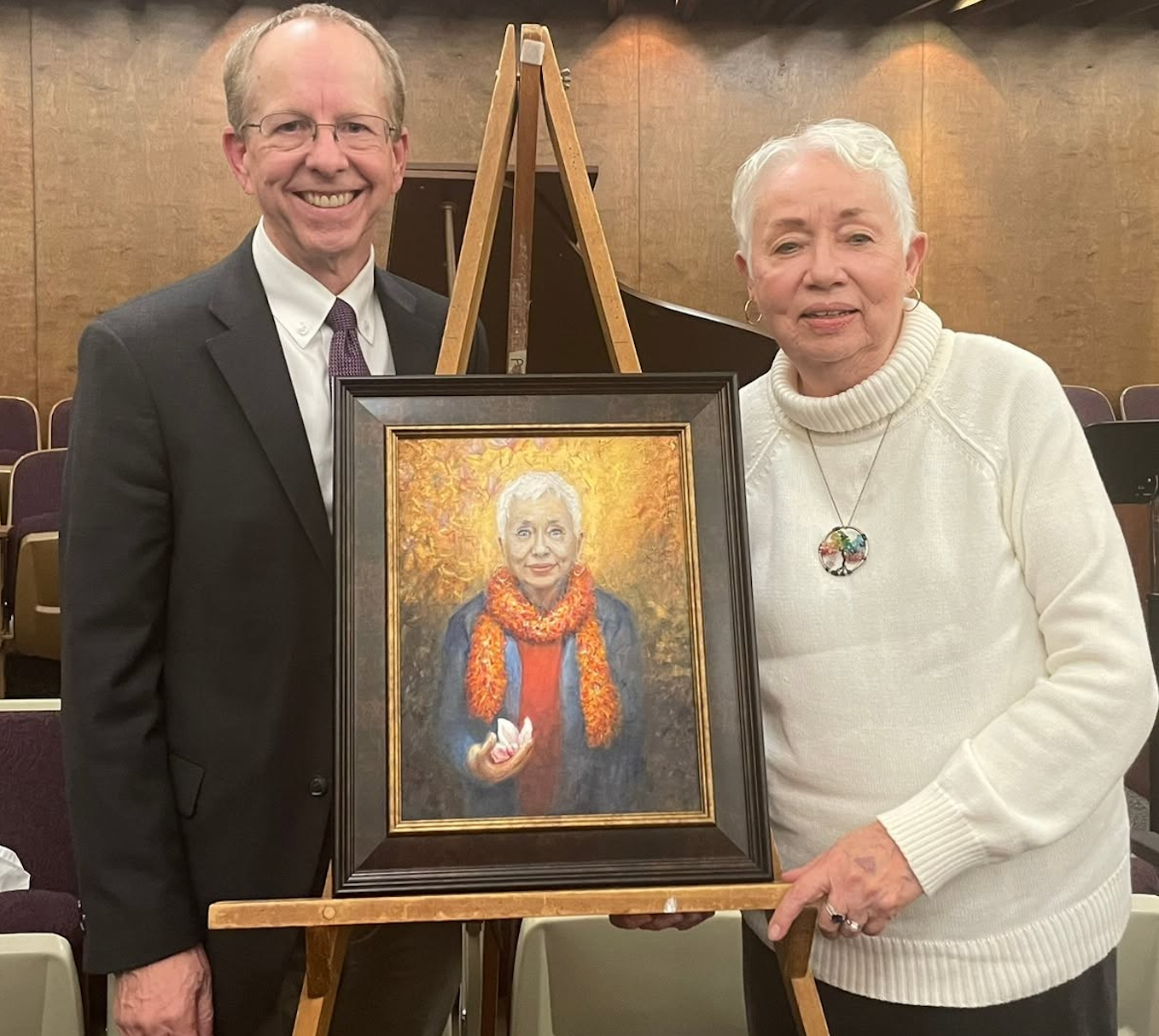
Remarks by Carol Lynn’s former bishop at the Bay Area Council for Latter-day Saint Studies, at her presentation with a Radiant Mormonism Award, September 29, 2024. As part of the celebration, Carol Lynn was presented with a portrait by Adrienne McConkie. A video recording is available at https://ldscouncil.org/eventarchive
Carol Lynn Pearson is no stranger to receiving awards. She has been honored, and rightly so, by countless people and organizations much more notable than any of us in the Bay Area Council of Latter-day Saint Studies. But this is the first time I know of that she has been honored in this way here in her own chapel, where she has attended church for 48 years this month, sitting (at least in recent years) in a pew not too far from where she is sitting now, singing the hymns (but of course replacing as she sings the male pronouns with more inclusive pronouns). The Bible says a prophet is not without honor, except in her own country. As someone who has attended this ward with Carol Lynn for 37 of the 48 years she has been here, I can say that we have long honored her here—and I am glad that we are honoring her here tonight for her Radiant Mormonism.
Carol Lynn Wright was born in Salt Lake City. As she proclaims in one of her many beloved poems, her “people were pioneers.” One sailed to San Francisco on the Ship Brooklyn, another marched in the Mormon Battalion. Her grandmother, Sarah Oakey Sirrine, walked across the plains beside a covered wagon at eight years old.
True to this heritage, Carol Lynn started making her mark early. As a fourth grader living in Gusher, Utah, she won four dollars in a school district essay contest on “Why We Should Eat a Better Breakfast.” As a high school student in Provo, she was the editor of her school newspaper and president of the thespian club. And she won another essay contest, with a prize much better than four dollars—a visit to the Rose Garden and a meeting with President Eisenhower.
She went on to BYU, where she majored in theater. One of her professors crowned her “The First Lady of BYU Theatre.” She won the “Best Actress Award” twice, including for portraying Joan of Arc. Later, after she graduated, she portrayed one of Pancho Villa’s soldiers—not sure if she won an award for that.
Her first job after graduation was teaching English at Snow College, which she did for a year before taking a year off to travel. Then it was back to Provo and a job as a writer at BYU Motion Picture Studios, with some acting on the side in BYU theatrical productions. There she met Gerald Pearson, fell in love, and soon was married.
Gerald quickly became Carol Lynn’s promoter. When they couldn’t persuade publishers in Salt Lake to publish her poetry, Gerald insisted that they publish on their own and borrowed $2,000 to do so. They convinced the BYU Bookstore to sell the book—Beginnings—on consignment. The Bookstore wanted to start with just five copies. Carol Lynn and Gerald convinced them to take 20. And then, within hours of putting the books on sale, the Bookstore was asking for more. As the accolades began to roll in, Carol Lynn wrote in her diary “I’m kind of like a celebrity.”
Indeed, she was. But nothing like she would become in the years to come.
In the years since Beginnings, she has written over 80 published works, ranging from poetry collections like Beginnings, to light-hearted humor books, cherished Christmas tales, beloved plays like My Turn on Earth and The Order is Love, and (maybe most importantly) books and plays to push us to greater progress on embracing our gay brothers and sisters, achieving greater partnership between men and women in our church and society (including reconciling with our history past and present on the important topic of polygamy), and inviting our Mother in Heaven into our lives and conversation.
Her celebrity within the church became nationwide celebrity in 1986, albeit not in the way Carol Lynn had mapped it out. In 1978, after 12 years and four children, Carol Lynn and Gerald’s efforts to maintain their marriage despite Gerald’s homosexuality reached their end and Gerald moved out. They remained friends, though, and six years after the divorce, she held him and sang to him as he lay dying on her couch of AIDS. Her book telling that story, Good-Bye, I Love You, was published in 1986. It was a pathbreaking book in a dark time when all of us had much more to learn about homosexuality than we do even now. The book led to a national tour with Carol Lynn making appearances on Oprah, Good Morning America, and many other major talk shows, as well as being featured in People Magazine. And it led to Carol Lynn devoting much of her writing, speaking, and personal energy in the ensuing years to promoting greater love for and understanding of our LGBTQ family members, co-workers, church members, and friends. As Carol Lynn puts it, she was born into “women’s issues” and married into “gay issues.”
While Goodbye I Love You is her most well-known book, her best-known play is Mother Wove the Morning, a one woman-play in which Carol Lynn portrayed sixteen women throughout history in search of the female face of God. She performed it over 300 times to transfixed audiences across the country and in two foreign countries. Joan Baez (yes, that Joan Baez) saw the performance and proclaimed it a “powerhouse.” Olympia Dukakis declared it “an extraordinary piece of work.”
Of course, Carol Lynn portraying Elizabeth Cady Stanton declaring herself to be a radical was also Carol Lynn portraying Carol Lynn. At the time she was performing her play, she noted in her diary that we are often urged in church not to “murmur.” Her response? “I don’t ‘murmur.’ I speak as articulately and loudly as possible. I even hire a theatre. One does not ‘murmur’ on the stage.”
Is it possible to be both a Radical Mormon who hires a theater to speak as articulately and loudly as possible and at the same time be a Radiant Mormon? Carol Lynn answers that question. They are not mutually exclusive. To the contrary, one can lead to the other. As she put it to me recently, being radiant means being a light everywhere, including in dark places where we need greater light and knowledge.
If Carol Lynn’s contributions to all of us consisted only of plays like Mother Wove the Morning, and books like Goodbye I Love You, she would on that basis alone have earned many times over the accolade Radiant Mormon.
One of her other published works, however, highlights a more fundamental reason why, for me least at least, we honor her here tonight. In 1988, at the request of the church’s General Primary Board, she wrote a song for the then-new Primary Children’s Songbook. The song is titled “I’ll Walk With You.” Most of you here know the song and have sung it many times. It will be performed here in a minute. It speaks of not walking away from people who don’t walk like us, and not refusing to talk to people who don’t talk like us. I am confident Carol Lynn did not write that song as a memoir, but it is just as much or more a memoir of her life as was Goodbye I Love You.
Through her books and plays, Carol Lynn has figuratively walked with and talked with countless people who needed to hear what she was saying. But more than that, she has literally walked with and talked with countless people in need. Gay men from around the country, rejected by their families, struggling with whether they have in place in the church or in this life, call her for support and guidance. And she gives it, spending untold hours, giving encouragement, expressing love, demanding of them that they hang onto this life, and checking in with them repeatedly to make sure they are doing so. She invites them and numerous others struggling with problems to her home, takes them for walks in the neighboring hills, listens to their concerns, blesses their lives.
When I served as her bishop, I often tapped into Carol Lynn’s generosity, sending to her people in distress or in need of a listening ear. And then I would hear later how Carol Lynn invited those people to her home, took them on a walk, had them over for holiday dinners. A teenager whose life had unraveled and needed a place to stay found one in Carol Lynn’s home. Another teenager who had decided life was not worth living found a listening ear in Carol Lynn. When a sister in the ward needed to be included more, Carol Lynn suggested they do a duet together in sacrament meeting, which they did.
The scriptures tell us to bear one another’s burdens, mourn with those that mourn, comfort those that stand in need of comfort, and stand as witnesses of God at all times and in all things. Carol Lynn lives true to that charge as effectively and energetically as anyone I know. She wrote once in her diary,
“How would it be if the totality of our conversation, doctrine, endeavors were directed only to renovating each other’s spirits, repairing the breakage, restoring the memory of who we really are, inviting each other into a more beautiful place?”
Indeed, how would it be? Thank you, Carol Lynn for devoting your life to inviting us into a more beautiful place.
Steven Peck
I was so sad to hear about the passing of Carol Lynn Pearson. She was such an influence in my life, from her musical play My Turn on Earth to her books of poetry which I read just as I was discovering poetry myself through her book Beginnings. She was also one of the most joyous and compassionate people I know. And she was so much fun. Below you can see from the a chapter of my book Gilda Trillim: Shepherdess of Rats where she appears as herself in the chapter in which Gilda titles a chapbook of her poetry, My Turn on Earth long after it was originally written in the 1950’s, after Pearson’s play. But what was so fun is I asked her to blurb this book (with some trepidation I assure you). She came back with the attached quote. Note the she claims that Gilda is a real person too because she fell in love with her. She was such a force of good despite a difficult life. I will miss her dearly.
Gilda Trillim blurb: “Beautifully Bizarre! I could not have taken this dizzying journey except for a master hand leading me through the surprising giggles to the even more surprising blessings of grace, wisdom, and healing. I really don’t think Gilda is fiction, for I fell in love with her, and as she and I both know, love is stunningly real.”
Eric W. Jepson
Since moving to the Oakland Stake twenty years ago, I’ve had the pleasure of bumping into Carol Lynn now and then. Each time we met, we met for the first time. She was engaged in being a loving matriarch to the wounded and, since I was doing just fine, I wasn’t anyone she needed to commit to memory. We got better acquainted when I put together the 2019 AML Conference where she received the AML’s Lifetime Achievement Award. I’ll never see an AML meeting so well attended as that. People both local and from all over came to be with her and to recognize her role, not just in literature but in saving their lives—helping them find meaning in their lives. We were always supposed to go hiking near her home sometime, but first covid got in the way and then she just wasn’t as active. Although I’m a little bummed never to have sat in her living room or to have wandered the hills with her, I’m satisfied knowing that she was prioritizing those who lives needed saving, those who needed help finding their lives’ meaning. She was an agent of charity and in her final decades she was gifted with the gravitas and wisdom that comes from a lifetime focused on loving others and in explaining her love through her individual words.
Lisa Rampton Halverson
I just have a few short connections to the poet Carol Lyn Pearson. I do not think I ever met her in person. However, her poetry helped my mom as an 18-year old young convert to the Church in 1968.
In high school I started to read the copies of her poetry books on my mom’s bookshelves.
In college, my mom would send me her poetry in the letters she mailed me every week or so. My freshman year we went together to BYU’s Women’s Conference. On our rendezvous one morning, my mom was so excited about Carol Lynn’s most recently published book of poetry that she had read it all the night before. But I was also excited because I had purchased her a copy for Mother’s Day. We laugh-cried and swapped copies so we each had one of Women I Have Known and Been.
Home for the summer, I checked out copies of Carol Lynn’s books from the Oregon State Institute library. I opened one and saw my mom’s name in the cover on the Library slip — after she had joined The Church of Jesus Christ of Latter-day Saints but before she married my dad Mark Rampton. I then signed my name beneath hers. A friend tried to hunt down that exact book for me at the library, but didn’t come up with it.
Carol Lynn’s Goodbye, I Love You touched my heart so deeply. I wept as I read it.
I have loved Carol Lynn’s poetry for connecting me to both my earthly and my heavenly parents.
Jim Bennett
I was aware of Carol Lynn Pearson for years before I discovered The Ghost of Eternal Polygamy. But I wasn’t in awe of her until I read that book.
I’d spent enough time in online apologetics to know the full catalog of justifications for plural marriage and to know that all of them fall flat. They downplay bad behavior and normalize the inexcusable, all while avoiding the doctrinal stumbling block that polygamy places at the center of our theology. Yet unlike the rest of us, Carol Lynn Pearson refused to flinch at any of polygamy’s messiness. She demanded that we all confront the damage the doctrine has done and continues to do to the Kingdom of God.
Praised as a faithful believer and condemned as an ardent critic, she was, in reality, simultaneously both and neither. Her singular focus was on individuals, not institutions. Goodbye, I Love You was not written to reform the Church’s approach to LGBTQ rights; it was a love letter to her dying husband. Yet the focus on the individual couldn’t help but improve the institution. That book gave the Church a vocabulary to deal with a volatile social issue that most members refused to acknowledge.
The same was true of The Ghost of Eternal Polygamy, which condemns the doctrine of a polygamous heaven in which legions of women share a single husband. Rather than repudiate it, most members just wave their hands and say God will sort it all out. Carol Lynn Pearson was having none of that. Her argument was not some theological abstraction; it was intensely personal. She illustrated the direct real-world consequences of a 19th Century doctrinal relic for individual, specific women in the 21st Century Church.
I never had the opportunity to meet Sister Pearson in person, but there is no denying the lasting impact she had on me and on thousands of others who encountered her only through her work. For me, she will always be the model for telling hard truths about the Church from the inside without losing genuine affection for it. This is the path I’m trying to follow. And I, like so many others, can see the way forward, because she walked it first.
See also:
I didn’t discover Carol Lynn Pearson until I began questioning so much of what I had been taught about the Church.
I wish I had known about her sooner.
When I found her, I found a woman who was willing to ask difficult questions and say difficult things, but who somehow never seemed to let any of it harden her. She could disagree. She could challenge. She could be angry. And still, underneath it all, there was love.
She was brilliant, a gifted poet and storyteller, but it was the person behind the words who inspired me most.
The courage and the tenderness existed together.
There was a genuineness about Carol Lynn that made you feel the goodness of her heart. She showed me tenderness and compassion, not only for others, but for myself. At a time when so much of what I had once been certain about was changing, that mattered to me.
And she gave me hope.
Hope in a Mother in Heaven, not simply as an idea, but as a reality. Hope in the divinity of women. Hope that the feminine is not somewhere at the edges of the sacred, but belongs at its very center.
Carol Lynn showed me that I didn’t have to choose between courage and tenderness. I could question. I could disagree. I could even be angry. And I could still love.
There is something profoundly beautiful about a person who can see things that need to change and fight for that change without allowing the fight to take away her softness.
Carol Lynn Pearson was that kind of person.
I am grateful I found her. Grateful for her courage, her words, her enormous heart, and for the trail she made wider for the women who came behind her.
Thank you, Carol Lynn, for giving me hope.
And thank you for showing me the courage it takes to remain tender.