
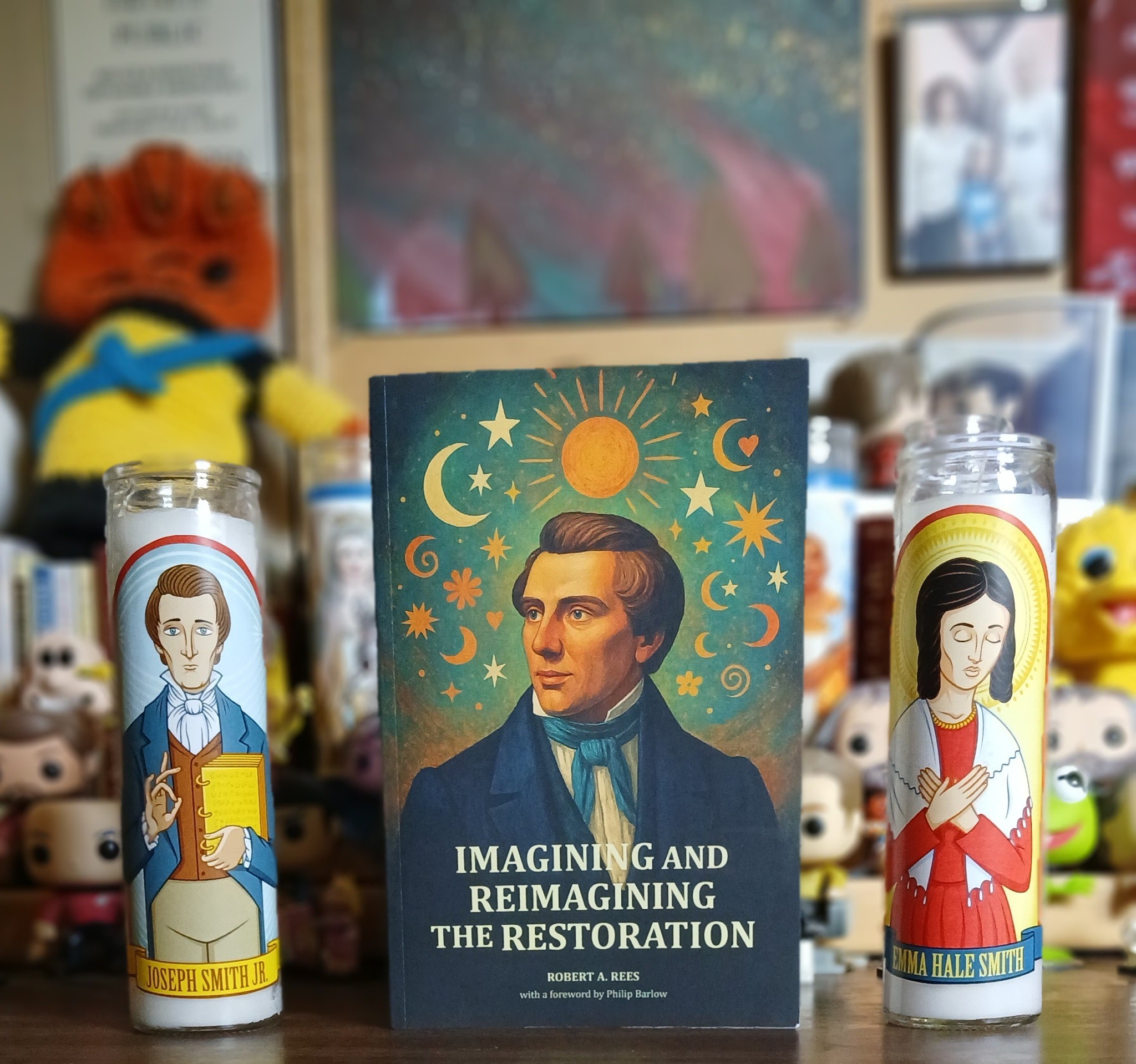
Review
Title: Imagining and Reimagining the Restoration
Author: Robert A. Rees
Publisher: Greg Kofford Books
Genre: Religious
Year Published: 2025
Number of Pages: 203
Binding: Paperback, ebook
ISBN: 978-1589588240
Price: $23.52 – $25.95
Reviewed by Ryan Ward for the Association of Mormon Letters
The Church of Jesus Christ of Latter-day Saints is facing some significant growing pains. The young religion is struggling with how to continue to appeal to a membership that is growing increasingly polarized politically, and in particular a youth demographic for which its conservative positions on a number of very visible social issues are out of step with the intellectual, social, and often scientific zeitgeist.
For progressive members of the Church, depending on where one lives, there seems to be less and less to hold onto within the institutional church. There are many online groups and forums and even more established organizations that host podcasts and hold events geared towards these more progressive members, but these organizations and groups are not officially recognized by the Church and often find themselves at odds with it. They seem to be becoming increasingly siloed into their own echo chambers.
In this climate of tension, Robert “Bob” Rees’s book Imagining and Reimagining the Restoration will come as a welcome relief to many progressive members of the Church. Rees needs no introduction, although we are given one which illuminates some personal and difficult angles of his early life by Philip Barlow in the Foreword.
For those unaware of who he is, Rees was the editor at Dialogue who decided, against the wishes of the Church authorities, to publish what is probably the most consequential article in modern Mormonism, Lester Bush’s historical catalogue of the evolution of the Church’s policy and doctrine on the priesthood and temple ban. Rees dedicates a full chapter to this “revelation”—the article, not the proclamation by President Kimball—in his book.
Rees’s own discipleship has taken many forms throughout his life, from his participation in and founding of various foundations to his teaching and other service, he is the consummate disciple of Christ, having spent his life in the service of those around him. His life is a moving example of someone who internalized the teachings of Jesus, particularly around the covenant responsibility to the poor and needy, and has worked within his means and influence to better the lives of those who are most precarious.
All of this would mean nothing if his book didn’t measure up. Thankfully, the depth of humanity and generosity of spirit that those who know him have been privileged to experience shine through in this collection. It is his attempt to imagine what an ongoing restoration might look like for the Church. It is also, at times, an attempt to reimagine what the Church might have looked like had it chosen a different path. Both of these exercises are crucial to the ongoing work of the restoration Rees addresses here.
The book is a collection of essays —some more formal than others —reflections, and poetry. All of this is in the service of helping the reader to catch a glimpse of the richness of the restoration tradition and the limitless possibilities for its future. If, as Joseph Smith said, Mormonism is a religion premised on an ongoing restoration of God’s truth, then members of that religion can participate, indeed must participate, in acts of imagination in order to bring about the fullness of that restoration.
It is a quietly radical assertion that Rees makes here, and his interventions go a long way towards helping his readers understand what such imaginative exercises might look like. The varied essays and exercises touch on many relevant contemporary topics such as racism, women in the church, heavenly mother, the poor, political discord and division, and others. Those who are inclined to follow Rees’s imagination will be richly rewarded with beautiful prose and evocative imagery. He blends insight from scripture, literature, and personal experience in a holistic way that feels quite different from much contemporary church and gospel writing. It is refreshing and feels very alive and vibrant, pregnant with possibility and meaning. Many of the poems, such as “Emma In Sunlight,” are very lyrical and moving.
If there is one criticism to be made, it’s that Rees, who seems uniquely qualified to take a bold and even critical stance on some of these issues, chooses instead to take the apologetic route. While many of the pieces are not critical of the institutional church and are more theological in nature, when he does venture into critical territory, Rees repeatedly hedges his critiques by, for example, reminding the reader that he knows he is not a prophet and so his suggestions should only be taken as such. For more progressive members, I’m afraid that the treatment here might be a bit too apologetic, notwithstanding the quiet radicalism at the heart of many of these ideas, including what is sure to be a controversial suggestion to discontinue the tradition of choosing the prophet based on seniority.
It seems to me that a significant, if controversial, aspect of imagining and reimagining a restoration, one in line with Rees’s own ideas, is conceding, even asserting, the possibility that leaders have made and are making the wrong choices, and that these choices are not in accordance with the teachings of Jesus or the desires of loving Heavenly Parents. This includes functioning in a prophetic mode to explicitly call out shortcomings, even in leadership. Rees too often comes off as apologetic, not only for the Church, but for the perceived radicalism of his own assertions. Perhaps this is just his own humility, but it feels like a missed opportunity given that the most consequential decision he made as editor of Dialogue was in direct opposition to the leadership of the Church. This decision likely tipped the scales in terms of the priesthood revelation. He started a foundation to feed hungry children who were members of the Church, a move that evidences the Church’s unwillingness or inability to feed its poor and hungry members. Thus, Rees has had direct experience with Church policy and decisions that would be ripe for criticism on firm historical, moral, even spiritual—and not just antagonistic— grounds. It would have been heartening to see him more fully embrace his prophetic mode here.
I hope I’m not faulting Rees’s book for simply not being what I want it to be. In many ways, it will be exactly the salve and lightly provocative exercise that is needed by its readers. For others who are in the throes of a faith crisis or who yearn to see someone on the inside take a more bold stance towards some of the most pressing issues, it may come off as more of the same, notwithstanding its variety and creativity. It’s obviously not possible for one book to do all of these things, but given his life experiences, Rees seems uniquely positioned to take these more bold, imaginative stances, and the fact that he doesn’t do so here feels disappointing.
Despite these criticisms, Imagining and Reimagining the Restoration is a necessary contribution to the contemporary Mormon discussion and will be read with interest by many both in and out of the Church. I believe that it will, as hoped by Rees, inspire many to take a more imaginative position towards the restoration. Rees’s wisdom and quietly powerful exploration of discipleship stands as something to aspire to as well as a call to recognize the possibilities within ourselves and all members of the Church to envision a more just and Christlike restoration. It is acts of imagination like these that will be necessary in order for the ongoing restoration to help the Church grow into its full potential to bring to pass the establishment of Zion.