 Reposted from the Mormon Short Stories substack.
Just a quick reminder that the AML awards are coming up on June 20th from 3:00-6:00 mountain time, so you can look forward to several new posts on my substack about this year’s excellent short story nominees and winners in the upcoming months.
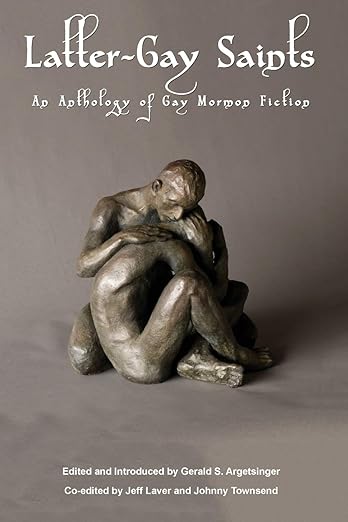
This month, to celebrate Pride, however, I’m completing my survey of the BIG 5 Mormon short story anthologies of the last couple decades, concluding with Johnny Townsend and Jeff Laver’s Latter-Gay Saints: An Anthology of Gay Mormon Fiction. I cannot emphasize enough how much I recommend it, but unfortunately it is also regrettably out of print and used copies are becoming increasingly hard to find. Luckily, however, I was able to procure a copy thanks to Jeff Laver, and in the spirit of the Perpetual Emigration Fund, I’d like to make it available to as many people as possible. I will send it for free to anyone who wants to read it. All I ask is that you read it in a reasonable amount of time after receiving it and mail it back to me (Robert Bennett / 1502 S. Black Ave. / Bozeman, MT 59715) after you have finished, so that I can pass it on to the next person. If you are interested in having a turn, just email me (robert.bennett@montana.edu), and I will add you to the list. It’s now required reading for any well-read Mormon short story afficionado (which I assume you all are if you are reading this substack)—and it’s free—so you have no excuse not to be au courant anymore.
When I took Eugene England out behind the woodshed last month in “The Shock of the New,” I was just having a little fun. It was just a couple of middling English professors sparring in some dive gym somewhere in North Philly. All just for laughs. The stuff of Saturday morning cartoons. Tom and Jerry. Bugs Bunny and Yosemite Sam. Road Runner and Coyote. Just a couple of frenemies bitching about literature. Mere words, words, words as someone wiser than I once put it. I’ll freely admit that I may have thrown a couple cheap shots, possibly even one or two punches below the belt. I may have even lost the fight for all that I care, but nobody can accuse me of going down without a fight. And certainly not of punching down. He’s Eugene England for heaven’s sake. His reputation can survive a couple rounds in the ring with anybody, and I’m just a nobody. But he’s the godfather of Mormon letters. The OG. The Mormon Shakespeare—or at least Mormonism’s answer to Harold Bloom. (Sorry. I just couldn’t resist one last cheap shot.)
But this month, my analysis of Johnny Townsend and Jeff Laver’s Latter-Gay Saints will tackle something far more important. This one is personal. This one matters. Viscerally and existentially. So, I apologize in advance if I run a little long—this will probably be the longest post that I will ever write on this substack, so bear with me on this one. It’s that important to me, and it probably should be to you, too. Because I have both dear friends and close family who live at the complex intersection between the LGBTQ and Mormon communities—often painfully so. And unless you have been living somewhere under a log for the past two decades, so do you.
This time, therefore, I write not merely as a literature professor, but also as an ally, as a friend, and as a father. So, buckle up!
Simply put, the time is far past when Mormons can afford to neglect latter-gay voices any longer, and the stories in this volume are a collective voice—whether from the dust or crying in the wilderness I haven’t decided—clamoring to be heard. I’m not addressing the church at large right now, but rather I speak specifically to the community of Mormon letters. The church may have its theology, its policies and handbooks, and even its Proclamation on the Family, which collectively limit its ability to even hear, let alone embrace and celebrate, LGBTQ voices. So be it.
But we, as writers and readers, are not beholden to the rigid strictures of ecclesiastical edicts and church discipline. The church may deny its LGBTQ members temple recommends, or even excommunicate them, but us people of the book are duty bound to, if nothing else, at least hear their voices and read their words. Every story matters! I’m not saying that you must agree with them, embrace their theology, or even empathize with their lives. (You can still be boorish or even bigoted if you really want to). But you don’t have to be a big tent Mormon to realize that, in the year of our Lord 2026, these latter-gay voices at least deserve a seat at the table of Mormon letters. If you don’t already believe me, read Langston Hughes “I, Too,” hang your head in shame, and correct the error of your ways.
But this immediately presents me with a dilemma. I have just claimed, in my last post no less, to have carved in stone my Mount Rushmore of Mormon short story anthologies, including—simply in chronological order—Eugene England’s Bright Angels and Familiars, Robert Perry Raleigh’s In Our Lovely Deseret, Angela Hallstrom’s Dispensations, and Andrew Hall and Raleigh’s The Path and the Gate. After reading Townsend and Laver’s anthology, however, I am absolutely, unequivocally, irrevocably convinced that one of these must go. A true Rushmore means four and only four (forget about it, Trump), and IMHO Latter-Gay Saints—on virtually any account imaginable—absolutely deserves to be one of them.
Maybe only Roosevelt in your book. I’ll leave it for you to decide which is who, and I’ll let you pick for yourselves which of the other four to discard. I don’t have a horse in those particular races today, but the voices of latter-gay saints simply can no longer be marginalized as just a niche subfield, let alone second-class citizens. These stories are now required reading on any serious syllabus of Mormon literature, and they will figure prominently on the final exam at the end of the semester because this anthology deserves—on its merits—a central place in the canon, a call-up to the major leagues, and a seat at the cool kids’ table. In short, its own face on Rushmore.
And I’m not just trying to be DEI politically correct or even generically multiculturally inclusive here. Issues of gender and sexuality are not something that simply belong to some minority LGBTQ community; they have become one of, if not the, central defining issue within Mormonism itself writ large for the entire Twenty-first Century. They have arguably provoked its most controversial musket fire sermons and ill-fated policies of exclusion, they have definitely fueled the church’s most disastrous public relations pyrrhic victory with Proposition 8 in California, they have probably caused the most resignations of church membership and the more diffuse PIMO(physically in, mentally out)-ization of its remaining members, and they have pervasively touched—when they haven’t outright devastated—virtually every single ward if not quite every family in the church. And personally, I don’t see these issues going away anywhere anytime soon. Even the most devout members must admit that issues of gender and sexuality are the central focal, and flash, point of the church’s single most, if not only, truly epoch-defining revelation—the Proclamation on the Family—since President Kimball’s reversal of the priesthood and temple ban half a century ago.
Simply put, to be a Mormon standing on the edge of the Twenty-first Century—whether you are gay, straight, or fluid; whether you find yourself in the center of the inside or on the far edges of the outside—is to take a stand on issues of gender and sexual identity. Period. Full stop. Because even if you are personally comfortable in your own personal church-approved identity, the church as an institution does not approve of the full expression of LGBTQ identities. It has drawn a line in the sand. It has taken a stand. It has chosen this hill to die on. So, if you choose to affiliate with the church either directly or obliquely, I think it is fair to expect that you have a well-thought-out and principled opinion about where you personally stand on these issues.
I believe, however, that it is simply irresponsible, this late in the game, to form such opinions without at least listening to the stories of those who have been most directly impacted by the church’s official theology and policies regarding gender and sexuality. I’m not even suggesting that you should not support official church policies on these matters. I am only insisting, as forcefully as I can, that no one can in good conscious unquestioningly defend the church’s party line on gender and sexuality with muskets—or even with trowels—anymore unless they have at least first listened to the voices of our own community of fellow latter-gay saints. And for a member of the community of Mormon Letters, there is no better place to start than reading Latter-Gay Saints.
That said, let me get one thing straight up front, this is not just an anthology about latter-gay sexuality, it is also an anthology of well-crafted fiction. Homosexuality is perhaps central to every story, but that doesn’t mean you can forget that these stories are also simply great literature that belongs in any literary anthology. Maybe no story reveals these dual gay and literary dimensions more clearly than Donna Banta’s “The Call”: a masterful mystery story about a Mormon missionary found “dangling behind the LDS mission home” with the words “fag hater” spray painted across his suit coat. Obviously a hate crime, the mission president explains to the detective on the case. Just more evidence that “Mormons have been persecuted for nearly two centuries.”
Like every superb mystery, however, this story is full of clever, even brilliant, twists and turns guided by some real hardboiled gumshoe footwork. Immediately on the surface, of course, homosexuality figures prominently in the story, but ultimately the careful construction of this story’s complex plot explores homosexuality in many more ways and in much more interesting ways than you might expect at first glance. And the story’s engagement with Mormonism also extends far beyond simply its relation to homosexuality to include at the very least mission rule-breaking, religious guilt, Mormonism’s persecution complex, and the sacred cow of protecting the good name of the church at all costs.
Consequently, this story is an intriguing exploration of homosexuality, a complex narrative about Mormonism, and also quite simply just a damn good detective story. It belongs side by side with James Goldberg’s “The Case of Frau K”—a nominee for the 2025 AML short story award—which tells a story where the missionaries are “detectives” trying to solve the surprising “mystery” of why an investigator is reluctant to come to church. Both are perfect stories that belong together in any collection of Mormon mystery stories. One just happens to involve homosexuality, as both a central theme and a compelling plot device, intricately interweaving its gayness with its literariness. You would have to be willfully ignorant, however, to not see how its clever and complex engagement with homosexuality—which is simply too good to give away—makes this story much better, not worse, even simply as a work of fiction, let alone as insightful social commentary.
Another popular Mormon genre is the day-in-the-life of a bishop story. Both Levi Peterson’s “The Christianizing of Coburn Heights” and Ryan Shoemaker’s “The Lord’s Sacred Funds” comically explore how one of a bishop’s fundamental quotidian duties is to care for the poor and needy. This is, after all, the fourth mission of the church. But outside of Townsend and Laver’s anthology—and maybe Walter Kirn’s occasionally maligned classic, “Planetarium”—few Mormon authors have really tackled one of a bishop’s other primary tasks: pastorally regulating youths’—or even adults’—sexuality. Drawing on Mark E. Peterson’s LOL infamous memorandum on masturbation, a little calendar marked off with black ink marks day by day, and a wrist tied to a bedframe, Rik Isensee’s “The Summer My Cousin Turned Mormon” similarly satirizes church leaders’ often over-the-top attempts to monitor young Mormons’ youthful explorations of masturbation. In M. Larsen’s “M.T.C. Interview,” an M.T.C. branch president hears the confession of a new Elder’s homosexual dalliance with a fellow Elder in the M.T.C. By the time we get to John Bennion’s “The Interview,” a soon to be not-newlywed gay man confesses that he can no longer go forward with his planned nuptials because of his deficient heterosexuality. All three stories tell distinct variations on the sexual confessional with different twists, but by the time we get to the third story about church leaders’ often deeply flawed attempts to exercise jurisdiction over their flocks’ sexuality, we might begin to wonder if there isn’t a fifth mission of the church: policing kids’ genitals.
The stories in this anthology may include specifically homosexual elements, but it’s the lock of the day to bet that your average Mormon youth, heterosexual or homosexual, can relate more to these stories of ecclesiastical sexual supervision on a more personal level than they can to Mormon fiction about almost any other topic. Once again, every Mormon youth experiences it, but many straight Mormon writers seem reticent to talk about it. Personally, I suspect that one reason why is because it is immediately obvious that Mormon leaders’ attempts to police sexuality are often highly problematic, and many more devotional writers shy away from such critical depictions of the church. It is refreshing to see writers address these issues so thoughtfully and candidly in homosexual contexts, but who is going to represent the experiences of our straight youth? They say a people without stories flounders. I think we are floundering. We probably need fundamental structural change, but even that can sometimes begin with compelling stories.
I’ve praised Ryan Shoemaker’s “Righteous Road” as a Good Samaritan level exploration of not just moral responsibility, in general, but more specifically the complexity of moral responsibility, in particular. In “M.T.C. Interview,” M. Larsen develops an equally biblical sense of the complexity of moral dilemmas. I won’t spoil this excellent story by telling you outright what that moral dilemma is but suffice it to say that the story demonstrates how sexuality involves much more than just body parts and bodily fluids. In this story, a simple gay indiscretion becomes the smithy in which is forged a powerful exploration of larger moral issues involving at the very least honesty, responsibility, selfishness, and integrity. If by devotional we simply mean literature that protects the good name of the church by always representing Mormonism in the most positive light, then this anthology may be found wanting. But if we mean a truly broader and deeper existential exploration of religious morality and human values at large, then this story, among several others in the anthology, stands head-to-head with any in the Mormon canon—even Shoemaker’s.
Robert Hodgson Van Wagoner’s “Strong Like Water” presents a particularly poignant variation on complex moral dilemmas as it explores the fraught situation of a man (Peter) awakening to his homosexuality and coming out to his wife (Karmine) years into their marriage—with kids—forcing them both to grapple with the difficult question of what to do in the face of daunting uncertainty: should he stay, or should he go? Will Peter’s infidelities even bring him the happiness and sexual freedom/integrity that he seeks, which even he himself is beginning to have second thoughts about? And at what cost? Is this really a price that he is willing to pay? Obviously, it is, or at least it has been, or he wouldn’t even find himself in this situation, but is this really a cost that he is willing to keep paying as well? And how will Karmine become collateral damage in the process? And the kids? (Emily January Petersen’s “I Love You No Matter What” explores this situation from a kid’s perspective.) These are all additional questions unto themselves. Once you come out of the closet, especially as a married person with children, there is often a whole house full of rooms, and existential quandaries, that you must now deal with as well.
Brilliantly focused as much, if not more, on Karmine as it is on Peter, this story, in particular, explores the often devastating impact that one person’s sexual choices have, especially when it involves infidelity—however rationalized or justified or not—on their partners and families who inevitably must also pay a high price for their decisions. Certainly, such complex existential questions offer no simple solutions—if they are even answerable at all. You can call it a cost benefit analysis if you want to, and it is, but it is also so much more than that. At least in part because there are so many uncertain and interdependent variables which so frequently place individuals in one Catch-22 or another.
Yet another thing that Van Wagoner cleverly does is remind the reader that issues of sexuality are not an island unto themselves. They do not happen in a vacuum but rather play themselves out amidst all the other multiple busy complexities of life. When the story’s brilliant first line says that the “same week Karmine discovers her husband is having an affair with a man, she takes her mother to a doctor, who finds a tiny patch of cancer on the tip of the old woman’s nose” this is only the beginning of her aging mother’s physical and mental problems which Karmine now must also balance with her own marital difficulties. Ultimately, it is hard to make one’s own personal choices while simultaneously trying to deal with the moving target of another person’s choices while you are also on a moving train, so to speak. And did I mention that the train is now also being shot at by bandits, too. Throughout this anthology, issues of gender and sexuality are frequently intertwined in complex ways with larger moral issues that extend far beyond simple sexuality itself.
I have also praised Shoemaker’s The Righteous Road for its charming sense of humor, and this anthology is funny, too, but often with a broader range of humor. Much of the humor is not LOL haha funny, but rather more serio-comic. Sometimes even dark. The kind of stuff that often makes you simultaneously want to both laugh and cry. There is the dark humor of Banta’s “The Call,” which ends with tragedies within tragedies, but you have to laugh—almost gleefully through tears—when the detectives finally serve the real criminals their comeuppance. There is also the hysterical image of Isensee’s teenage convert trying, at the behest of his spiritual leaders, to resist the urge to masturbate by tying his hand to the bedframe, but that’s not really funny. Nor is it funny when another missionary is advised by another leader to follow Elder Packer’s infamous advice to physically assault anyone who makes a homosexual advance toward him. Not funny either. Although Elder Packer did tell it as a punchline. So, is it funny after all? Probably just a bad joke. But are bad jokes actually funny? There is a lot in the gay Mormon experience at large, and within the stories in this anthology, in particular, that definitely lies in that no-man’s zone of the funny/not funny. This anthology as a whole may not be quite as ROFL funny as Neal Chandler’s hysterical benediction (in “Benediction”), but the range and complexity of its humor is arguably unmatched in Mormon short fiction.
If you want to read the one story where everything in this anthology all comes together in one place, however, I believe that it is in Johnny Townsend’s “Partying with St. Roch.” I’m not going to insist that every reader should find this the best story in the anthology, although I—both wearing my professional hat as a literature professor and lounging on a beach towel as a lay reader—personally do. And if you are new to all this, I’m certainly not going to suggest that this should be the first story that you read. On the contrary, you should probably break yourself in more gently and read the anthology starting from its proper beginning. This is a legitimately challenging story—as an exploration of sexuality, as a critique of Mormonism, and simply as a work of literature—but it is also the story where one finds the most creative and complete—the tastiest—combination of the anthology’s basic ingredients: the gay and the Mormon, the literary and the sexual, and the LOL funny with the this really isn’t a laughing matter anymore.
Let’s start with the funny/not funny. This story is chock full of comic incongruities. When the protagonist’s boyfriend, Dennis, is introduced as having a Coke problem, it is as in Coke the soda pop, not coke the illegal drug. Having been raised a caffeine teetotaler, however, he had never even drunk the beverage until his first trip to a gay bar. Arguably the most incongruous comic image—its set piece—is when the couple role plays a little gay sex wearing “missionary” name tags for “Elder Top” and “Elder Bottom” representing the “Church of Jesus Christ of Latter-gay Saints.” Hilarious for some. Not so funny for others. Just like the protagonist’s missionary story about having gay sex on his mission. Comic incongruity? Definitely. Funny/not funny? Humor is probably only in the eye of the beholder.
This anthology’s occasionally blasphemous and sacrilegious sense of humor may not be your cup of tea, but don’t you have to admit that this sexual roleplaying is at least a clever play on the “missionary” position even if you have recently become a staunch defender of the proper name of the church? The real unfunny—and poignant—incongruity, however, is when during this sexual roleplaying the protagonist notices his partner’s “large black Karposi’s lesions,” painful reminders of both his partner’s AIDS and the protagonist’s desire to “memorize every sexual encounter with him, so that I could replay them after he [is] gone.” Between the jokes then, this story is serious, very serious, even deadly serious about such significant issues as the tragic realities of AIDS and the protagonist’s recurring fears that he might be “going to hell” because the actual Church of Jesus Christ of Latter-day Saints goes “around spreading such a plague of hateful teachings in the first place.” Even if the protagonist occasionally makes a few jokes at the church’s expense, who really bears the greater blame here? Which is the greater sin? A little playful sacrilege, or outright damning a soul to hell in the name of the Almighty Jehovah? No matter how funny this story gets, however, it never leaves the complex liminal space of the serio-comic because its humorous punchlines are always quickly followed by serious knock-out punches.
This story’s gay/Mormon polarity is equally obvious and significant. Even though the gay couple now attend the Unitarian church, they are both immediately introduced as “excommunicated Mormons,” a constant reminder of the ever-present tension, even conflict, between their religious and their sexual identities. I’ve already mentioned the faux missionary nametags, another reminder that religion and sexuality travel hand in hand throughout this story, but religion and sexuality’s most dramatic confluence in this story occurs when the protagonist’s stake president “lovingly” warns him that he is “pray[ing] that God will give [him] AIDS, for [his] own good” to “help [him] repent.” What more needs to be said about Mormonism’s miserable and damaging “outreach” to the LGBTQ community? The church’s rhetoric may have softened over time, but it has never fundamentally changed its theology and practices in any truly meaningful way at least if we are talking about the full expression of LGBTQ identities. And who wants to only be a partial self? Have you taken vows of celibacy yourself recently?
Finally, the sexual and the literary. There are some, perhaps even many who, like Eugene England, will simply remain incapable of seeing past such a story’s angry—justifiably so—denunciation of the church to consider it good (or if you want to obfuscate and say ethical instead) literature. Nonetheless, this story in particular most certainly is great literature by any reasonable standard: the delightful humor, the careful pacing, the clever imagery, the poignant symbolism, the significant themes, the deliberate premise, the well-developed complex characterization, the sharp social commentary, the careful plot structure with an inciting incident, a climax, and a little denouement, etc., etc. It’s all there, all concisely packed into a simple six-page story, at least for those who have eyes to see, but I will only briefly mention what I believe to be the story’s climax and most significant and most literary line: “Could one be inoculated against the infection of self-doubt?”
Here Townsend brilliantly ties together the entire story, including at the very least—and here I’m going to deliberately craft an overly byzantine sentence to mirror the story’s own literary complexity, so hang on and stay with me—the characters’ initial excommunication and the protagonist’s stake president’s horrific curse which—in a clear act of unrighteous dominion—would plant the seeds of self-doubt in anyone; the protagonist’s continually recurring fears that God despises him or that his “fleeting” gay relationship is somehow simply a “poor substitute” for a “‘true’ eternal marriage”—the story’s real deeper theme not just its gay sex—with a clear reminder that the unjust cause of those self-doubts is unmistakably the stake president’s naked bigotry (which is by the way not an unfair stereotype of at least what the stake president may have thought if not quite said out loud back in his day—and some still do); a clever juxtaposition between the literal treatments for the disease of AIDS and the figurative inoculation against unhealthy religious manipulation; the very real, at times crippling, life-long damage caused by the church’s hateful theology and policies regarding homosexuality; a damning suggestion, even accusation—the stake president clearly deserves his comeuppance, and turnabout is fair play, after all—that religion may be just as much of a disease as AIDS (i.e. something that we need to inoculate ourselves against).
And I want to make one very crucial point here. GAY SAINTS ARE NOT THE ONLY SAINTS WHO SUFFER FROM RELIGIOUSLY INDUCED SELF-DOUBT. In fact, if you have lived your whole life in the church and never experienced religiously induced self-doubt, I would suggest that you weren’t exactly paying attention to the program—not to mention went through puberty or served a mission. And if you don’t believe me, and you haven’t personally experienced such self-doubt yourself, just consider the epidemic of missionaries leaving their missions early these days, therapists’ recommendations in hand, because they are suffering from crippling anxiety and depression. I’m certainly not laying all the blame entirely at the feet of the church. After all, this generation is broadly anxious across the board, and self-doubt is a universal experience, but I am suggesting, as forcefully as I can with a bullhorn on a soapbox, that the church is not entirely blameless either. Any sober and impartial observer must admit that at the very least the church has room for improvement, and straight saints also have much to learn from their gay co-religionists about, if nothing else, how religious teachings, especially about sexuality, can infect you with damaging self-doubt. I’m not saying this is your personal experience, but you don’t have to walk too far in other people’s shoes to find someone who has had this experience. You don’t have to like Townsend’s blasphemous sense of humor, but if you dismiss his spiritual diagnosis and metaphor altogether, you do so at your own peril. As Ralph Ellison so memorably put it, “Who knows but that, on the lower frequencies, I speak for you?”
I could go on, but I fear that I may be losing my readers simply at the level of grammar, let alone critical analysis. Perhaps not every line in the story is quite as brilliant as this one, but I truly believe that pound for pound this line equals, if not exceeds, virtually any other line in the entire canon of Mormon short stories. Simply on its literary merit alone, let alone its penetrating, albeit admittedly and deliberately critical, analysis of Mormon theology and day-to-day religious practices. I’ll go to my grave on it. Taken in its entirety, however, the story is bold, daring, and inventive as a work of literature in general. Experimental, and possibly even avantgarde, as a Mormon short story specifically. A real highwire act with summersaults and cartwheels no less as a penetrating social critique.
But I could also say much the same thing about Michael Fillerup’s exceptional “The Seduction of H. Lyman Winger,” which should surprise no one given Fillerup’s widely anthologized and award-winning stories, including the AML-award winning collection, The Year They Gave Women the Priesthood and Other Stories. I would say much more about this story if I was not planning to write a separate piece focusing specifically on his overall collected work. Jeff Laver’s “Peter’s Mirror” and David Leavitt’s “The Term Paper Artist” tell very different stories about gay prostitution. This may be a bridge too far for some of my readers. Like I say, feel free to draw your own ethical boundaries, but don’t dismiss these stories as literature. They are thoughtful, even poignant, creative, and engaging, and both are real page-turners, also deserving of their own standalone analysis someday. Hugo Olaiz’s “The Birth of Tragedy” is a very short story primarily about a gay brother helping a young man navigate his family’s mixed-faith heritage, but it also has a nice brief comic mix-up between a lesbian and a thespian. And with very few exceptions, the rest of the stories are also consistently strong from beginning to end.
What I hope to be demonstrating here is that even though homosexuality features prominently in each of these stories, these stories can no longer be marginalized, let alone dismissed, simply as gay stories. Their narratives belong to and explore the entire range of Mormon experiences and fiction at large, and they find perfectly legitimate, even inescapable, comps across the board. These are obviously gay stories. They are also clearly and inescapably Mormon stories. Let’s just call them latter-gay stories in a way that includes everything. Big tent. Whitmanian multitudes. I may repeat these taglines ad nauseum, but hey, it’s my brand.
At the end of the day, Latter-Gay Saints is not simply good literature; it is also challenging literature that fundamentally reconfigures our larger understanding of Mormon letters in toto. To begin with, it reminds us that issues of gender and sexuality lie at the heart of our (contested) theology and (diverse) experiences—if not quite our literature yet. With the exception of Raleigh’s In Our Lovely Deseret, and maybe the occasional fellatio in a few of David G. Pace’s stories, this centrality of gender and sexuality has not often been directly and fully recognized in Mormon short stories. I mean get real. Gay saints are not the only Mormons who masturbate or get scolded by their bishops when they do. Or feel guilty about or explore their sexuality. Often far beyond their youth. But apparently, they seem to be largely the only ones brave enough to talk about it. If stories about gay sexuality make you uncomfortable, then write your own stories about straight sex. If stories about sexuality period make you uncomfortable, well then that’s a you problem. Sex has been around a long time. Oldest profession in the world, as they say. But if this anthology’s sex is too gay for your taste, I would simply remind you that not everyone prefers the Family Proclamation’s flavor du jour: vanilla.
Second, and perhaps most importantly, Latter-Gay Saints demonstrates powerfully that gays are not one of the so-called three enemies of the church. Pace Elder Packer. Homosexuality often exists in tension with, even conflict with, Mormon theology and practice, but that does not mean that homosexuals are simply showing up out of the blue with six-shooters at the OK Corral gunning for a fight for no reason at all. Clearly, these stories express ways in which Mormonism often hurts, and rarely helps, homosexuals, and they frequently show the church in a less than flattering light. But is that their problem or the church’s? Obviously, these stories attempt to clear a space for alternative voices that are not often heard, or at least not officially recognized and understood, by the institutional church.
But such voices exist in every ward and stake of Zion. To simply ignore them does a disservice not only to them but also to the church at large. If you read these stories generously, as every story (if not quite every critical essay) deserves to be read, I think that you will find that they are on the whole more generous to the church than they could have been. This is not a burn, baby, burn anthology trying to do some kind of no-holds-barred body-slam take down of the church. It is not even a gay manifesto, although it might not be opposed to one either. It is a much more expansive thoughtful and engaging conversation between gay and Mormon voices and experiences.
Its only demand is that everybody be given a seat at the table, and nobody be sent to eat in the kitchen, as Langston Hughes puts it, “when company comes.” I’m speaking directly to you President “don’t expect us . . . to deal with you in a public situation.” Mr. prophet, seer, and revelator. You know who you are. So, who’s the problem now? I don’t think that I’m being unreasonable to suggest that this question deserves much more serious discussion—with a healthy dose of greater institutional humility and many more seats at the table—and there is no better place to begin that discussion than by reading Latter-Gay Saints.
Third, and most importantly for a substack on Mormon short stories, these are simply some of the best Mormon short stories out there. Period. Full stop. I simply cannot say this forcefully enough: Come for the homosexuality; stay for the literature. Or vice versa. I don’t care. Just show up for class, do your assigned reading, and add your own verse to the conversation if you are so moved.
I know that it’s summer, so you aren’t even supposed to have homework anymore, but let me leave you with just one last small assignment: Read Allen Ginsberg’s “America” beginning to end and consider just how many lines of this poem roughly echo—at least on some lower frequency—what the voices in Latter-Gay Saints express about the church, starting with the first line, “America, I’ve given you all and now I’m nothing.” How many latter-gay saints have felt this same sense of exhaustion, and what does that tell us about how well the church’s LGBTQ outreach is working? It’s an easy assignment, and there are no right or wrong answers, even if there might be a few obvious ones, such as Ginsberg’s ultimate resolution to put his “queer shoulder to the wheel,” an expression of queer Mormon joy so delightful that you would think that he must have grown up in the faith singing the hymn. But if Latter-Gay Saints can resonate line by line with one of the greatest American poems of the Twentieth Century—simply by replacing the word America with Mormonism (and maybe the occasional atom bomb with Family Proclamation, etc., etc.)—this anthology arguably deserves a place not only in the canon of Mormon literature, but also in the canon of American literature writ large. And how many other Mormon short story anthologies can say that? Can any?