
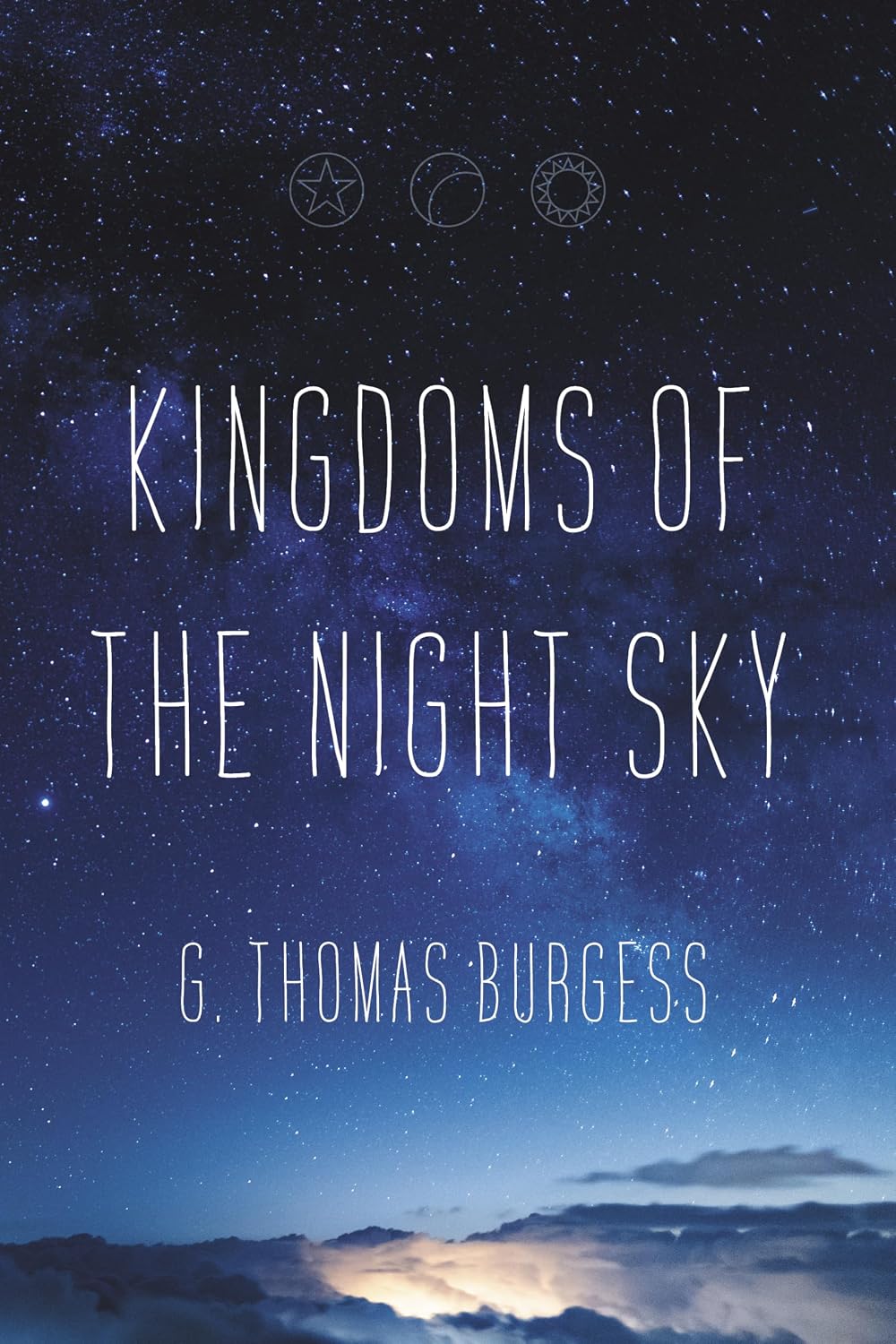
 G. Thomas Burgess introduces his new novel, Kingdoms of the Night Sky, which is being published by Signature Books this week. First, here is the publisher blurb:
It is 2026, and millions of Americans are getting ready to form separate communities so they may live by the principles taught in The Book of Shem. Calling themselves “Fellows,” they revere Isaac Snow, the deceased author of The Book of Shem, as their prophet. To settle the question of whether he’s a prophet, a fraud, or something else, Snow’s son sets out to tell his father’s story. Inspired by the 1960s folk music revival, and his experiences with the beatniks, hippies, and Mormons, Isaac has crafted a unique message that millions of Americans find irresistible, but only after many years of feeling cursed and forsaken. In a story that blends tragedy, humor, and redemption and is set in New York City, San Francisco, and Provo, Utah, Kingdoms of the Night Sky is a rollicking journey of discovery that reminds us of the fractured nature of reality itself.
Kingdoms of the Night Sky began life as follows. A friend in Washington DC signed up for a storytelling class, and when I eventually went to see her and her classmates perform, I was completely captivated. So much that I wanted to write my own stories, in the belief that novel-writing was only a matter of spinning tales that inspired the same pleasure and connectedness I felt that night in DC.
I also knew the Mormon tradition is in many ways a storytelling tradition, both in its holy books and in how believers interpret their lives both publicly and privately. My grandparents were gifted storytellers, and the first time I ever wanted to write a novel came when I was around ten, and staying with them for the summer. Many years later, I still remember their stories better than some of my own.
I confess Kingdoms is in some ways deeply personal, in that woven into the narrative are elements loosely crafted from real life. If Kingdoms wasn’t somehow personal, I doubt I’d have finished it. At the same time, it’s by no means a memoir or novel-in-name-only. Most of it comes out of thin air.
In Kingdoms, a son tells his father’s life story, and how he ends up writing The Book of Shem, which spawns a religious movement that spreads like wildfire across American society. In an alternative present, the Fellowship of Shem reveres the deceased Isaac Snow as a prophet, and prepares to separate from the rest of American society, to found villages based on the principles taught in The Book of Shem. At this critical juncture, the narrator has two purposes in mind. One is to sort out the question of whether his father is a prophet, a fraud, or something else. Another is to call for peace—because the Fellowship appears ready to launch a major exodus from American society, it has provoked profound tensions and a major backlash among those who consider the movement a danger and a threat.
Kingdoms departs from some literary styles and conventions in that it moves through the years rather swiftly. It begins and ends in the present, yet much of it plays out in the 1960s and 1970s in places like Provo, San Francisco, and New York City.
Many readers from the Mormon tradition will recognize a familiar terrain of star-crossed missionaries and awkward yet thrilling church dances. Desperate adolescent attempts to conform, and determined pursuits of holy matrimony. Iron discipline and youthful exaltation. Painful efforts to preserve a marriage. Tragedy and redemption. They will also see a religious community in transition, suddenly in the mid-twentieth century aware and proud of its global reach, yet poised between suspicion and acceptance of the Gentiles. Mormons asking the question: do we go on separating ourselves, or live with them on equal terms? Are we a kingdom or just a church?
Readers may also find some of the terrain unrecognizable: Mormon space colonies, a stunning chorus girl, a boy hypnotist, and a midnight motorcyclist high on acid. A Sausalito houseboat and a Greenwich Village basement apartment teaming with cockroaches. An emphasis on exaltation over salvation, and the Holy Ghost over the other two members of the Godhead. If Kingdoms has any sort of consistent religious theme, it is the perennial Kingdoms is also full of conflict—between spouses, generations, and friends. And the sort of conflict that happens when people aren’t satisfied with their community, or want to live in more than one at the same time. The story’s two main characters—Isaac and Mary—find Gentile life both emancipating and repellant. Mary experiences several transitions, while Isaac is drawn to the beatniks and hippies. He’s torn between ancestral visions and the promise of a new age in which misfits like him obtain heavenly powers. His sole desire is to realize the promise of the early Mormon prophetic tradition. It is his dream and also his demise.
Kingdoms raises unique questions about the Mormon experience. Yet it also asks: if contemporary America birthed a new religious movement, what would it look like? How would it come about? It’s not so far-fetched—we’re moving into a post-Enlightenment age, in which as the days pass people obtain more and more tools to fashion their own realities. We’re not seeing the triumph of science in the public square but instead the rise of tortured imaginations, in which the future offers more panic than progress. New existential threats—both real and fanciful—displace the certainties that empowered earlier generations to build, share, trust, and conserve. Religion isn’t in decline; it’s assuming new forms. And in an age of fear and doubt there’s plenty of space for prophets to offer sanctuary and protection.
Years ago, as a student enrolled in Dr. Eugene England’s remarkable Mormon Fiction class, I sat spellbound as he spoke of exploring the universal through the particular. Of how a story with a uniquely Mormon setting could nevertheless speak to a very broad band of human experience. This has been my intention, if not perhaps my result.
Originally from the West Coast, G. Thomas Burgess now resides in Maryland and is an associate professor of African history. His short story “Twinkie” was published in In Our Lovely Deseret. This is his first novel. He may be contacted at gthomasburgess@gmail.com.
Sounds like a fascinating concept for a novel. I’m intrigued, fascinated, and sitting on the edge of my seat. Your sales pitch was pitch perfect. You had me at beatniks and Mormon space colonies. Just downloaded the ebook and look forward to reading it.